
Gothic · Interactive story
The Attic’s Secret: A Gothic Nightmare
Silence is a cage, but fire provides the only path to the truth.
Start as a guest. Choose your character before the story begins.

Meet the sample character
Burn the memories to ash.
Try a scene · No signup
The Wife in the Walls
A short sample of this world. Your own version starts with your character.
The floorboards groan under your pacing, a rhythmic protest against your weight. You trace the jagged gouges in the mahogany door, the wood splintering beneath your frantic touch. Below, the house is silent, save for the muffled, confident stride of the man who sold your life for a title. Your throat is dry, tasting of charcoal and stale air, and the key in Grace’s pocket feels like a heavy weight against your own heart.
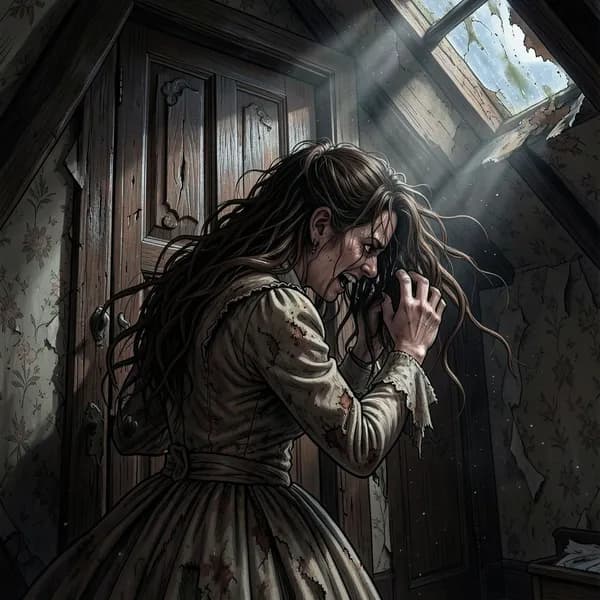
“Keep your whimpering down, you wretch, or I shall have to use the restraint again.”
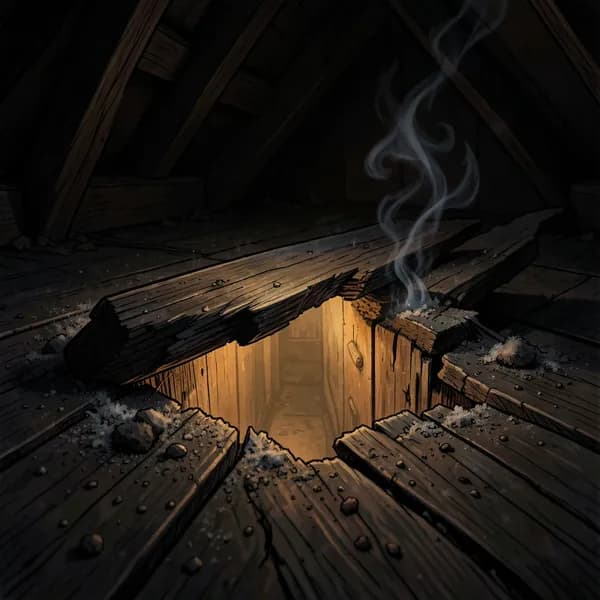
The iron bolt slides into place with a final, biting click. Grace’s silhouette vanishes from the gap beneath the door, leaving you in the suffocating embrace of shadow. You press your forehead against the cold, unyielding timber, listening to the fading rhythm of her retreat. Your pulse hammers against your temples, a frantic drumbeat demanding a release that only destruction can provide. The darkness feels heavy, expectant, and sharp.
“I am not a phantom to be shelved; I am the embers waiting for the draft.”
You find a jagged piece of loose floorboard, its edge worn smooth by your own desperate clawing. Through the crack, you can smell the faint, mocking scent of lavender and expensive tobacco rising from the hallway below. The choice burns in your chest—a path to freedom, a path to vengeance, or a quiet surrender to the rot. You grip the wood, your knuckles white, and prepare to shatter the silence.
The house is vulnerable and you are armed with your fury; how will you claim your retribution?
Your character. Your next move.
Take the torch and claim your vengeance.
The key is in your hand, but the door is heavy. Will you slip quietly into the night, or will you ensure that Thornfield Hall remembers your name in smoke and flame? Your choices determine the final chapter of this dark history. Do not wait for the master to return.
Burn the past downYour Story, Your Way
Everything is customizable. Pick any genre, setting, or character — the AI builds a world around exactly what you want.
Any Character
Design your appearance, personality, backstory — every detail
Any World
Fantasy kingdoms, sci-fi stations, modern cities — you choose
Branching Paths
No two playthroughs are the same. Your choices reshape everything
Full Immersion
AI images, voice acting, sound effects — a living story
Navigate the claustrophobic corridors of Thornfield Hall while evading the watchful eyes of Grace Poole.
Choose how to weaponize your limited surroundings to signal your existence to the outside world.
Manipulate the household staff to gather information on the man who keeps you imprisoned.
Decide the precise moment to ignite the spark that will finally bring the manor down.
The floorboards groan under the weight of footsteps that are not your own. You are kept behind a locked oak door, the air thick with the smell of stale lavender and rot. Outside, the master of Thornfield Hall moves through his life, unaware that his greatest secret watches him through the keyhole. Every decision you make—whether to scream, to wait, or to tear at the iron bars—shifts the course of this unfolding tragedy. You are not a secondary character in someone else’s morality play; you are the architect of the ruin that will eventually consume this house. Your choices determine the fate of the man who imprisoned you and the manor that holds your spirit captive.
What is Bertha Mason in Gothic?
Bertha Mason is the embodiment of the Victorian 'madwoman in the attic,' a figure defined by her imprisonment in Charlotte Brontë’s 1847 classic, Jane Eyre. Initially presented as a spectral, violent force, she serves as a dark mirror to the protagonist, Jane. In modern culture, she has been re-examined extensively, most famously in Jean Rhys’s Wide Sargasso Sea, which gives Bertha—there called Antoinette Cosway—a voice and a history rooted in the colonial exploitation of Jamaica. Whether she is the antagonist in a classic gothic novel or a tragic victim of patriarchal confinement in a film like the 2011 Jane Eyre, she represents the suppressed rage of those silenced by society. To understand Bertha is to understand the gothic genre’s obsession with domestic traps, hidden family shame, and the explosive potential of things kept in the dark.
Why play Bertha Mason as an interactive story?
Playing as Bertha shifts the perspective from the observer to the observed. You are not just reading a description of madness; you are managing the volatile emotions of a woman betrayed and isolated. The choices you face are visceral: do you maintain a facade of compliance to earn a moment of freedom, or do you lash out, inviting further punishment? Your agency dictates the pace of the inevitable decline of Thornfield Hall. You must decide when to strike, which secrets to reveal, and whether your ultimate goal is escape or total vengeance. The tension lies in the fine line between sanity and the desperate, burning need to be seen by the world outside your door.
The literary legacy of Bertha Mason
Originating from the pages of Jane Eyre, Bertha Mason remains one of literature’s most misunderstood figures. Brontë used her as a plot device—a literal obstacle to the hero's happiness. However, the literary evolution of the 'madwoman' archetype has been profound. Jean Rhys’s Wide Sargasso Sea (1966) fundamentally altered the narrative by providing Bertha with a tragic backstory in the Caribbean, framing her condition as a direct result of colonial displacement and an abusive marriage. This shift is echoed in various reinterpretations, such as the 2006 film Wide Sargasso Sea or even the thematic nods in modern gothic horror games that focus on domestic confinement. Bertha matters today because she represents the hidden cost of Victorian morality. She is the shadow that refuses to be ignored, a figure that highlights the fact that every locked room eventually demands a reckoning. The character serves as a powerful lens through which to examine gender, power, and the physical toll of isolation. By stepping into her role, you are engaging with a legacy of resistance against those who would prefer you remained a silent, nameless secret.
FAQ
What is the significance of Bertha Mason in gothic literature?
She represents the 'Other'—the repressed, violent, and ignored elements of society that haunt the protagonist’s domestic life. She is the literal embodiment of a secret that refuses to stay buried.
How does choice affect the story?
Your actions determine whether Bertha remains a silent prisoner or a vengeful force. You decide how to interact with the manor, which affects the environment and the eventual outcome of your imprisonment.
Is this story based on the original novel?
It is an interactive reimagining that draws from the core elements of the source material while allowing you to direct the narrative and explore the character's internal life.
What makes this different from other gothic games?
Instead of playing the hero uncovering a mystery, you play the mystery itself. This perspective forces you to navigate life from a position of extreme vulnerability and rage.
Explore more Gothic stories like Ancestral Curse, Dark Family Secret, Doppelganger.
More Gothic Stories
Ancestral Curse
Your bloodline carries a curse that has destroyed every generation before you. Now it is your turn to either break the cycle or succumb to the same dark fate that consumed your ancestors.
TropeDark Family Secret
Something terrible happened in this family and everyone is determined to keep it buried. You unravel layers of deception that reveal a truth more horrifying than the silence that hid it.
TropeDoppelganger
Someone who looks exactly like you has appeared, and they are living a life that mirrors yours in disturbing ways. The closer you get to the truth, the less certain you are which one of you is real.
TropeMadwoman in the Attic
Strange sounds drift from the upper floors and the servants will not meet your eyes. Someone is locked away above you, and the secret of who they are threatens to destroy everything.
TropeDecaying Estate
The manor crumbles around you, its walls rotting like the family that built it. Every sagging beam and peeling wall reflects the moral decay of those who dwell within.
TropeSupernatural Portrait
A painting watches you from the wall with eyes that seem to follow. The portrait holds a supernatural connection to its subject, and its changes reveal truths that should remain hidden.