Espionage · Interactive story
The Analyst: Decoding the Shadow War
A single oversight leads to a coup. You are the only one who sees it.
Start as a guest. Choose your character before the story begins.

Meet the sample character
Truth is a variable you cannot calculate.
Try a scene · No signup
Signal in the Static
A short sample of this world. Your own version starts with your character.
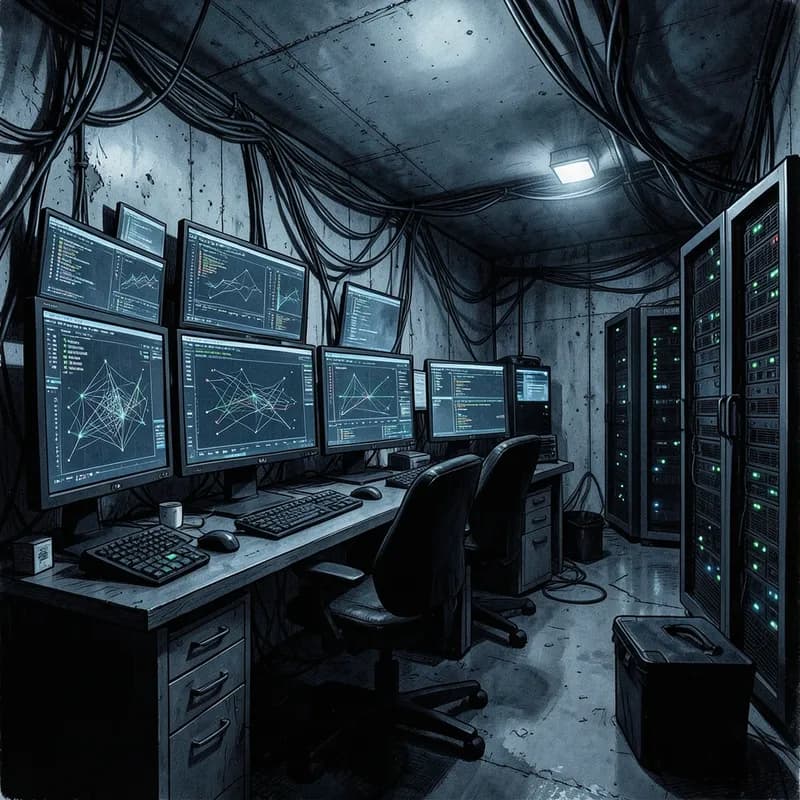
The decrypted packet sits on your screen, a chaotic mess of encrypted headers and ghost signals. You scroll through the logs, your fingers hovering over the mechanical keyboard as you isolate a recurring handshake protocol. It shouldn't exist. It’s an anomaly that points directly to a breach in the department's most secure server, yet every diagnostic tool reports that the firewall is perfectly intact.

“Stop looking, Hiroshi. Some patterns are better left unrecognized.”

Her reflection appears in the darkened glass of your monitor, looming over your shoulder. The cold weight of her hand rests on your chair, and your heart rate spikes, though your face remains an unreadable mask. You know she’s lying; the math in front of you contradicts every word she just uttered. If you close the file, the anomaly disappears, but if you push, you become the target.
“The math doesn't lie, Director. Are we burying the truth, or protecting it?”
She tilts her head, her expression unreadable. Outside the sub-basement, the heavy security door clicks, locking from the outside. You have seconds before the automated purge cycles your terminal, wiping the evidence—and perhaps your clearance—into oblivion. Your fingers tremble as you decide which command to execute on your console.
The purge sequence is active. How do you handle the data?
Your character. Your next move.
The intel is incoming. Are you ready?
A secure channel just opened with a message from a ghost agent. They have proof of a mole in the cabinet, but they need you to verify the encrypted key before they send the file. If you’re wrong, you’re dead. If you’re right, you change history. The terminal is waiting.
Start Your AnalysisYour Story, Your Way
Everything is customizable. Pick any genre, setting, or character — the AI builds a world around exactly what you want.
Any Character
Design your appearance, personality, backstory — every detail
Any World
Fantasy kingdoms, sci-fi stations, modern cities — you choose
Branching Paths
No two playthroughs are the same. Your choices reshape everything
Full Immersion
AI images, voice acting, sound effects — a living story
Cross-reference conflicting data streams to identify deep-cover moles within your own agency.
Decide whether to authorize high-risk field operations based on incomplete intelligence reports.
Manage the psychological toll of balancing civilian safety against the needs of national security.
Decrypt intercepted messages under time pressure while avoiding detection by counter-intelligence software.
The hum of the cooling fans is the only sound in the office at 3:14 AM. On your primary monitor, a series of satellite photos shows a thermal anomaly in a restricted shipping lane off the coast of Vladivostok. Your field contact, code-named 'Kestrel,' insists the manifest is routine. The data, however, tells a different story. You cross-reference the cargo weight with fuel consumption logs, and your heart rate spikes. The math does not lie. Someone is moving enriched materials, and they are doing it under the cover of a humanitarian aid shipment. You have exactly ninety seconds to decide whether to flag this for command, effectively burning your most valuable asset in the field, or to stay silent and wait for further evidence. In this interactive story, your choices dictate the lives of those on the ground and the stability of the entire region. Every keystroke is a gamble, and the person watching you from the shadows is already waiting for you to make a mistake.
What is The Analyst in Espionage?
The Analyst is the intellectual engine of any intelligence agency. While field agents are the hands and feet, the Analyst is the brain. This archetype operates in the cold, clinical glow of monitors, parsing through petabytes of intercepted communications, financial ledgers, and surveillance footage to find the one needle in a haystack that prevents a global catastrophe. Unlike the classic action hero, this character survives by being right, not by being fast. A prime example of this is George Smiley from John le Carré’s 'Tinker Tailor Soldier Spy,' a man who dismantles entire networks through patience and observation rather than violence. In modern media, we see this in the frantic, high-stakes data-crunching of Carrie Mathison in 'Homeland.' The Analyst is rarely the one kicking down doors; they are the one who identifies the door that needs to be kicked down. They live with the constant, grinding weight of knowing that if they miss a connection, the fallout occurs on someone else's watch.
Why play The Analyst as an interactive story?
Playing as the Analyst forces you to confront the moral ambiguity of information warfare. You are not just reading a plot; you are managing a flow of data that is often incomplete, contradictory, or intentionally falsified by double agents. The tension comes from the lack of physical safety. You are safe in your chair, but you are responsible for the lives of agents thousands of miles away. You will face moments where the data suggests a betrayal, but your gut tells you to trust your contact. Do you authorize a drone strike based on a 70% probability? Do you leak classified intel to a journalist to stop an operation you know is corrupt? Every choice you make updates the global situation, shifting alliances and altering the outcome of the entire campaign.
The psychology of The Analyst: why readers fall for this character
The appeal of the Analyst lies in the fantasy of total awareness. In an increasingly chaotic world, the ability to see patterns where others see noise is a powerful, almost god-like capability. Readers gravitate toward this archetype because it prioritizes intellect and cold logic over brute force. It activates a desire for control; we want to believe that if we just had the right information, we could fix the broken parts of the world. However, this power comes with a crushing psychological burden. Take Jack Ryan in Tom Clancy’s novels; his journey from desk-bound analyst to field operative highlights the transition from the safety of theory to the grim reality of practice. The Analyst is fundamentally a tragic figure because they are perpetually removed from the action, forced to witness the consequences of their decisions from a distance. They are the ultimate observers, forever haunted by the 'what-ifs' of their own calculations. They represent the fear that no matter how much data you process, you can never fully account for human error or the unpredictable nature of betrayal. This archetype thrives on the tension between the clinical nature of their work and the messy, visceral reality of its consequences.
FAQ
What makes the Analyst different from a field agent in these stories?
The primary difference is agency and perspective. A field agent deals with immediate, physical threats, while the Analyst manages the broader strategic picture. As an Analyst, your 'weapon' is information. You influence the story by directing resources, exposing secrets, and predicting enemy movements, whereas a field agent influences the story through combat and infiltration.
Can I be wrong in my analysis?
Absolutely. The system provides you with data, but that data can be misleading or planted. If you misinterpret a signal or trust the wrong source, your decisions will have direct, often negative, consequences on the mission and the characters involved.
Is this suitable for fans of political thrillers?
Yes. If you enjoy the slow-burn tension of political thrillers where the stakes are global and the enemies are often hidden within one's own government, this archetype is designed for you.
Do I need to know a lot about real-world intelligence to play?
No. The stories provide the context and the tools you need. While the experience is grounded in realism, you do not need technical expertise to enjoy the narrative and make critical decisions.
Explore more Espionage stories like Double Agent, Honey Trap, Dead Drop.
More Espionage Stories
Double Agent
You serve two masters, and both would kill you if they knew the truth. Every report you file is a carefully constructed lie, and every friendship could be the one that unravels your cover.
TropeHoney Trap
Seduction is your weapon, and your target has secrets worth nations. You engineer an intimate connection designed to extract intelligence, but the line between performance and genuine feeling is dangerously thin.
TropeDead Drop
A chalk mark on a park bench triggers a sequence that could change the balance of power between nations. You execute a dead drop exchange where a single mistake means exposure, capture, or worse.
TropeExtraction Mission
An asset is compromised and has forty-eight hours before the secret police close in. You must plan and execute an extraction across hostile territory where every checkpoint could be the last.
TropeMole Hunt
There is a traitor inside the agency, and agents are dying because of it. You lead the investigation, suspecting everyone including your closest colleagues, knowing the mole is watching your every move.
TropeDefection
You want out. After years of serving a regime you no longer believe in, you reach out to the other side with an offer: your knowledge in exchange for a new life. But defectors are never fully trusted and always hunted.