
Espionage · Interactive story
The Dead Drop: Trust No One, Leave Nothing Behind
One wrong move at the drop site, and you disappear without a trace.
Start as a guest. Choose your character before the story begins.
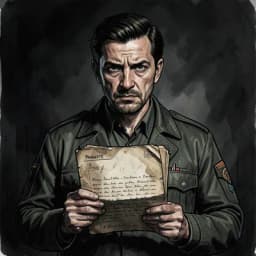
Meet the sample character
The cost of silence is measured in wet chalk and cold steel.
Try a scene · No signup
Concrete Shadows
A short sample of this world. Your own version starts with your character.
You sit on the damp wood of the bench, the chill of Berlin seeping through your wool coat. A yellow chalk mark, shaped like a fractured compass, sits under the slats. The heavy air tastes of coal smoke and wet leaves. You keep your gaze forward, listening to the crunch of gravel as someone approaches from the darkness behind you.

“The microfilm is under the third plank. Don't touch it until I have left the park, or we both cease to exist.”
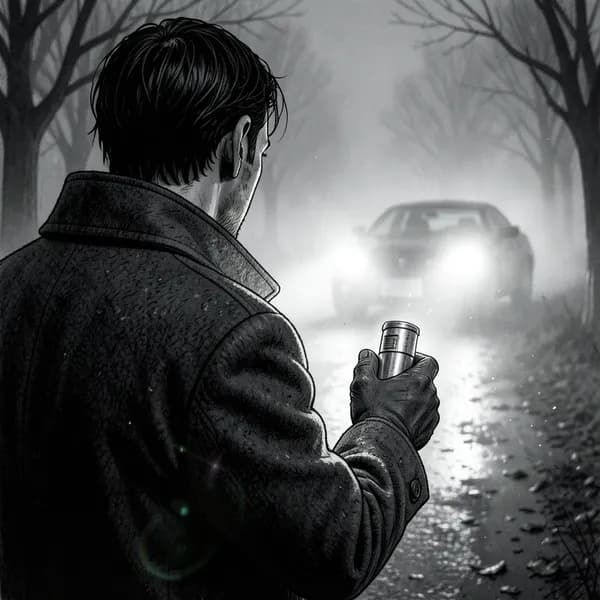
The weight of the situation settles against your ribs like lead. You count the seconds, listening to his boots recede into the thick fog. Your hand hovers over the gap between the slats, fingers brushing against cold iron. If this is a setup, the perimeter is already compromised and your exit route is likely blocked by waiting eyes.
“Trust is a luxury I sold years ago. I verify the contents now, or I walk away empty-handed.”
A black sedan idles at the park entrance, its headlights killed. You feel the cold metal of the canister against your skin as you pull it from the wood. The driver leans out, his face obscured by the brim of a hat. You have three seconds to decide if you are walking toward a promotion or a shallow grave.
The sedan is creeping forward, closing the distance. How do you secure your future?
Your character. Your next move.
The Handler is Waiting at the Bench
Your choice determines if you make it out of the city alive. Will you deliver the package or burn your cover? The mission is live, and the clock is ticking.
Execute the DropYour Story, Your Way
Everything is customizable. Pick any genre, setting, or character — the AI builds a world around exactly what you want.
Any Character
Design your appearance, personality, backstory — every detail
Any World
Fantasy kingdoms, sci-fi stations, modern cities — you choose
Branching Paths
No two playthroughs are the same. Your choices reshape everything
Full Immersion
AI images, voice acting, sound effects — a living story
Scan the perimeter for hostile surveillance before approaching the designated drop point.
Decide whether to abandon the mission when you spot an unexpected tail.
Encrypt your messages under pressure while being tracked by state security forces.
A rain-slicked park bench. A torn newspaper left intentionally on the slats. You walk past, counting the seconds, your pulse drumming against your ribs. The handler is watching from a black sedan three blocks away, but you have no way of knowing if he is alone or if he has already been compromised. Your hands are steady, but your mind is racing through the contingencies: What if the package is a trap? What if the contact is already dead? You are not just reading about the tension; you are holding the microfilm in your pocket, deciding whether to make the exchange or vanish into the subway station. Every choice you make echoes through the intelligence network, determining if you return home or become a ghost in a city that does not want you there.
What is Dead Drop in Espionage?
A dead drop is the classic clandestine method used by intelligence officers to pass information without ever coming into direct contact. It bypasses the risk of a face-to-face meeting, which is the easiest way to be spotted by counter-intelligence. Think of the pivotal scenes in John le Carré’s *Tinker Tailor Soldier Spy*, where the tension hangs on the physical location of a secret meeting point. The operative leaves a package—a hollowed-out coin, a microdot, or a classified document—in a pre-arranged location, like a loose brick in a wall or a hollowed-out tree. The recipient then retrieves it hours later. It is a game of patience, paranoia, and extreme precision. If the location is burned, the entire network collapses. It is not just about the object; it is about the silence between the drop and the pickup.
Why play Dead Drop as an interactive story?
You are the operative on the ground. The agency is not there to hold your hand; they only provide the coordinates and the deadline. You face decisions that define your survival: Do you check for surveillance, wasting precious time but ensuring your safety? Do you swap the package despite the flicker of a camera lens in the distance? The agency will not tell you if you have been followed—you have to notice the car that has been idling at the same corner for twenty minutes. You decide how to signal the pickup, how to handle a sudden interrogation, and when to cut your losses. If you leave a footprint, the enemy will follow it all the way to your front door.
Famous examples of Dead Drop in books, film, and games
In John le Carré’s *The Spy Who Came in from the Cold*, the dead drop is the lifeline of the operative, yet it is also the mechanism of betrayal. It highlights how the physical environment becomes a weapon. In the film *Bridge of Spies*, the exchange process—while more formal—mirrors the high-stakes, clock-ticking nature of a dead drop where the wrong word ruins a diplomatic breakthrough. Even in games like *Hitman*, the dead drop functions as a core mechanic for stealth, forcing players to manage their exposure while navigating heavily guarded zones. These examples show that the trope works because it forces a character to act alone in an environment that is fundamentally hostile. The dead drop is the ultimate test of an agent's ability to remain invisible.
FAQ
What is a dead drop in real espionage?
A dead drop is a secure, indirect method of passing items or intelligence between two people. By using a pre-agreed location to hide a package, agents avoid the risks associated with being seen together in public.
How do my choices impact the outcome of a dead drop?
Every action, from the route you take to the way you signal a contact, alters your risk profile. A wrong choice can alert surveillance, leading to mission failure or capture by enemy intelligence.
Is it possible to fail a mission during a dead drop?
Yes. If your cover is blown or you are caught with sensitive materials, the mission ends. You must balance the need for speed with the requirement for absolute stealth.
What makes this different from other spy stories?
This experience focuses on the granular details of field craft. You are not watching a hero; you are managing the paranoia and the tactical decisions that define a real-world intelligence operation.
Explore more Espionage stories like Double Agent, Honey Trap, Extraction Mission.
More Espionage Stories
Double Agent
You serve two masters, and both would kill you if they knew the truth. Every report you file is a carefully constructed lie, and every friendship could be the one that unravels your cover.
TropeHoney Trap
Seduction is your weapon, and your target has secrets worth nations. You engineer an intimate connection designed to extract intelligence, but the line between performance and genuine feeling is dangerously thin.
TropeExtraction Mission
An asset is compromised and has forty-eight hours before the secret police close in. You must plan and execute an extraction across hostile territory where every checkpoint could be the last.
TropeMole Hunt
There is a traitor inside the agency, and agents are dying because of it. You lead the investigation, suspecting everyone including your closest colleagues, knowing the mole is watching your every move.
TropeDefection
You want out. After years of serving a regime you no longer believe in, you reach out to the other side with an offer: your knowledge in exchange for a new life. But defectors are never fully trusted and always hunted.
TropeCold War Tension
Two superpowers stare each other down across an iron curtain, and you operate in the shadows between them. Every move risks escalation, every miscalculation could trigger annihilation, and diplomacy is conducted through deniable operatives like you.