
Werewolf Fiction · Interactive story
The Wolf of Gubbio: Beast of the Italian Hills
Hunger gnaws at your ribs, but the scent of incense promises a strange, new peace.
Start as a guest. Choose your character before the story begins.
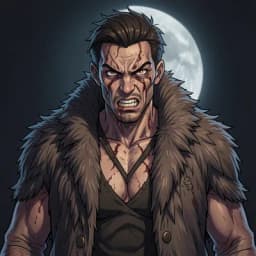
Meet the sample character
A pact forged in blood and holy fire.
Try a scene · No signup
The Teeth of Penance
A short sample of this world. Your own version starts with your character.
You huddle in the limestone shadows of Mount Ingino, your coat matted with burs and dried gore. Below, the town of Gubbio glows with flicker-lights—the terrified scent of sheep and soft, unguarded throats drifts up the mountain air. Your stomach churns, a hollow, aching void demanding fuel. You shift, claws scraping stone, fighting the urge to howl at the uncaring moon.

“Brother Wolf, the blood on your muzzle has no place in the kingdom of God.”

The Friar's voice rasps against your ears like dry silk. You growl, a low, guttural vibration that rumbles through your ribcage. His presence is alien—devoid of the jagged fear that usually defines the townspeople. He doesn't hold a spear; he holds only his wooden crucifix, his eyes bright with a maddening, peaceful clarity that insults your predatory instincts.
“Go back to your prayers, Friar, before I decide your heart makes a finer meal than the livestock.”
You arch your back, hackles raised, ready to spring. He takes a step forward, feet bare against the jagged mountain path, and holds out a palm stained with dust. He is not afraid of the teeth that have turned this region into a graveyard. You are a hunger given form, yet he waits for you to choose your next kill.
Will you strike the holy man, or surrender your hunger to his peace?
Your character. Your next move.
Will you break the pact?
The town of Gubbio waits with pitchforks and prayers. The friar’s hand is outstretched, but your claws are itching for the hunt. Will you accept the bread of the village and fade into the shadows of the forest, or will you prove that some beasts can never be tamed? The decision is yours.
Play as the WolfYour Story, Your Way
Everything is customizable. Pick any genre, setting, or character — the AI builds a world around exactly what you want.
Any Character
Design your appearance, personality, backstory — every detail
Any World
Fantasy kingdoms, sci-fi stations, modern cities — you choose
Branching Paths
No two playthroughs are the same. Your choices reshape everything
Full Immersion
AI images, voice acting, sound effects — a living story
Choose whether to obey the friar’s command or tear the habit from his back.
Navigate the shifting loyalties of the town council as they debate killing you.
Manage your hunger levels against the risk of exposing your vulnerability to the villagers.
The iron taste of blood is fresh on your muzzle as you stand at the edge of the Umbrian forest. Below, the stone walls of Gubbio glow under the moonlight, a feast of terrified livestock and trembling humans. You are the terror the villagers whisper about in their prayers, the shadow that turns their nights into nightmares. But a man in a rough brown habit stands between you and the gates, his hands raised in a gesture that is not a threat. This interactive story puts you behind the yellow, unblinking eyes of the beast. Your choices dictate whether you remain a feral predator or succumb to the mercy of a saint. Every scent you catch and every growl you release shifts the balance between the village’s survival and your own savage needs.
What is The Wolf of Gubbio in Werewolf Fiction?
The Wolf of Gubbio is a figure pulled from the Fioretti di San Francesco, a 14th-century collection of stories about the life of the saint. In the original legend, a massive, ferocious wolf plagued the town of Gubbio, devouring both animals and people. When Saint Francis of Assisi arrived, he did not bring a spear or a trap; he brought an invitation to parley. He confronted the wolf, commanded it in the name of God to stop its slaughter, and brokered a pact where the townspeople would feed the wolf in exchange for safety. It is a foundational piece of medieval hagiography that bridges the gap between nature and civilization. While often depicted as a simple morality play, it functions as a terrifying werewolf origin story when viewed through the lens of a creature fighting its own predatory nature. You might recognize echoes of this dynamic in modern werewolf media like the Ginger Snaps franchise or the tense, psychological wolf-shifting found in The Wolf Among Us. It asks the question: is the monster truly evil, or is it simply a creature pushed to extremes by hunger and displacement?
Why play The Wolf of Gubbio as an interactive story?
Playing the Wolf of Gubbio forces you to reconcile your primal instincts with the sudden, confusing offer of a truce. You are the monster, and every decision ripples through the pack and the village. Do you growl at the friar, sensing a trick? Or does the exhaustion of the hunt make you curious about his promise of a full belly without the cost of a fight? You will face moments where the scent of fear from a villager triggers your hunt response, forcing you to fight your own nervous system to maintain the peace. The tension lies in the friction between your wolfish drive to dominate and the complex social contract Saint Francis presents. You control the trajectory of the legend, deciding if the wolf finds redemption or if the town burns.
The literary legacy of The Wolf of Gubbio
The tale of the Wolf of Gubbio originates from the Fioretti, a collection that highlights the mystical connection between Saint Francis and the natural world. Historically, it reflects the medieval fear of the wilderness—the dark woods where wolves were viewed as literal manifestations of the devil. However, the story flips the trope of the slaying of the beast. Instead of a knight killing the dragon, the saint creates a social contract. This story has seen numerous reinterpretations, appearing in everything from children’s books to dark fantasy tabletop RPGs. In the 1972 film Brother Sun, Sister Moon, the encounter is framed as a moment of profound communion, whereas modern interpretations, such as those found in gothic horror literature, often explore the wolf as a metaphor for the primal, suppressed self. The legend endures because it touches on the universal human desire to tame the wild. By placing the wolf at the center of the narrative, you tap into that ancient, visceral fear—the realization that the boundary between human and animal is thinner than we like to admit. It works because it forces you to inhabit the creature that the world desperately wants to destroy, challenging the binary of good versus evil.
FAQ
Is this story historically accurate?
It is based on the 14th-century Fioretti, but we adapt the legend into an interactive narrative where you control the beast's choices, allowing for outcomes that diverge from the traditional saintly peace.
Can I choose to remain a predator?
Yes. The narrative gives you the agency to reject the pact and continue your reign of terror, though you must deal with the consequences of an increasingly hostile town.
Does this game include combat?
Combat is a significant part of the experience, particularly when your survival instincts clash with the diplomatic efforts of the friar.
What makes this different from other werewolf stories?
Most werewolf stories focus on the human struggling with the transition. Here, you start as the wolf, exploring the world through the senses and instincts of the beast itself.
Explore more Werewolf Fiction stories like Fated Mates, Alpha Challenge, First Shift.
More Werewolf Fiction Stories
Fated Mates
The bond hits you like a freight train the moment your eyes meet — your wolf knows before your mind catches up. Navigate the overwhelming pull of a fated mate bond while deciding whether destiny gets to choose your partner or you do.
TropeAlpha Challenge
A challenger has risen against the alpha, and the entire pack holds its breath. Whether you're the one issuing the challenge or caught between two wolves fighting for dominance, your choices will reshape the pack hierarchy forever.
TropeFirst Shift
Bones crack, skin tears, and the wolf inside you awakens for the first time in an agonizing, exhilarating transformation. Your first shift changes everything about who you are and where you belong — if you survive it.
TropePack Rejection
Cast out by the only family you've ever known, you must survive as a lone wolf in a world where packless means powerless. Fight your way back, find a new pack, or prove that you're stronger alone than they ever imagined.
TropeRogue Wolf
A rogue wolf has been spotted on pack territory — feral, dangerous, and answering to no alpha. Track the rogue through dark forests and discover that the threat might be a misunderstood outcast, a deadly enemy, or your fated mate.
TropeMate Bond Rejection
Your fated mate looks you in the eye and rejects the bond, and the agony nearly destroys you. Claw your way through the devastating pain to discover whether this rejection is truly the end or the beginning of something even more powerful.