Werewolf Fiction · Interactive story
The Knight Who Wears the Wolf
Three days a week, the knight vanishes. The wolf remains.
Start as a guest. Choose your character before the story begins.
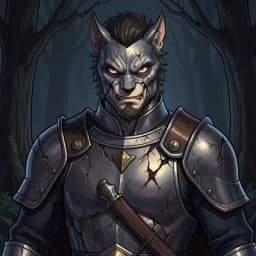
Meet the sample character
The moon demands its tithe.
Try a scene · No signup
The Knight’s Velvet Skin
A short sample of this world. Your own version starts with your character.
You sit on the edge of the furs, the skin between your shoulder blades itching with a phantom ache. The moon is two nights away, yet your pulse thrums with a rhythm that is not human. The heavy scent of pine and raw earth clings to your mantle, a lingering stain from your last prowl that no amount of scrubbing can erase.

“My lord, your absence leaves me cold. You vanish to the woods, returning with hollow eyes and torn tunics. Tell me where you truly go, for my heart cannot bear this silence.”

Her fingers trace the line of your jaw, her touch cool against your heated skin. You want to press your face into her palm, to breathe in the lavender and comfort, but your instincts scream that she is a trap. If she knew the beast that wakes when the sun sets, she would recoil. You feel the castle walls closing in, the urge to run growing violent.
“The woods are my sanctuary, not my shame. Some debts are paid in solitude, and the King’s business requires a quiet mind.”
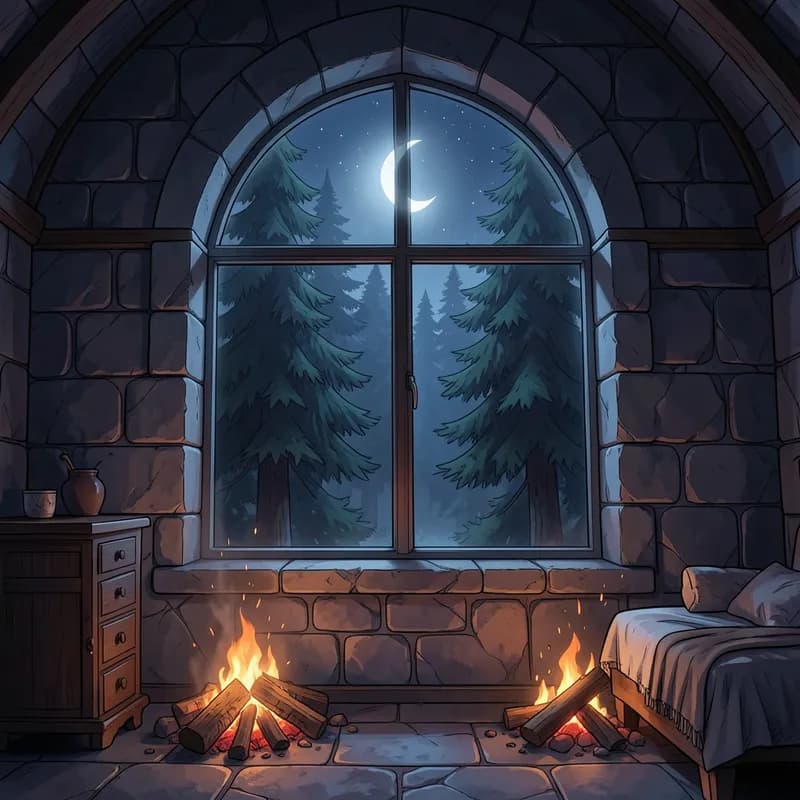
Outside, the clouds tear apart, revealing a sliver of the moon. It catches on the silver buckle of your belt, turning the metal into a predatory eye. You hear a low, familiar growl vibrating in your own throat, unbidden and sharp. The window latch rattles against the mounting wind, signaling that the change is coming faster than you anticipated.
The beast within demands release before the moon claims your mind. How do you respond to her suspicion?
Your character. Your next move.
Will you remain a man or embrace the beast?
The king is waiting for your report, and your wife is already whispering in the shadows. Every moment you delay is a risk to your secret. Step into the medieval court and decide the fate of the cursed knight today.
Start your Bisclavret storyYour Story, Your Way
Everything is customizable. Pick any genre, setting, or character — the AI builds a world around exactly what you want.
Any Character
Design your appearance, personality, backstory — every detail
Any World
Fantasy kingdoms, sci-fi stations, modern cities — you choose
Branching Paths
No two playthroughs are the same. Your choices reshape everything
Full Immersion
AI images, voice acting, sound effects — a living story
Choose how to conceal your transformation from the king’s prying eyes.
Navigate the intricate political schemes set in motion by your vengeful wife.
Balance your knightly duties with the irresistible call of the moonlit forest.
Decide who earns your trust when your secret is finally laid bare.
A sharp scent of pine and iron hangs in the air of the king’s hunting grounds. You are the king's most trusted knight, a man of status and favor, yet your clothes sit heavy on your skin. Every Tuesday, you shed your velvet tunic and slip into the shadows of the woods to run on four paws. The king wonders why you disappear; your wife watches with eyes that hold no warmth, but cold, calculating betrayal. You stand at a crossroads where your humanity is a fragile mask. Your next breath could define whether you return to the court as a man or die in the forest as a beast. In this interactive story, your choices dictate if you can maintain your honor or if the wild will swallow you whole.
What is Bisclavret in Werewolf Fiction?
Bisclavret is a foundational figure in European werewolf folklore, hailing from the 12th-century lais of the poet Marie de France. Unlike modern horror tropes of mindless, bloodthirsty monsters, Bisclavret—the Breton word for werewolf—is a noble knight. His transformation is a secret he keeps to maintain his standing in the royal court, a duality that forces him to manage the social dangers of the nobility alongside the primal instincts of his lupine form. In the original text, his tragedy stems not from his condition, but from the treachery of his spouse, who conspires to steal his clothing to keep him trapped in his wolf shape. This narrative archetype has influenced countless works, from the complex monsters in The Witcher games to the political dynamics seen in shows like Teen Wolf. Understanding Bisclavret means looking at the werewolf not as a villain, but as a victim of both nature and human malice. It shifts the focus from a monster hunting victims to a man struggling to survive the people around him.
Why play Bisclavret as an interactive story?
Playing as Bisclavret forces you to balance the rigid expectations of medieval chivalry against the raw, predatory urges of the hunt. You are not just reading a tale; you are weighing the consequences of your secrets. Will you hide your condition from the king at the risk of appearing suspicious, or will you seek an alliance with the forest creatures to protect your true self from your wife’s schemes? Every decision impacts your social standing and your survival. You might choose to hunt in the king's presence to prove your loyalty, only to have your lupine instincts threaten to expose your identity. You will manage the tension of maintaining a facade while your body demands the freedom of the wild. Every choice has a weight, as the court is filled with those looking for any sign of weakness or heresy.
The literary legacy of Bisclavret
Marie de France’s Bisclavret is a landmark piece of medieval literature that humanizes the monstrous. While many contemporary werewolf stories focus on the horror of infection, this lai examines the loss of agency. The knight’s clothes are the tether to his humanity; without them, he is a creature of instinct. This theme of lost identity has echoed through centuries of storytelling. We see it in the tragic transformation of Remus Lupin in J.K. Rowling’s Harry Potter series, where the wolf is a burden managed with potions rather than a curse of the soul. Similarly, the 1941 film The Wolf Man captures the same feeling of a man struggling against a fate he did not choose. The reason Bisclavret remains compelling is that it mirrors our own struggles: the tension between who we are in public and the private shadows we fear showing the world. It is a story about loyalty, the fragility of social status, and the raw, untamed nature that exists beneath even the most refined armor. By placing the player in this role, the narrative highlights the vulnerability of the knight, turning a medieval poem into a modern examination of identity.
FAQ
What is the origin of the Bisclavret story?
Bisclavret originates from a 12th-century poem written by Marie de France. It tells the story of a knight who must transform into a wolf for three days each week to satisfy a curse.
How does the transformation work in this interactive game?
You must manage your time carefully. If you fail to reach a safe, secluded location before the transformation begins, your secret risks exposure to the royal court.
Can I change the ending of the original tale?
Yes. Your decisions determine whether you reclaim your humanity, expose your wife’s treachery, or remain trapped in the form of a wolf forever.
Is this story focused on horror or court politics?
It balances both. You must navigate the social traps of the court while managing the dangerous, predatory instincts that grow stronger the longer you remain a wolf.
Explore more Werewolf Fiction stories like Fated Mates, Alpha Challenge, First Shift.
More Werewolf Fiction Stories
Fated Mates
The bond hits you like a freight train the moment your eyes meet — your wolf knows before your mind catches up. Navigate the overwhelming pull of a fated mate bond while deciding whether destiny gets to choose your partner or you do.
TropeAlpha Challenge
A challenger has risen against the alpha, and the entire pack holds its breath. Whether you're the one issuing the challenge or caught between two wolves fighting for dominance, your choices will reshape the pack hierarchy forever.
TropeFirst Shift
Bones crack, skin tears, and the wolf inside you awakens for the first time in an agonizing, exhilarating transformation. Your first shift changes everything about who you are and where you belong — if you survive it.
TropePack Rejection
Cast out by the only family you've ever known, you must survive as a lone wolf in a world where packless means powerless. Fight your way back, find a new pack, or prove that you're stronger alone than they ever imagined.
TropeRogue Wolf
A rogue wolf has been spotted on pack territory — feral, dangerous, and answering to no alpha. Track the rogue through dark forests and discover that the threat might be a misunderstood outcast, a deadly enemy, or your fated mate.
TropeMate Bond Rejection
Your fated mate looks you in the eye and rejects the bond, and the agony nearly destroys you. Claw your way through the devastating pain to discover whether this rejection is truly the end or the beginning of something even more powerful.