
Time Travel · Interactive story
The Time Traveller: Rewrite the End of Days
The brass levers lock into place. The future is waiting to be rewritten.
Start as a guest. Choose your character before the story begins.
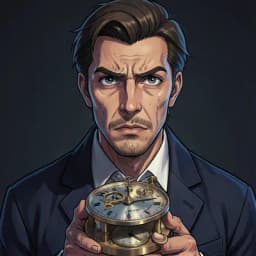
Meet the sample character
The machine hums with a failing pulse, and the pilot is nowhere to be found.
Try a scene · No signup
Brass Gears and Pale Sunsets
A short sample of this world. Your own version starts with your character.
You grip the cold brass levers, your knuckles white against the rusted metal. The sun hangs like a bloated, crimson blister in the sky, casting sickly shadows across the overgrown ruins of the Palace of Green Porcelain. The Time Traveller’s machine sits shuddering, its quartz housing cracked and weeping a strange, viscous lubricant. You are thousands of centuries from London, and the man who brought you here has vanished into the dark, humming tunnels.

“The pale ones… they take the light. They have taken him to the deep places.”

Her voice is a thin, reedy vibration in the suffocating heat. You scan the horizon, your boots crunching on dust that was once human bone. Somewhere in the subterranean gloom, the rhythmic grinding of Morlock machinery echoes, a mechanical heartbeat that mocks your own rapid pulse. The air feels heavy, pressurized by the weight of millions of years of decay.
“If he’s down there, he’s already lost. I have to fix this chronometer before the hunting parties return.”
The gears inside the control console grind, refusing to engage with the temporal track. If you force the mechanism, you risk shattering the stabilizers, stranding yourself in this rotting era forever. Yet, the sound of skittering claws draws closer from the ventilation shafts above. You have mere heartbeats before the shadow falls over your workbench and the opportunity for flight closes for good.
The ventilation shaft groans under the weight of something heavy. Do you force the jammed temporal gear, descend into the dark, or trigger a collapse?
Your character. Your next move.
The machine is waiting for its pilot.
The levers are set, and the future is shifting. Will you witness the end of days, or will you find a way to rewrite the story of mankind? Your journey through the fourth dimension begins now. Step into the machine and see what secrets wait in the year 802,701.
Start your journeyYour Story, Your Way
Everything is customizable. Pick any genre, setting, or character — the AI builds a world around exactly what you want.
Any Character
Design your appearance, personality, backstory — every detail
Any World
Fantasy kingdoms, sci-fi stations, modern cities — you choose
Branching Paths
No two playthroughs are the same. Your choices reshape everything
Full Immersion
AI images, voice acting, sound effects — a living story
Repair the brass machine using scavenged components found in the ruins of the future.
Choose between protecting the vulnerable Eloi or striking a deal with the Morlocks.
Calculate the risk of temporal paradoxes before adjusting the dial for your next jump.
Decide whether to bring modern technology to a primitive future or leave it untouched.
The air in the laboratory smells of ozone and scorched copper. Before you sits the machine—a tangled mess of nickel, ivory, and quartz crystal, humming with a frequency that makes your teeth ache. Outside the window, Victorian London fades into a smear of gray, but your focus remains fixed on the dial. You are not merely a spectator to the passage of decades; you are the architect of the coming entropy. As you pull the primary lever, the walls of the room dissolve into streaks of light, and the silence of the void replaces the ticking clock. Your choices here dictate whether the sun sets forever on humanity or if you find a way to redirect the course of evolution itself. This is an interactive story where every shift in the temporal stream ripples into the far future. Whether you land in the sun-drenched gardens of the Eloi or the subterranean tunnels of the Morlocks, the machine responds to your intent. Will you attempt to save the lost civilization, or will you accept the cold reality that time is a predator that eventually consumes all things? The machine is fueled by your decisions, and the paradoxes you create are yours to carry.
What is The Time Traveller (H.G. Wells) in Time Travel?
The Time Traveller is the protagonist of H.G. Wells’s foundational 1895 novella, The Time Machine. He is a Victorian scientist—often referred to as an inventor or philosopher—who constructs a vehicle capable of moving through the fourth dimension. Unlike later pop-culture iterations of time travel that focus on fixing history or preventing wars, the original character represents the Victorian fear of social Darwinism. He travels to the year 802,701 AD, finding that the human race has bifurcated into two distinct species: the delicate, childlike Eloi who live above ground, and the predatory, monstrous Morlocks who dwell in the dark, industrial depths. This character serves as a warning about the extremes of class stratification. In the 1960 George Pal film adaptation, the Traveller is portrayed as a man of science who struggles to reconcile his optimism with the grim reality of the future. Similarly, the 2002 film adaptation shifts the focus toward a more personal tragedy, showing the machine used to attempt to correct a singular, painful loss. In interactive fiction, this archetype is defined by the tension between curiosity and consequence. You aren't just observing the decay of the planet; you are interacting with a world that has evolved beyond human recognition. The Time Traveller character provides a framework for exploring deep-time philosophy, forcing the player to confront the outcome of human civilization while managing the mechanical limitations of a device that is as fragile as it is powerful.
Why play The Time Traveller (H.G. Wells) as an interactive story?
Playing as the Time Traveller shifts the focus from passive reading to active intervention. You are not trapped in a linear narrative; you are tasked with managing the mechanical integrity of the machine while negotiating with species that no longer speak the language of men. The tension arises from the scarcity of resources and the unpredictability of the temporal flow. When you land in the far future, your primary objective is survival, but your secondary objective is understanding. You will face moments where you must decide whether to share your knowledge with the Eloi, potentially altering their trajectory, or to descend into the Morlock tunnels to retrieve your stolen machine. Each decision carries the risk of a paradox. If you change the past too drastically, you may return to a version of London that is unrecognizable. The agency provided here forces a calculation: is the preservation of your own timeline worth the destruction of another? You will encounter situations where the machine is damaged, forcing you to scavenge for parts in a landscape that has long forgotten the technology you brought with you. It is a game of logic, sacrifice, and the terrifying realization that time does not care about your intentions.
The literary legacy of The Time Traveller (H.G. Wells)
H.G. Wells did not just write a story; he invented a subgenre. When The Time Machine was serialized and later published as a book in 1895, it introduced the concept of a vehicle—rather than a dream or a supernatural occurrence—as the means to traverse time. This scientific approach to the impossible grounded the narrative in the anxieties of the Industrial Revolution. The character of the Time Traveller became an icon of the 'mad scientist' archetype, driven by a restless, often dangerous, intellectual hunger. Over the decades, this character has evolved through various media. The 1960 film remains a high-water mark for the genre, utilizing striking practical effects to visualize the accelerated passage of time. Later interpretations, including the 2002 film and various radio dramas, have toyed with the character’s motivations, often making the machine a tool for grief. However, the core of the character remains consistent: he is an observer who is forced to become a participant. His legacy persists because his story asks the ultimate question of humanity: if we could see the end of our species, would we try to stop it, or would we simply watch it happen? Modern adaptations continue to draw from Wells because the central conflict—the divide between the haves and the have-nots—is as relevant today as it was in the late 19th century. By putting the player in the seat of the machine, we maintain that legacy. You are the one looking at the sun hanging low in a dying sky, and you are the one holding the lever. The character works because he is human, flawed, and profoundly out of his depth. He is the original explorer of the fourth dimension, and through interactive play, his mission becomes your own.
FAQ
How does the machine affect my choices?
The machine is your primary tool for navigation and survival. If it sustains damage during your jumps, your options for travel become restricted. You must prioritize maintenance and fuel over exploration, which forces you to make difficult choices about which era to visit next.
Can I prevent the future from becoming the world of the Morlocks?
Your actions have a direct impact on the state of the future. Whether you can successfully pivot the course of human evolution depends on your willingness to intervene in the past and the consequences that follow from those changes.
Is this story accurate to the original H.G. Wells book?
The narrative honors the themes, settings, and character archetypes established by Wells. While you have the freedom to change the outcome, the world-building remains rooted in the spirit of the original Victorian sci-fi classic.
What makes this different from other time travel games?
This experience focuses on the mechanical and philosophical weight of time travel. It isn't just about jumping between points; it is about the cost of those jumps, the decay of the world you visit, and the burden of knowing what happens to humanity in the end.
Explore more Time Travel stories like Butterfly Effect, Time Loop, Grandfather Paradox.
More Time Travel Stories
Butterfly Effect
You stepped on something you should not have, and now the present is unrecognizable. Every small change you make in the past cascades into catastrophic consequences, and fixing one thing always breaks another.
TropeTime Loop
You are living the same day over and over, and you are the only one who knows. Each loop gives you another chance to get it right—but the repetition is driving you closer to the edge.
TropeGrandfather Paradox
You have accidentally created a paradox that threatens to unravel your own existence. The timeline is collapsing around you, and you must find a way to resolve the contradiction before you are erased.
TropeTime Police
You enforce the laws of time itself, hunting down those who would alter history for personal gain. But the latest case is personal—someone has changed your own past, and regulations say you cannot intervene.
TropeHistorical Correction
History went wrong and you have been sent to fix it. You must blend into a past era, locate the point of divergence, and correct it without creating new problems that are even worse.
TropeFuture Knowledge Advantage
You are stuck in the past with knowledge of everything that will happen. The temptation to profit from what you know is overwhelming, but every advantage you take risks alerting people who should never learn the truth.