
Time Travel · Interactive story
Waking to a World That Forgot You
Your life ended in 1770. You woke up today. Can you survive the future?
Start as a guest. Choose your character before the story begins.
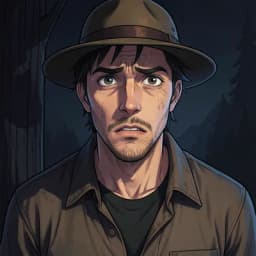
Meet the sample character
The mountains kept your secrets, but time kept your life.
Try a scene · No signup
Rust on the Musket
A short sample of this world. Your own version starts with your character.
You rub the grit from your eyes, your knuckles aching with the stiffness of decades. The musket you carried is a skeleton of red rust, crumbling into flakes under your touch. The thicket where you laid your head is gone, replaced by a jagged iron fence and the smell of ozone. A stranger stands nearby, holding a glowing slate that hums with a rhythmic, alien frequency.

“Hey, you! This is restricted property. How did you get past the perimeter sensors without a bioscanner pass?”

Your tongue feels like dry parchment. You try to speak, but the name of the village—your village—dissolves into a guttural wheeze. The faces you knew are replaced by harsh, synthetic light and the constant, thrumming hum of machines buried deep beneath the earth. You realize with a sickening jolt that the sky itself looks wrong, flickering with geometric distortions that make your head swim.
“I am not a trespasser. I live here. Tell me, where is the tavern? Where is the stream?”
The stranger’s expression shifts from irritation to a cold, clinical curiosity, and they raise the slate toward your face. A beam of white light scans your retinas, and the hum rises to a piercing shriek. You hear your own name spoken by a voice that isn't human, echoing from the air around you, warning you that your heartbeat is a temporal anomaly that must be corrected immediately.
The scanning beam intensifies, threatening to lock your biological signature into this timeline's database. How do you respond to the machine?
Your character. Your next move.
Will you adapt or fade away?
The forest is gone, replaced by steel and shadow. You are the only person who remembers the taste of the old world. Will you search for your family in the ruins, or will you use your unique perspective to reshape this new society? Your choices decide whether you become a ghost or a legend.
Begin your long sleepYour Story, Your Way
Everything is customizable. Pick any genre, setting, or character — the AI builds a world around exactly what you want.
Any Character
Design your appearance, personality, backstory — every detail
Any World
Fantasy kingdoms, sci-fi stations, modern cities — you choose
Branching Paths
No two playthroughs are the same. Your choices reshape everything
Full Immersion
AI images, voice acting, sound effects — a living story
Decide whether to hide your true origins or risk being labeled a societal anomaly.
Choose to seek out the descendants of your old life or build a new identity.
Negotiate with futuristic factions using skills and knowledge from a forgotten century.
Determine if your influence on the future is a gift or a catastrophic paradox.
The air tastes of ozone and burnt plastic, not the pine needles of the Catskills. Your joints ache with a stiffness that feels like decades of stillness. You reach for the flintlock rifle you carried into the woods, but your fingers find only a metallic, cold surface embedded in the roots of an ancient, petrified tree. Looking up, the sky is scarred by streaks of light that move with unnatural speed, and the forest you knew has been paved over by towering monoliths of glass and shifting neon. You are a ghost in a timeline that moved on without you. Every decision you make now determines whether you adapt to this unrecognizable reality or become a relic crushed by the gears of history. The choices you face define the fate of a man who missed his own era, forcing you to reconcile a forgotten past with a terrifyingly efficient future.
What is Rip Van Winkle in Time Travel?
The Rip Van Winkle trope centers on the disorientation of an individual displaced by time. Originally penned by Washington Irving in 1819, the story follows a man who falls asleep in the mountains and awakens twenty years later to find his village transformed and his family unrecognizable. In modern interactive fiction, this concept acts as a catalyst for profound cultural shock. Unlike time travel stories where the protagonist actively jumps through portals, the Rip Van Winkle character is a passive victim of time’s arrow, forced to play catch-up in a world that has evolved past their understanding. We see this dynamic in works like H.G. Wells' 'The Sleeper Awakes' or even in the comedic fish-out-of-water scenarios seen in 'Futurama,' where the protagonist Fry experiences the jarring shift from the 20th to the 31st century. This narrative framework functions as a mirror, reflecting how much our society changes when we aren't looking. By placing a character from an older era into a high-tech or post-apocalyptic future, the narrative highlights the fragility of identity. You aren't just surviving; you are evaluating the cost of progress through the eyes of someone who remembers the silence of a world before the noise of the machine.
Why play Rip Van Winkle as an interactive story?
Playing through this narrative grants you agency over the most significant question in the character's life: is it better to cling to a ghost of the past or to embrace the chaos of the present? You will confront moments where your archaic values clash with advanced technology, forcing you to choose between your survival and your integrity. Will you attempt to find your descendants, knowing they have long since passed? Will you leverage your knowledge of 'primitive' survival to gain power in a crumbling high-tech city? The tension arises from the fact that you are a stranger everywhere. Every conversation is a minefield of cultural misunderstanding. You might try to explain a simple barter system to a merchant who trades in digital currency, or find yourself hiding in the shadows of a skyscraper because you don't recognize the uniforms of the people walking the streets. Your choices dictate whether you become a legend, a pariah, or a cautionary tale.
The literary legacy of Rip Van Winkle
Washington Irving’s 'Rip Van Winkle' remains the definitive template for the man out of time. Published as part of 'The Sketch Book of Geoffrey Crayon, Gent,' the story was a response to the rapid changes in American identity following the Revolutionary War. Irving used the character to capture the anxiety of a nation that had fundamentally shifted its political and social foundation while its citizens were busy with daily labor. The character has since evolved into a versatile archetype. In the 1960s, the concept was adapted into various 'Twilight Zone' episodes, where the focus shifted toward the psychological horror of waking up to a world that no longer values your existence. More recently, the archetype has appeared in video games like 'Fallout 4,' where the protagonist emerges from cryogenic stasis to find the world ruined by nuclear fire. This persistence in pop culture speaks to a universal fear: that we will wake up one day and find that the world has moved on, leaving us behind. Whether it is used as a critique of rapid technological advancement or a meditation on the inevitability of change, the Rip Van Winkle archetype persists because it forces us to confront the transience of our own lives. It is a story about the intersection of memory and progress, and why we are never truly finished with our history, even when the world forgets it.
FAQ
How does the time travel mechanic work in this game?
The mechanics focus on the psychological and social consequences of displacement. You aren't hopping between years; you are living in the 'now' of a future that feels alien. The game tracks how your past-world knowledge interacts with current technology and societal norms.
Can I change the future after I wake up?
Yes. Your actions ripple through the timeline. Because you are an outsider with a different perspective, your choices can destabilize established power structures or provide the missing link to solving a modern crisis.
Is this based on the original Washington Irving story?
The premise draws inspiration from the central theme of Irving’s work—the shock of waking to a changed world—but the narrative takes place in a speculative, evolving future that allows for diverse branching outcomes.
What happens if I try to reclaim my old life?
Attempts to reclaim the past often lead to conflict. The world has moved on, and your old home, family, or social status likely no longer exist. The story explores the tragic, often difficult reality of trying to force the past into a new, incompatible reality.
Explore more Time Travel stories like Butterfly Effect, Time Loop, Grandfather Paradox.
More Time Travel Stories
Butterfly Effect
You stepped on something you should not have, and now the present is unrecognizable. Every small change you make in the past cascades into catastrophic consequences, and fixing one thing always breaks another.
TropeTime Loop
You are living the same day over and over, and you are the only one who knows. Each loop gives you another chance to get it right—but the repetition is driving you closer to the edge.
TropeGrandfather Paradox
You have accidentally created a paradox that threatens to unravel your own existence. The timeline is collapsing around you, and you must find a way to resolve the contradiction before you are erased.
TropeTime Police
You enforce the laws of time itself, hunting down those who would alter history for personal gain. But the latest case is personal—someone has changed your own past, and regulations say you cannot intervene.
TropeHistorical Correction
History went wrong and you have been sent to fix it. You must blend into a past era, locate the point of divergence, and correct it without creating new problems that are even worse.
TropeFuture Knowledge Advantage
You are stuck in the past with knowledge of everything that will happen. The temptation to profit from what you know is overwhelming, but every advantage you take risks alerting people who should never learn the truth.