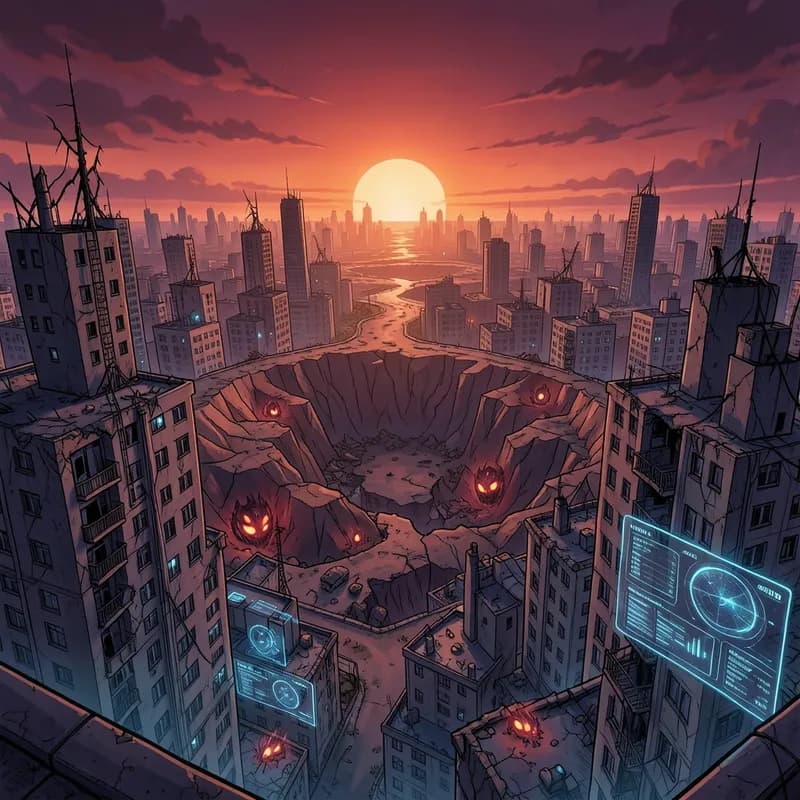
System Apocalypse · Interactive story
The Rooftop Safe Zone: High Ground in a System Apocalypse
The ground is a death trap. How long can you hold the high ground?
Start as a guest. Choose your character before the story begins.

Meet the sample character
The status window shows you have three minutes before the sky turns red.
Try a scene · No signup
Concrete Canopy Survival
A short sample of this world. Your own version starts with your character.
You stare at the translucent blue interface hovering over the rusted air conditioning unit. Your stamina bar flashes amber, a rhythmic pulse that matches the distant, wet thudding of something large hitting the pavement below. The wind carries the metallic scent of ozone and decay. Mira leans against the parapet, her knuckles white as she grips a jagged piece of rebar.
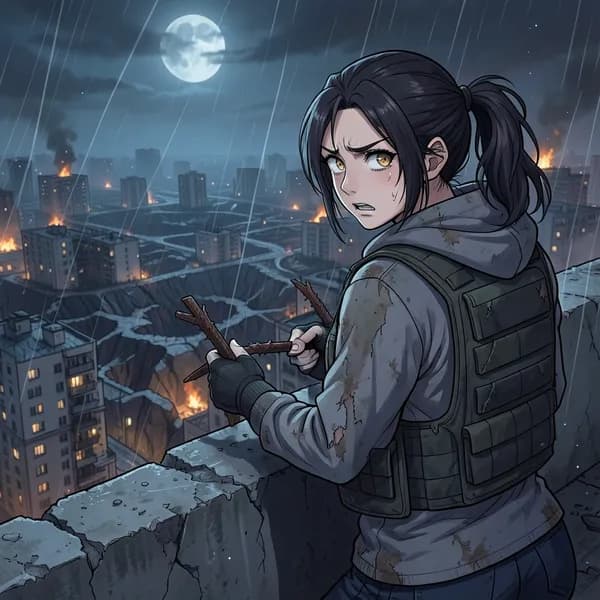
“The supply crate landed on the third-floor balcony, Kenji. If we don't go now, the prowler pack will smell the mana signature and tear the whole structure down to get to it.”

Your 'Danger Sense' passive flickers. A red warning text crawls across your peripheral vision: Level 14 Prowler detected within 50 meters. The gap between the rooftops is ten feet of open air, a drop that guarantees a broken leg if your landing calculation is off by a single pixel. You feel the weight of your equipment—barely enough to sustain a fight, let alone a siege.
“If we jump, we lose our height advantage, but if we stay, we starve within forty-eight hours. I am calculating the trajectory, but the wind shear makes this a low-probability gamble.”
The shadow of a massive wing stretches across the roof, blotting out the dying sun. A screech echoes from the street—a sound that makes the very air vibrate. You have seconds before the building is swarmed and your fragile sanctuary becomes a slaughterhouse. Do you risk the jump to secure the crate, or do you sacrifice your remaining supplies to lure the creatures elsewhere?
The screeching grows louder as the shadow descends. How do you secure your survival?
Your character. Your next move.
The swarm is rising. Will your barricades hold?
The sun is setting, and your supplies are down to the last few cans. A mysterious signal is blinking from the roof across the street. Do you risk your position to investigate, or do you lock the hatch and hope the monsters don't look up? Your choices define the fate of your camp.
Start Your Rooftop SurvivalYour Story, Your Way
Everything is customizable. Pick any genre, setting, or character — the AI builds a world around exactly what you want.
Any Character
Design your appearance, personality, backstory — every detail
Any World
Fantasy kingdoms, sci-fi stations, modern cities — you choose
Branching Paths
No two playthroughs are the same. Your choices reshape everything
Full Immersion
AI images, voice acting, sound effects — a living story
Allocate limited skill points to either combat defense or resource management efficiency.
Decide which survivors to trust when supplies hit critically low levels.
Upgrade your rooftop barricades using salvaged materials found during high-risk supply runs.
Manage the morale of your camp through dialogue choices that impact future cooperation.
Jinho gripped the rusted railing, his system interface flickering a dim red against the pitch-black sky. Below, the city streets pulsed with the guttural clicks of creatures that did not exist twenty-four hours ago. He held three liters of water, a sharpened rebar pipe, and a group of strangers looking to him for a plan. The rooftop of the apartment complex was the only thing separating them from the swarm. Every choice you make carries immediate weight. Do you spend your remaining stamina to reinforce the stairwell, or do you risk a descent into the dark to scavenge for medical supplies? In this environment, your status window is your only map, and your decisions determine if you see another sunrise or become just another statistic in the system's log.
What is Rooftop Safe Zone in System Apocalypse?
The Rooftop Safe Zone is a setting defined by verticality and extreme resource scarcity. When the system apocalypse resets the world, the streets become spawning grounds for monsters, leaving the rooftops as the only viable sanctuary. This trope creates a pressure cooker environment, forcing characters into a small, exposed perimeter where they must balance defense with basic survival. Think of the desperate, claustrophobic tension found in the apartment building setting of 'Sweet Home' or the rooftop standoffs in 'World War Z.' In this setting, the 'safe' part of the zone is relative. You are balancing hunger, morale, and structural integrity against a relentless external threat. The system doesn't just grant you levels; it tracks the degradation of your barricades and the dwindling oxygen or water supplies. You are not a hero in a grand fantasy; you are a survivor managing a fragile foothold in a world that has turned into a hostile game.
Why play Rooftop Safe Zone as an interactive story?
Playing in this setting places the burden of leadership on your shoulders. You are not just observing a story; you are calculating the cost of every action. When a neighboring rooftop sends a distress signal, you must decide if it is a trap or a chance to gain a skilled survivor. The system interface provides you with real-time feedback on your choices—if you choose to hoard supplies, your morale stat might drop as your camp turns on itself. If you focus solely on combat training, your infrastructure will decay. You will face moments where you must choose between a teammate's life and the integrity of your barricades. The agency provided by the system means that your specific strategy dictates whether your haven remains a shelter or becomes a tomb.
What makes Rooftop Safe Zone work: the worldbuilding
The effectiveness of the Rooftop Safe Zone lies in its natural conflict generators: gravity, visibility, and isolation. Unlike a fortified base in a forest, a rooftop is exposed. You can see the enemy, and they can see you. This constant visual threat forces a specific type of gameplay—one where you are always watching the horizon for movement. The setting naturally filters for character types: the pragmatic scrounger, the desperate optimist, and the military-minded strategist. These archetypes clash over limited food and space, creating drama without needing external monster attacks. Real-world works like J.G. Ballard’s 'High-Rise' or the isolated apartment setting in 'The Mist' demonstrate that when people are trapped in a high-density, vertical space, the social order collapses faster than the walls. By adding a system apocalypse element, you introduce objective metrics to this social decay. The system rewards aggression with experience points, but the rooftop setting rewards caution and structural maintenance. This conflict between the game’s incentive to fight and the setting’s incentive to hide is what keeps the tension high. Sensory details define this experience: the smell of ozone from the system interface, the biting wind at high altitudes, and the sound of claws scraping against the metal fire escape. Every story in this setting succeeds when it makes the reader feel the weight of every floor between them and the safety of the street.
FAQ
How does the system interface impact my survival chances?
The interface tracks your vital statistics, including energy, hydration, and sanity. It also provides notifications on monster activity levels below. Your choices directly influence these numbers; for example, choosing to skip sleep to keep watch will boost your defense rating but increase your fatigue, making you less effective in combat.
Can I leave the rooftop to explore the ground floor?
Yes, but it is high-risk. The ground floor is where high-tier loot and rare resources are hidden, but it is also where the monster density is at its peak. You must weigh the potential gain of a supply run against the high probability of a fatal encounter.
Is this a permanent base, or do I have to move?
A rooftop is rarely permanent. As the system apocalypse progresses, monsters evolve and threats change. You may eventually find your roof compromised by aerial enemies or structural collapse, forcing you to plan a dangerous migration to a new high-ground position.
What happens if I run out of food or water?
Your character will start to accumulate debuffs that decrease your effectiveness in combat and decision-making. If your health reaches zero due to starvation or dehydration, the story ends. The game forces you to prioritize trade-offs, such as choosing between a combat upgrade or a water filtration system.
Explore more System Apocalypse stories like System Activation Day, First Monster Wave, Class Selection.
More System Apocalypse Stories
System Activation Day
You watch a translucent blue window materialize in front of your eyes and the world as you knew it ends. The System has arrived, granting humanity stats, classes, and levels while simultaneously unleashing monsters across the globe, and the old rules of civilization are gone in an instant.
TropeFirst Monster Wave
You hear the screaming before you see them — creatures that should not exist, pouring through rifts in reality and tearing through a world that has no idea how to fight back. The first monster wave is pure chaos, and survival depends on how quickly you adapt to a reality where ordinary people must become warriors.
TropeClass Selection
You stand before a screen listing classes you can become — warrior, mage, healer, assassin, and stranger options that defy categorization. This choice will define your power, your role, and your survival odds, and the System does not allow do-overs.
TropeTutorial Dungeon
You are teleported into a contained space designed to teach you the System's rules through a series of escalating challenges. The tutorial dungeon is supposed to be survivable, but the mortality rate is horrifying, and the lessons are taught through blood.
TropeTower Appearance
You watch a massive tower materialize in the center of the city, its peak vanishing into clouds that were not there a moment ago. The tower is a challenge, a reward system, and a mystery all at once, and the floors above hold power that could save or doom what remains of humanity.
TropeGuild Founding
You bring together survivors with complementary classes and a shared determination to do more than just survive. Founding a guild means organizing humanity's fightback, but it also means navigating egos, resource conflicts, and the question of whether you are building a team or a government.