
System Apocalypse · Interactive story
The Mead Hall System: A Beowulf Boss-Fight Survival Challenge
The beast has no name, but the system has your stats. Will you survive tonight?
Start as a guest. Choose your character before the story begins.
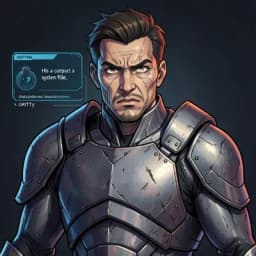
Meet the sample character
No weapon forged by man can hold back the red-coded error.
Try a scene · No signup
The Static at Heorot's Threshold
A short sample of this world. Your own version starts with your character.
Your vision glitches, the world stuttering as the System overlays a warning onto your retina: WARNING. BREACH DETECTED. SECTOR 4. The concrete floor beneath your boots vibrates with a rhythmic, heavy thud that registers as a Level 50 boss threat. You grip your sword, the metal feeling colder than it should in this stifling heat.

“It’s back, Wulfric. The barrier won't hold against that kind of raw data output for another minute.”

You look at the monitor display, where the pixelated silhouette of a creature—part beast, part corrupted code—tears through the blast doors. The System chimes with a sickening, melodic ping, updating your objective: SURVIVE OR ERASE. You realize the entity isn't just trying to kill you; it’s trying to overwrite your very existence in the game logs.
“Let it come. I’ll show this glitch what happens when a man refuses to be deleted.”
The creature lunges, its limbs flickering between solid shadow and raw, jagged code. You have a split second to decide how to face an opponent that ignores the laws of physics. If you strike now, you might draw its aggression, but if you wait, you risk losing the bunker's power supply forever.
How do you engage the incoming entity before it shreds the bunker's core?
Your character. Your next move.
Grab your steel. The hall is waiting.
The system has calculated your odds, and they are grim. Will you stand your ground against the beast, or will you let the lights in the mead hall go out forever? Every choice you make is recorded in your status log. Step into the arena, prove your strength, and see if you have what it takes to survive the night.
Begin your hunt nowYour Story, Your Way
Everything is customizable. Pick any genre, setting, or character — the AI builds a world around exactly what you want.
Any Character
Design your appearance, personality, backstory — every detail
Any World
Fantasy kingdoms, sci-fi stations, modern cities — you choose
Branching Paths
No two playthroughs are the same. Your choices reshape everything
Full Immersion
AI images, voice acting, sound effects — a living story
Manage stamina and weapon durability during intense, multi-phase monster boss fights.
Allocate skill points between raw power, defense, and speed to customize your combat style.
Decide when to engage in direct melee or utilize system-provided tactical environmental advantages.
Face dynamic consequences where poor choices lead to permanent status debuffs or limb injury.
The sky splits open, revealing lines of glowing violet code that cascade across the horizon. A status window flickers into existence before your eyes: [QUEST ALERT: ELIMINATE THE THREAT IN HEOROT]. You grip your sword, the cold steel biting into your palm as you track the heavy, rhythmic thuds vibrating through the floorboards. In this interactive story, your choices dictate your survival against an adversary that ignores the laws of biology. You are not just a warrior; you are a player forced to balance your stamina, weapon durability, and tactical positioning against creatures that grow stronger with every kill. Whether you rely on brute strength or exploit the system’s hidden mechanics, your next move decides if you earn the title of hero or become another casualty in the digital collapse of society.
What is Beowulf in System Apocalypse?
Beowulf represents the archetype of the monster-slaying hero, a figure defined by unmatched physical power and the relentless pursuit of the world's most dangerous threats. In the original Old English epic, he is a Geatish warrior who crosses the sea to clear the mead hall of Heorot of the monstrous Grendel. By integrating this character into a system apocalypse framework, the narrative shifts from a linear poem to a tactical survival challenge. Readers familiar with Robert Zemeckis’s 2007 film *Beowulf* or Michael Crichton’s *Eaters of the Dead* recognize the tension of fighting an enemy that cannot be defeated through standard means. Here, the system apocalypse adds a layer of game logic—status bars, skill trees, and loot drops—that transforms the mythic encounters into high-stakes boss fights. The monster is no longer just a narrative obstacle; it is a raid boss with a health pool that requires precise timing and strategic resource management to deplete.
Why play Beowulf as an interactive story?
Playing as the legendary warrior allows you to confront the consequences of your tactical decisions in real-time. Unlike a static book or film, you choose how to approach the fight. Do you engage Grendel in a test of pure strength, risking your own health for a higher loot drop, or do you bait the creature into an environmental trap? The tension lies in the risk-reward ratio of every encounter. You might find yourself debating whether to save your stamina for the final blow or use a high-cost skill to mitigate damage from the dragon’s fire. Every choice changes your character’s build, affecting how subsequent monsters perceive and attack you. You are constantly testing your reflexes and logic against a system that wants to see your health bar hit zero, making every victory feel like a hard-won achievement.
The literary legacy of Beowulf
The story of Beowulf originated in early medieval England, written by an unknown poet who transformed oral traditions into an epic of profound cultural weight. It centers on the hero’s transition from a young, arrogant warrior to an aging king, a progression marked by three major conflicts: Grendel, his mother, and the dragon. This narrative structure has influenced countless creators, serving as the blueprint for the 'hero vs. monster' trope in modern media. John Gardner’s novel *Grendel* offered a brilliant reinterpretation by telling the story from the perspective of the monster, forcing readers to question the nature of the hero himself. Similarly, the film *The 13th Warrior* blended historical fiction with the mythic structure of the poem, showing how the character’s legacy persists through different interpretations of courage and sacrifice. Modern adaptations often strip away the archaic language to focus on the raw brutality of the combat, which is exactly why it fits so perfectly into the system apocalypse genre. By placing the player in the role of the hero, the story returns to its roots: a person standing alone against a darkness that threatens to consume everything. The enduring appeal of this character is his willingness to face impossible odds, a trait that feels just as relevant in a digital, game-ified world as it did in the dark, wood-paneled halls of the past.
FAQ
What is the core gameplay loop?
The loop revolves around identifying a monster threat, gathering intelligence on its attack patterns, managing your limited stamina and gear, and executing combat choices that determine your success or failure in boss encounters.
Can I choose my own weapons?
Yes. As you progress, you gain access to different equipment based on your combat style and the monsters you have defeated. Your choice of weapon significantly impacts your stats and how you interact with the game’s status-tracking system.
How does the system apocalypse setting change the original story?
While the core mythic beats remain, the setting introduces game mechanics like health bars, damage mitigation, and experience points. You are not just following a script; you are optimizing your survival in a world that operates on rigid, often punishing, mathematical rules.
Is this suitable for fans of high-fantasy RPGs?
If you enjoy tactical decision-making, stat optimization, and challenging boss fights, this provides a similar experience. It combines the narrative depth of epic poetry with the mechanical satisfaction of a tabletop or video game RPG.
Explore more System Apocalypse stories like System Activation Day, First Monster Wave, Class Selection.
More System Apocalypse Stories
System Activation Day
You watch a translucent blue window materialize in front of your eyes and the world as you knew it ends. The System has arrived, granting humanity stats, classes, and levels while simultaneously unleashing monsters across the globe, and the old rules of civilization are gone in an instant.
TropeFirst Monster Wave
You hear the screaming before you see them — creatures that should not exist, pouring through rifts in reality and tearing through a world that has no idea how to fight back. The first monster wave is pure chaos, and survival depends on how quickly you adapt to a reality where ordinary people must become warriors.
TropeClass Selection
You stand before a screen listing classes you can become — warrior, mage, healer, assassin, and stranger options that defy categorization. This choice will define your power, your role, and your survival odds, and the System does not allow do-overs.
TropeTutorial Dungeon
You are teleported into a contained space designed to teach you the System's rules through a series of escalating challenges. The tutorial dungeon is supposed to be survivable, but the mortality rate is horrifying, and the lessons are taught through blood.
TropeTower Appearance
You watch a massive tower materialize in the center of the city, its peak vanishing into clouds that were not there a moment ago. The tower is a challenge, a reward system, and a mystery all at once, and the floors above hold power that could save or doom what remains of humanity.
TropeGuild Founding
You bring together survivors with complementary classes and a shared determination to do more than just survive. Founding a guild means organizing humanity's fightback, but it also means navigating egos, resource conflicts, and the question of whether you are building a team or a government.