
System Apocalypse · Interactive story
The Ghost Code of the Abandoned System Zone
The UI is dying, the monsters are statues, and you are the only one awake.
Start as a guest. Choose your character before the story begins.
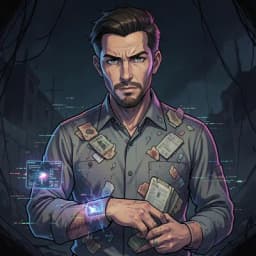
Meet the sample character
Where the server stops and the reality breaks.
Try a scene · No signup
The Dead Code of Station 402
A short sample of this world. Your own version starts with your character.
Your boots crunch on shattered glass as you step onto the platform of Station 402. Above you, the System map flickers, lines of code bleeding into empty space. Ten feet away, a Level 40 Crawler is frozen in mid-lunge, its textures tearing like wet paper, caught in a permanent loop of jagged pixels. The air tastes like ionized ozone and burnt copper.

“Don't touch that thing, Jinho. The last guy who tried to loot a frozen asset got his hand digitized into nothingness.”

Your own interface spasms, throwing a 'CRITICAL ERROR: ASSET DATA CORRUPTED' warning across your vision. Your left arm itches where the black, vein-like markings of your secret infection have begun to glow in sync with the room's distortion. You know this isn't just a dead zone; it's a hole in the game's logic, and something valuable is trapped in the center of the freeze.
“If I can stabilize the local code, I might be able to pull the data-shard before the area crashes entirely. I'm going in.”
As you move forward, the floor tiles beneath you begin to vanish, revealing a void of raw, unrendered space. The Crawler’s frozen eye twitches, its pupils shifting from red to white. Your status window vanishes, leaving you blind to your own health, and a prompt appears in the air, written in a language that looks like ancient cuneiform and binary. The station begins to groan as the wall of reality starts to peel back.
The station is collapsing into a void, and the Crawler is reactivating. How will you attempt to survive the crash?
Your character. Your next move.
Will you fix the code or exploit it?
The signal is fading. A frozen guard at the entrance holds a keycard that shouldn't exist. Do you try to extract its data before the zone resets, or do you retreat before your own interface crashes permanently? The choice is yours.
Enter the GlitchYour Story, Your Way
Everything is customizable. Pick any genre, setting, or character — the AI builds a world around exactly what you want.
Any Character
Design your appearance, personality, backstory — every detail
Any World
Fantasy kingdoms, sci-fi stations, modern cities — you choose
Branching Paths
No two playthroughs are the same. Your choices reshape everything
Full Immersion
AI images, voice acting, sound effects — a living story
Decide whether to siphon power from corrupted monsters or risk total system deletion.
Solve environmental puzzles by exploiting graphical glitches and broken collision detection.
Choose which corrupted memory logs to download, unlocking secrets about the world's origin.
Manage your flickering status window to prevent your character from being erased.
Static hums in the air where the streetlights should be. You step over a Level 4 Void-Stalker, its claws inches from your boot, trapped in a jagged frame of frozen animation. Above your head, your status window flickers violently, displaying error codes instead of your health bar. This is the edge of the map, a patch of reality corrupted by a failed system update. Your choices determine if you extract the data or become another permanent fixture in this digital graveyard. In this interactive story, the environment reacts to your presence; if you linger too long, the glitch might consume your own character data. The silence here is heavy, broken only by the sound of corrupted assets scraping against the pavement. You arrived seeking answers about the collapse of civilization, but the closer you get to the center of the zone, the more the rules of physics begin to unravel. Every step is a gamble against a reality that no longer remembers how to function.
What is Abandoned System Zone in System Apocalypse?
The Abandoned System Zone is a localized narrative setting where the overarching game engine that governs the world has suffered a critical failure. Unlike the standard apocalypse zones where monsters roam and the leveling system functions as intended, these sectors are frozen in time. Think of the Shimmer from Jeff VanderMeer’s 'Annihilation' or the haunting, abandoned urban decay of 'NieR: Automata'. In these areas, the game system is essentially 'corrupted.' NPCs might be stuck in infinite dialogue loops, monsters are frozen in mid-strike, and the loot tables are broken or glitched. These zones are rarely visited by common scavengers because the risk of being deleted by a software bug is higher than the risk of being killed by a monster. However, for those looking to understand the mechanics of the system, this is the only place to find raw, uncompiled data. It is a place where the logic of the world breaks down, and the player is forced to rely on their own intuition rather than their character’s stats or skills.
Why play Abandoned System Zone as an interactive story?
Playing in an Abandoned System Zone shifts the focus from combat to investigation and risk management. You aren't just fighting for survival; you are trying to manipulate the glitch to your advantage. You will face moments where you must decide whether to harvest a piece of corrupted code that could grant you a god-like ability or risk total data corruption that wipes your character profile. The tension comes from the unpredictability—the game system is not reliable here. You might try to cast a skill, only to have the interface crash or trigger a completely different effect. You have to navigate environments where the terrain itself might shift or duplicate. Every choice you make, from how you interact with the frozen entities to how you handle the flickering UI, changes how the zone responds to you. Will you be the one to patch the glitch, or will you use the instability to rewrite your own stats?
What makes Abandoned System Zone work: the worldbuilding
The Abandoned System Zone functions because it turns the tropes of the System Apocalypse genre against themselves. In most stories, the system is an absolute, immutable law. Here, it is a fragile, buggy construct. This creates a natural conflict: the struggle between the survivor and the environment. The atmosphere is defined by sensory dissonance—the sight of high-definition monsters trapped in low-resolution textures, the sound of audio files skipping, and the constant threat of the interface failing. Works like 'The Cabin in the Woods' succeed because they show the machinery behind the horror; this setting does the same for the game system. You are essentially walking through the 'backstage' of the apocalypse. When writing for this setting, focus on the contrast between the rigid, robotic nature of the system and the chaotic, organic nature of the glitch. Characters who thrive here are often hackers, data-miners, or those who have lost their connection to the system entirely. The sensory details should be jarring—a sky that turns into a grid of purple squares, or the feeling of your own limbs moving with a stuttering, frame-by-frame delay. This setting demands that you treat the world not as a reality, but as software. By doing so, you move from being a pawn in the game to a potential administrator. The narrative potential is vast, as you are not just surviving the monsters; you are surviving the code that created them.
FAQ
What is the primary danger in an Abandoned System Zone?
The primary danger is not just the monsters, but 'data corruption.' Because the system is unstable, your character's stats, items, and even identity can be rewritten or deleted if you interact with the wrong glitches. It is a game of high-stakes gambling.
How does the combat differ from standard zones?
Combat is unpredictable. Because the system's rules are breaking down, your abilities might fail, trigger at random, or cause environmental hazards. You must rely on cleverness rather than raw power.
Can I find better loot in an Abandoned System Zone?
Yes, but it is dangerous. You can find 'glitched' items that have stats or effects impossible to obtain in the standard game, but they often come with severe drawbacks or require a high-level skill check to stabilize.
Is this setting right for me?
If you enjoy stories where the rules of the world are meant to be broken or questioned, this is a perfect choice. It focuses more on mystery, technical exploitation, and high-risk decision-making than traditional combat.
Explore more System Apocalypse stories like System Activation Day, First Monster Wave, Class Selection.
More System Apocalypse Stories
System Activation Day
You watch a translucent blue window materialize in front of your eyes and the world as you knew it ends. The System has arrived, granting humanity stats, classes, and levels while simultaneously unleashing monsters across the globe, and the old rules of civilization are gone in an instant.
TropeFirst Monster Wave
You hear the screaming before you see them — creatures that should not exist, pouring through rifts in reality and tearing through a world that has no idea how to fight back. The first monster wave is pure chaos, and survival depends on how quickly you adapt to a reality where ordinary people must become warriors.
TropeClass Selection
You stand before a screen listing classes you can become — warrior, mage, healer, assassin, and stranger options that defy categorization. This choice will define your power, your role, and your survival odds, and the System does not allow do-overs.
TropeTutorial Dungeon
You are teleported into a contained space designed to teach you the System's rules through a series of escalating challenges. The tutorial dungeon is supposed to be survivable, but the mortality rate is horrifying, and the lessons are taught through blood.
TropeTower Appearance
You watch a massive tower materialize in the center of the city, its peak vanishing into clouds that were not there a moment ago. The tower is a challenge, a reward system, and a mystery all at once, and the floors above hold power that could save or doom what remains of humanity.
TropeGuild Founding
You bring together survivors with complementary classes and a shared determination to do more than just survive. Founding a guild means organizing humanity's fightback, but it also means navigating egos, resource conflicts, and the question of whether you are building a team or a government.