
Survival Adventure · Interactive story
Alone in the Wild: The Lost Hiker’s Test
The trail markers are gone, the temperature is dropping, and you are completely alone.
Start as a guest. Choose your character before the story begins.
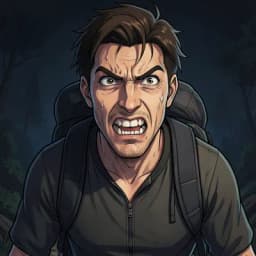
Meet the sample character
Try a scene · No signup
The Granite Shroud
A short sample of this world. Your own version starts with your character.
The glass of your phone remains stubbornly black, a useless mirror reflecting your own panicked eyes. You press the power button again, hoping for a flicker of life that never comes. The sun has dipped behind the jagged spine of the peaks, leaving you in a world of deepening violet shadows and rapidly falling temperatures.

“Arlo, stop tapping that dead screen and look at the clouds—the pass is closing in, and we're already losing the trail.”

You look toward the ridgeline. Maya’s breath comes in ragged, shallow puffs. Your own limbs feel heavy, sapped of energy after eight hours of climbing. The silence of the mountain is absolute, broken only by the sharp, rhythmic scraping of wind against quartz. You are calorie-depleted, dehydrated, and rapidly running out of visibility.
“If we stop now, the cold will kill us before dawn. We have to keep moving toward the lower timberline.”
Below you, a faint, flickering light glows from a distant valley—perhaps a ranger cabin, perhaps a hallucination. To your left, a small, shallow overhang offers a windbreak, but staying put means enduring a sub-zero night with only a light windbreaker. The wind gusting against your back carries the sharp, unmistakable scent of fresh snow. Every second you stand still, your body heat bleeds into the stone.
The temperature is plummeting. What is your strategy for surviving the night?
Your character. Your next move.
The sun is setting. Will you survive the night?
Your phone is dead, the temperature is plummeting, and the trail is gone. Every decision you make—from the shelter you build to the path you choose—determines your fate. Step into the wilderness and see if you have the grit to make it home.
Start Your Survival StoryYour Story, Your Way
Everything is customizable. Pick any genre, setting, or character — the AI builds a world around exactly what you want.
Any Character
Design your appearance, personality, backstory — every detail
Any World
Fantasy kingdoms, sci-fi stations, modern cities — you choose
Branching Paths
No two playthroughs are the same. Your choices reshape everything
Full Immersion
AI images, voice acting, sound effects — a living story
Scavenge for dry tinder before the freezing mountain rain begins to fall.
Decide whether to ration your remaining water or risk drinking from an untested stream.
Choose between trekking through the night or burning precious calories to build a shelter.
Manage your limited gear to signal for help without alerting local predators.
The map in your pocket is useless. You stopped to photograph a ridge an hour ago, but when you turned back, the path had dissolved into dense, unmapped scrub. The silence here is heavy, broken only by the snap of a twig under your boot. Your water bottle is half-empty, and the sun is beginning its rapid descent behind the jagged peaks. You have to decide: do you stay put and hope for a search party, or push toward the valley where the air feels warmer? Every decision you make carries weight in this unforgiving landscape. You are not a soldier or a hero; you are a person who stepped off the beaten path, expecting a scenic afternoon and finding a fight for your life. In this interactive story, your choices dictate whether you find your way back to civilization or become another cautionary tale carved into the mountain.
What is The Lost Hiker in Survival Adventure?
The Lost Hiker archetype strips away the comforts of modern life, leaving the protagonist with nothing but their own wits. Unlike high-fantasy adventures where the danger comes from monsters or magic, this archetype focuses on the quiet, agonizing struggle against biology and the environment. Consider the raw desperation of Aron Ralston in '127 Hours' or the isolation found in the game 'Firewatch'. These narratives turn the landscape itself into the primary antagonist. It is a story about the fragility of the human body when stripped of GPS, cell service, and reliable food sources. The archetype forces a shift in perspective; the hiker is no longer a visitor in nature, but a target. It is a fundamental examination of what happens when a person realizes that the world does not owe them safety, and their survival depends entirely on their ability to adapt to the changing light, temperature, and terrain.
Why play The Lost Hiker as an interactive story?
Playing this archetype puts the pressure of every calorie and every degree of temperature directly on your shoulders. You are not just reading about a struggle; you are calculating the risks of your next move. When the story presents you with a crossroads, your decision might mean the difference between finding a dry cave or spending the night exposed to the elements. You will face moments where you must choose between physical exertion to gain a better vantage point or conserving energy to stay warm. The tension comes from the lack of information—you don't know if the trail is just over the next ridge or if you are walking deeper into a dead-end ravine. Every interaction with a resource, like a patch of berries or a stream, requires a judgment call on safety and necessity. By controlling the narrative, you feel the weight of your own mistakes and the relief of your small victories.
The psychology of The Lost Hiker: why readers fall for this character
The Lost Hiker taps into the primal fear of being forgotten. It is the realization that civilization is a thin veneer, and once that is removed, we are entirely responsible for our own existence. In stories like 'The Revenant' or the survival classic 'Hatchet', the protagonist is stripped of their identity and forced to confront the absolute indifference of nature. We resonate with this because it is the most grounded of all adventure tropes—anyone who has walked a trail knows that split-second decision that could lead to being lost. The fantasy here is not about gaining power, but about proving one’s own resilience. It is the ultimate test of the human spirit. While some stories focus on the combat of survival, this archetype focuses on the internal dialogue of someone facing their own mortality. It asks the reader: 'When the distractions of the modern world are gone, who are you really?' This question is what drives the engagement, as the reader tests their own instincts against the simulated reality of the wilderness.
FAQ
What makes the Lost Hiker archetype different from a standard survival story?
Standard survival stories often feature protagonists with specialized training. The Lost Hiker is an ordinary person—a student, a parent, or a tourist—who lacks gear and experience. This makes the stakes feel higher and more personal.
How do survival choices impact the game?
Choices are tracked as physical and mental variables. If you ignore hunger or push through exhaustion, your character’s ability to make clear decisions or perform physical feats will degrade, leading to different narrative outcomes.
Is this game realistic?
The scenarios are grounded in real survival principles. While it is a story, the environment reacts to your choices based on logic—if you lose your light source in the dark, you will struggle to navigate.
Can I win if I make mistakes?
Survival is rarely a binary win/loss. You might survive the night but lose your gear, or you might find a trail but be too injured to walk it. Every path leads to a unique resolution.
Explore more Survival Adventure stories like Shipwreck Survival, Lost in the Wilderness, Mountain Climbing Disaster.
More Survival Adventure Stories
Shipwreck Survival
Your vessel shatters against jagged rocks and you drag yourself onto an unknown shore with nothing but saltwater in your lungs and the will to live. You must scavenge wreckage, find fresh water, and decide whether to wait for rescue or forge your own path to civilization.
TropeLost in the Wilderness
One wrong turn and the trail vanishes beneath your feet. The forest stretches endlessly in every direction, and night is falling fast. You must use every survival instinct you have to navigate back to safety before exposure, hunger, or something lurking in the trees claims you.
TropeMountain Climbing Disaster
An avalanche buries your base camp and severs your rope line halfway up the summit. You cling to a frozen ledge with dwindling oxygen and fading body heat, forced to choose between an impossible ascent and a deadly descent through unstable snow.
TropeDesert Survival
The sun bleaches the sand white and your water is almost gone. Every decision you make under this merciless sky burns precious calories and hydration, and the shimmering horizon offers mirages instead of hope. You must outsmart the desert before it claims you.
TropeArctic Expedition
Your expedition into the frozen north has gone catastrophically wrong. The supply sled is lost, frostbite creeps into your extremities, and a blizzard erases all landmarks. You push forward through whiteout conditions where one wrong step means falling through ice into oblivion.
TropeJungle Survival
The canopy swallows the sky and every vine, insect, and puddle carries the potential for death. You hack through dense undergrowth while battling dehydration, venomous creatures, and the disorienting sameness of the green hell that surrounds you.