
Survival Adventure · Interactive story
Lost in the Emerald Labyrinth
The canopy swallows the sun. Your canteen is empty. The hunt has just begun.
Start as a guest. Choose your character before the story begins.
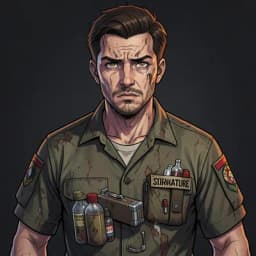
Meet the sample character
The humidity is a weight; the silence is a threat.
Try a scene · No signup
Fevered Canopy
A short sample of this world. Your own version starts with your character.
Your boots sink six inches into the sludge with every step, the mud pulling at your heels like greedy fingers. Sweat stings your eyes, mixing with the grime of the crash site. You clutch the rusted field radio, its casing cracked, while the towering ferns above block out the last of the dying sun.

“We are losing the light, Mateo. The mud is rising and the shadows aren't empty anymore.”

You feel the weight of the last ration pack in your side pocket—only a handful of crackers and a single, lukewarm bottle of water left. Your lungs burn with the effort of every breath, and your knee throbs with the dull, pulsing rhythm of an infection taking hold. The radio emits a faint, distorted hiss.
“Give me another hour. If I can patch the wiring, we might actually get a signal out before the temperature drops.”
A low, guttural chittering erupts directly above your heads, followed by the sound of heavy branches snapping. Something large and unseen has been tracking you for miles. You have seconds to act—either finish the repairs, find cover in the thicket, or try to lure the predator away from Hana.
The canopy above is shaking violently. How do you handle the immediate threat?
Your character. Your next move.
The canopy is closing in. Make your move.
You hear a snap of a branch behind you. Your water is gone, and the fever is starting to set in. Do you scramble up the muddy embankment to find higher ground, or do you hide in the hollow of a rotting tree and wait for the morning? The forest is watching. Your choice is the only thing standing between you and the dark.
Begin your survival storyYour Story, Your Way
Everything is customizable. Pick any genre, setting, or character — the AI builds a world around exactly what you want.
Any Character
Design your appearance, personality, backstory — every detail
Any World
Fantasy kingdoms, sci-fi stations, modern cities — you choose
Branching Paths
No two playthroughs are the same. Your choices reshape everything
Full Immersion
AI images, voice acting, sound effects — a living story
Manage limited supplies against the relentless rot and decay of the tropical heat.
Decide between risky shortcuts through murky swamps or grueling, energy-draining treks across ridges.
Analyze subtle animal tracks to avoid becoming prey for apex predators hidden in the brush.
Build makeshift shelters using only the materials scavenged from the immediate forest floor.
The humidity clings to your skin like a wet shroud, thick with the scent of rotting vegetation and stagnant water. High above, the canopy forms a solid roof of interlocking leaves, blocking the sky and leaving you in a permanent, emerald twilight. You check your pack—half a bottle of water and a rusted knife. Every rustle in the ferns could be a predator or a path to safety. Kenji wipes the sweat from his eyes, his boots sinking into the soft, black mud of the forest floor. He listens to the rhythmic clicking of insects, trying to distinguish the sound of a distant stream from the mimicry of a hunter. You decide whether to push forward through the dense thicket or conserve your limited energy in the shade of a massive banyan tree. Your next action determines if you survive the night or succumb to the fever.
What is Dense Jungle in Survival Adventure?
In survival fiction, the dense jungle acts as a primary antagonist. Unlike an open plain where visibility allows for planning, the jungle limits your perspective to a few feet of tangled vines and shadow. It is a setting defined by claustrophobia and the constant, rapid decay of organic matter. From the psychological intensity found in Joseph Conrad’s 'Heart of Darkness' to the frantic, gear-focused desperation of the 'Tomb Raider' reboots, this setting forces a shift in priorities. You are not fighting armies; you are fighting the environment itself. The jungle is a closed loop of resources that are difficult to harvest and even harder to keep. Moisture ruins supplies, insects carry disease, and the sheer density of the vegetation makes movement a slow, grueling process. In this genre, the jungle is a living entity that breathes, waits, and eventually consumes anything that fails to adapt to its relentless, humid pace.
Why play Dense Jungle as an interactive story?
Playing through a jungle survival scenario places the weight of every calorie and every drop of water directly on your shoulders. Agency transforms the story from a passive account of suffering into a tactical struggle for existence. You face the constant pressure of limited inventory space; do you carry the heavy medical kit that might save your life later, or the extra rations that keep you moving today? The tension arises from the ambiguity of your choices. A path that looks clear might lead to a hidden ravine, while the difficult climb over a ridge might reveal a landmark. You must read the environment, identifying which plants are safe to consume and which sounds indicate a threat. The stakes are personal, as every decision echoes through the remaining days of your trek.
What makes Dense Jungle work: the worldbuilding
The effectiveness of the jungle setting relies on sensory overload. To build a compelling narrative, you must lean into the specificities of the ecosystem: the deafening roar of cicadas that masks the approach of danger, the slick, unstable footing of moss-covered rocks, and the constant, oppressive heat. Real-world accounts like Yossi Ghinsberg’s 'Jungle' highlight the psychological toll of isolation, where the silence of the forest becomes as terrifying as the predators within it. Successful worldbuilding in this genre avoids over-explaining. Instead, it focuses on the immediate needs of the protagonist. What does the air smell like? How does the lack of sunlight affect the character's sense of time? By keeping the focus on the ground-level struggle, the setting feels authentic and dangerous. Characters in these stories often start with confidence, only to have their equipment and resolve stripped away by the sheer indifference of the wilderness. This transition—from prepared explorer to desperate survivor—is the engine of the genre. Whether it is the gritty realism of a film like 'Apocalypto' or the high-stakes exploration in 'Far Cry', the jungle thrives on the idea that nature does not care about human intentions. It is a place where biological necessity rules, and the only way to win is to outlast the forest's patience.
FAQ
What makes the jungle setting different from other survival environments?
The jungle is characterized by low visibility and high moisture. Unlike deserts or arctic tundras, the jungle provides abundant resources, but they are often hidden or dangerous, creating a 'starving in the midst of plenty' dynamic.
How does resource management affect the story?
Resource management dictates your pace. If you run out of water, you must choose between staying in one place to conserve energy or taking risks to find a new source, which changes the narrative outcome.
Is this story setting focused on combat or stealth?
The setting favors stealth and observation. Confronting the jungle head-on is rarely a winning strategy, as the environment is designed to exhaust you long before a predator makes its move.
Can I actually escape the jungle in this story?
Yes, but survival is never guaranteed. Your success depends on your ability to read the terrain, manage your health, and make calculated decisions under extreme pressure.
Explore more Survival Adventure stories like Shipwreck Survival, Lost in the Wilderness, Mountain Climbing Disaster.
More Survival Adventure Stories
Shipwreck Survival
Your vessel shatters against jagged rocks and you drag yourself onto an unknown shore with nothing but saltwater in your lungs and the will to live. You must scavenge wreckage, find fresh water, and decide whether to wait for rescue or forge your own path to civilization.
TropeLost in the Wilderness
One wrong turn and the trail vanishes beneath your feet. The forest stretches endlessly in every direction, and night is falling fast. You must use every survival instinct you have to navigate back to safety before exposure, hunger, or something lurking in the trees claims you.
TropeMountain Climbing Disaster
An avalanche buries your base camp and severs your rope line halfway up the summit. You cling to a frozen ledge with dwindling oxygen and fading body heat, forced to choose between an impossible ascent and a deadly descent through unstable snow.
TropeDesert Survival
The sun bleaches the sand white and your water is almost gone. Every decision you make under this merciless sky burns precious calories and hydration, and the shimmering horizon offers mirages instead of hope. You must outsmart the desert before it claims you.
TropeArctic Expedition
Your expedition into the frozen north has gone catastrophically wrong. The supply sled is lost, frostbite creeps into your extremities, and a blizzard erases all landmarks. You push forward through whiteout conditions where one wrong step means falling through ice into oblivion.
TropeJungle Survival
The canopy swallows the sky and every vine, insect, and puddle carries the potential for death. You hack through dense undergrowth while battling dehydration, venomous creatures, and the disorienting sameness of the green hell that surrounds you.