
Superhero · Interactive story
Shadowed Pasts, Heroic Futures
Can you convince the city you’ve changed, or will your old habits burn it down?
Start as a guest. Choose your character before the story begins.
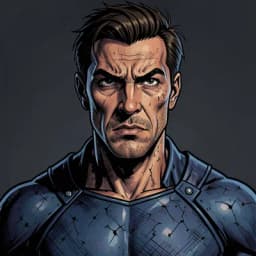
Meet the sample character
Redemption has a weight that crushes everything it touches.
Try a scene · No signup
Gravity's Debt
A short sample of this world. Your own version starts with your character.
Rain slicks the steel plating under your boots, reflecting the flickering neon of the city below. You stare at the warehouse where your former crew holds a group of engineers hostage. The familiar hum of gravity-warping energy pulls at your fingertips, desperate to reach out and crush the building. You swore you were finished with this, yet the city screams for the kind of force only you possess.

“The team is waiting, boss. Just pull the floor out from under them like the old days. Why hesitate now?”

The comms unit burns against your ear. Koji does not understand that every time you warp the local gravity, you fracture the structural stability of the street. You feel the weight of your past failures pressing into your chest. If you intervene, you risk immense collateral damage to save the hostages, but standing still guarantees their deaths.
“I am not the man who leveled Sector 4 anymore, Koji. Stop waiting for a ghost.”
Koji laughs, a grating sound that cuts through the static. Suddenly, the warehouse door explodes, and a pressurized beam of kinetic energy tears through the support pillars of the bridge you are standing on. Gravity shifts violently beneath your feet, dragging you toward the concrete. You have seconds to stabilize the structure or launch yourself into the fray before the entire city block collapses.
The bridge is buckling under the kinetic blast. How do you respond to the chaos?
Your character. Your next move.
Define your legacy: Savior or Scourge?
The city is under attack, and your former allies are waiting for you to make a move. Will you step into the light as a hero, or will the weight of your past pull you back into the shadows? Every decision you make carries consequences that will echo through the city. Start your story now and decide who you really are.
Begin Your RedemptionYour Story, Your Way
Everything is customizable. Pick any genre, setting, or character — the AI builds a world around exactly what you want.
Any Character
Design your appearance, personality, backstory — every detail
Any World
Fantasy kingdoms, sci-fi stations, modern cities — you choose
Branching Paths
No two playthroughs are the same. Your choices reshape everything
Full Immersion
AI images, voice acting, sound effects — a living story
Choose between using brutal past techniques or restrained, heroic combat tactics.
Manage your reputation with the public and local police through every public confrontation.
Decide whether to mentor a young hero or keep them at a distance.
Navigate tense dialogue with former allies who demand you return to the fold.
Soren stands on the edge of a gargoyle, the city lights flickering below like a dying fire. Five years ago, those same streets were his playground, scorched by the heat he produced as 'The Incinerator.' Now, he wears a different mask, one that doesn't hide his face but hides his intent. A distress signal pulses on his wrist—a bank heist, a hostage situation, a hero in over their head. The civilians below still fear his shadow, and the police have their weapons trained on him the moment he drops from the skyline. You must decide if he intervenes to save the innocent or if he stays in the darkness to avoid a confrontation he knows he cannot win without relapsing into his old, violent methods. Every tactical choice you make forces the public to either trust your new path or confirm their worst suspicions about your true nature.
What is The Reformed Villain in Superhero?
The reformed villain is a character archetype defined by the messy, often painful transition from antagonist to protagonist. Unlike a standard hero who operates from a place of inherent morality, the reformed villain operates from a place of learned restraint. They possess the same power sets, tactical knowledge, and sometimes the same brutal efficiency that once made them a threat. The tension lies in the contrast between their past crimes and their current, shaky alignment with justice. A classic example is Zuko from 'Avatar: The Last Airbender,' whose journey is marked by the constant struggle to unlearn the toxic ideology of his past. Similarly, Piccolo from 'Dragon Ball Z' demonstrates how a former conqueror can shift their focus toward protection, though they often retain a cold, utilitarian approach to problem-solving. This archetype thrives on the friction between who the character was and who they are trying to become, forcing them to prove their integrity in situations where their old, darker instincts would be far more effective.
Why play The Reformed Villain as an interactive story?
Playing as a reformed villain adds a layer of psychological weight that traditional hero stories lack. You are not just fighting crime; you are fighting the public's perception, the hero community's distrust, and your own muscle memory. During a mission, you might be presented with a situation where a villain is terrorizing a crowd. A standard hero would use non-lethal takedowns. As a former villain, you know that a lethal strike is faster and guarantees the threat won't return. You must choose: do you stick to the moral high ground and risk more casualties, or do you take the 'villainous' shortcut to ensure the job is done? These choices are not binary—they define your reputation. If you consistently choose efficiency over mercy, you may find that the authorities treat you like a monster regardless of your intentions. Your agency allows you to dictate whether your redemption is a genuine transformation or a mask you wear to keep the target off your back.
The psychology of The Reformed Villain: why readers fall for this character
The appeal of the reformed villain lies in the human desire for second chances. It is the ultimate fantasy of self-improvement—the idea that no matter how much damage you have caused, you can still fundamentally alter the trajectory of your life. This archetype activates a specific kind of engagement because it requires the reader to constantly audit the character's motives. Is this character doing good because they are altruistic, or because they are afraid of the consequences of their past? Characters like Catwoman (Selina Kyle) often embody this, straddling the line between thief and protector, never fully committing to the rigid code of a traditional hero. This creates a refreshing unpredictability. In stories featuring this type of character, the stakes are not just physical—they are internal. The reader is tasked with maintaining the balance between a cold, calculating past and a hopeful, albeit fragile, future. This archetype challenges the reader to consider if morality is something you are born with or something you build through hard, consistent choices. By placing the reader in the driver’s seat, the story transforms from a passive observation of redemption into an active, high-pressure test of character.
FAQ
What makes a reformed villain different from a hero?
A hero typically acts from an internal moral compass that aligns with societal norms. A reformed villain often views morality as a set of rules they are actively learning to follow. Their methods are often more pragmatic, bordering on ruthless, because they have spent years operating outside the law.
Can I choose to return to being a villain?
Yes. Your choices throughout the story determine your path. If you repeatedly prioritize your old methods or succumb to past alliances, the narrative will reflect your shift back into villainy, altering how the city and other heroes interact with you.
How do my past actions affect the game world?
The world remembers your history. NPCs may react with fear, skepticism, or hostility based on the crimes your character committed before the story began. Earning trust is a slow process that requires consistent, positive actions.
Is this type of story right for me?
If you enjoy stories where the protagonist is morally grey and every decision carries the weight of past mistakes, this is a perfect fit. It is ideal for players who want to explore the tension between identity and the choices we make.
Explore more Superhero stories like Origin Story, Secret Identity Crisis, Sidekick Rising.
More Superhero Stories
Origin Story
The accident, the experiment, the cosmic event that changes everything — your origin story begins now. Make the choices that define what kind of hero you become when extraordinary power lands in ordinary hands.
TropeSecret Identity Crisis
The mask protects the people you love, but it is destroying the life you live. Juggle a double existence where every close call threatens to expose who you really are beneath the costume.
TropeSidekick Rising
You have been the sidekick long enough. When your mentor falls, the city turns to you — the one everyone underestimated. Prove that the student has surpassed the teacher in this rise-to-greatness superhero story.
TropeVillain Redemption Arc
You were the villain, but a crisis forces you to fight alongside the heroes you once terrorized. Earn redemption through impossible choices where every good deed is met with suspicion and your dark past keeps pulling you back.
TropeTeam Assembly
A threat too massive for any single hero requires assembling a team of extraordinary individuals who can barely stand each other. Recruit, negotiate, and unite a dysfunctional squad before the world ends.
TropePower Loss
Your powers vanish at the worst possible moment, leaving you terrifyingly human in a world that still needs saving. Discover what kind of hero you are when the superpowers are stripped away and all you have left is your will.