
Superhero · Interactive story
When Your DNA Becomes a Weapon
The world does not want you to exist, but your bloodline is demanding an evolution.
Start as a guest. Choose your character before the story begins.
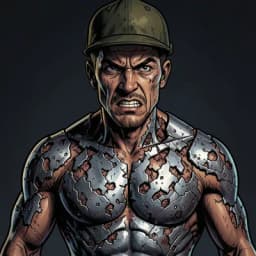
Meet the sample character
The evolution of your DNA is a death sentence in a city that fears what it cannot cage.
Try a scene · No signup
Iron Under the Skin
A short sample of this world. Your own version starts with your character.
You press your back against the cold, wet subway tile. Your left forearm ripples, the skin splitting to reveal a jagged, chrome-like lattice underneath. It pulses with a heat that has nothing to do with your fever. Every breath tastes like copper and burnt plastic. You have three minutes before the heavy boots echoing down the tunnel reach this alcove.

“I know you're down there, Mateo. You can't outrun the biology that is already killing you.”

Outside, the rain hammers against the street grates, a rhythmic thrum that masks your ragged breathing. Your vision blurs, and for a split second, the world fragments into heat signatures—every moving thing is a potential target. The metallic plate on your arm expands, grinding against your wrist bone with a sickening, wet crunch.
“I am not a disease, Vance, and I am finished hiding in the trash to prove it.”
The shadows shift as Vance turns the corner, his tactical light slicing through the gloom like a scalpel. He is not holding a stun baton; he carries a stabilization collar designed to lock your cells in place—or shut them down permanently. The metal on your arm cries out to be set loose, vibrating with a frequency that makes the overhead lights shatter. You have one heartbeat to act.
Vance is closing the distance; how do you react to the encroaching threat?
Your character. Your next move.
The City Is Watching. Will You Reveal Yourself?
Your pulse is quickening, and the air around you is starting to warp. The authorities are closing in, and they know you are different. Every second you hesitate is a second they get closer to containing you. Will you stand your ground and show them the true extent of your evolution, or will you vanish into the night? Your biology is a ticking clock.
Claim Your Power NowYour Story, Your Way
Everything is customizable. Pick any genre, setting, or character — the AI builds a world around exactly what you want.
Any Character
Design your appearance, personality, backstory — every detail
Any World
Fantasy kingdoms, sci-fi stations, modern cities — you choose
Branching Paths
No two playthroughs are the same. Your choices reshape everything
Full Immersion
AI images, voice acting, sound effects — a living story
Decide whether to embrace your mutation as a gift or suppress it as a curse.
Manage the physical toll your powers take on your health during intense combat encounters.
Choose which faction of the superhuman resistance to support based on their radical ideologies.
The mirror shows a stranger. Yesterday, your hands were steady; today, they hum with a frequency that shatters glass. You scrub the bathroom floor, trying to hide the jagged, iridescent scales blooming along your forearm before your roommate walks in. Fear tastes like copper in your mouth, a sharp reminder that the authorities track every biological anomaly in the city. You are not sick, and you are not dying, but the changes in your marrow suggest you are no longer strictly human. Every decision you make—whether to reveal your shift or bury it—ripples outward, forcing you to live as an anomaly in a society that hunts what it cannot understand. Your choices dictate whether you become the hero this crumbling skyline needs or the catalyst for the extinction of your own kind.
What is Genetic Mutation in Superhero Fiction?
Genetic mutation as a narrative trope focuses on the biological other. It is the story of the outsider who suddenly discovers their body is the site of a radical, unauthorized update. Unlike heroes who gain powers through accidents or technology, the mutant hero carries the burden of their origin in their very cells. It is an internal conflict that manifests externally. Consider the X-Men by Marvel Comics; the entire premise hinges on the divide between those who accept their mutation as the next step in human progress and those who view it as a terrifying aberration. The core of this trope is not just the power itself—the ability to project energy or shift bone structure—but the social isolation that follows. You are the anomaly in the room. When your biology becomes a target, the question shifts from what you can do to who you trust with the truth. This trope resonates because it mirrors the human experience of feeling different, amplified by the high-stakes reality of having the power to level a city block.
Why play Genetic Mutation as an interactive story?
Playing as a mutant requires more than just managing a power meter; it forces a constant negotiation between your humanity and your emerging biology. You face choices that test your moral compass. Do you use your new, volatile abilities to save the people who fear you, or do you retreat into the shadows to protect your own life? You will encounter moments where your physiology reacts to stress, forcing you to choose between control and catastrophe. Perhaps a city official is questioning your history, and your heart rate is spiking—do you lie and risk exposure, or do you use your power to influence their perception? These decisions are about defining your legacy in a world that wants you erased.
Famous examples of Genetic Mutation in books, film, and games
The genetic mutation trope serves as a lens for societal anxiety. In Akira by Katsuhiro Otomo, the mutation of Tetsuo is not a gift; it is a grotesque, all-consuming force that mirrors the trauma and corruption of Neo-Tokyo. His body swells and mutates as he loses control, showing how biological evolution without moral grounding leads to total destruction. Contrast this with the approach in the Infamous video game series, where Cole MacGrath’s conduit powers are a result of a biological trigger. His journey is defined by the choice between heroism and infamy. The public's perception of him changes based on his actions, highlighting how being a mutant is as much about reputation as it is about ability. In the novel Wild Cards edited by George R.R. Martin, the virus causes a spectrum of mutations, where the Aces get incredible powers and the Jokers suffer debilitating physical changes. This highlights the lottery aspect of mutation—it is an unpredictable, often unfair process. The trope endures because it forces characters to confront their own nature. It asks if you are defined by your blood or by your choices.
FAQ
What makes a mutant hero different from other superheroes?
Mutant heroes derive their abilities from biological shifts rather than external accidents or technology. This makes the power an intrinsic, often permanent part of their identity that they cannot simply turn off or leave behind.
How do my choices impact my mutation in this story?
Your choices determine your level of control, how the public perceives your abilities, and whether your mutation stabilizes or evolves into something more dangerous.
Is this story game for fans of superhero comics?
Yes, it is designed for those who enjoy the classic themes of identity, social stigma, and the struggle to do the right thing when the world is against you.
Can I hide my powers from the world?
Yes, secrecy is a major gameplay mechanic, though staying hidden comes with its own set of risks, social consequences, and narrative challenges.
Explore more Superhero stories like Origin Story, Secret Identity Crisis, Sidekick Rising.
More Superhero Stories
Origin Story
The accident, the experiment, the cosmic event that changes everything — your origin story begins now. Make the choices that define what kind of hero you become when extraordinary power lands in ordinary hands.
TropeSecret Identity Crisis
The mask protects the people you love, but it is destroying the life you live. Juggle a double existence where every close call threatens to expose who you really are beneath the costume.
TropeSidekick Rising
You have been the sidekick long enough. When your mentor falls, the city turns to you — the one everyone underestimated. Prove that the student has surpassed the teacher in this rise-to-greatness superhero story.
TropeVillain Redemption Arc
You were the villain, but a crisis forces you to fight alongside the heroes you once terrorized. Earn redemption through impossible choices where every good deed is met with suspicion and your dark past keeps pulling you back.
TropeTeam Assembly
A threat too massive for any single hero requires assembling a team of extraordinary individuals who can barely stand each other. Recruit, negotiate, and unite a dysfunctional squad before the world ends.
TropePower Loss
Your powers vanish at the worst possible moment, leaving you terrifyingly human in a world that still needs saving. Discover what kind of hero you are when the superpowers are stripped away and all you have left is your will.