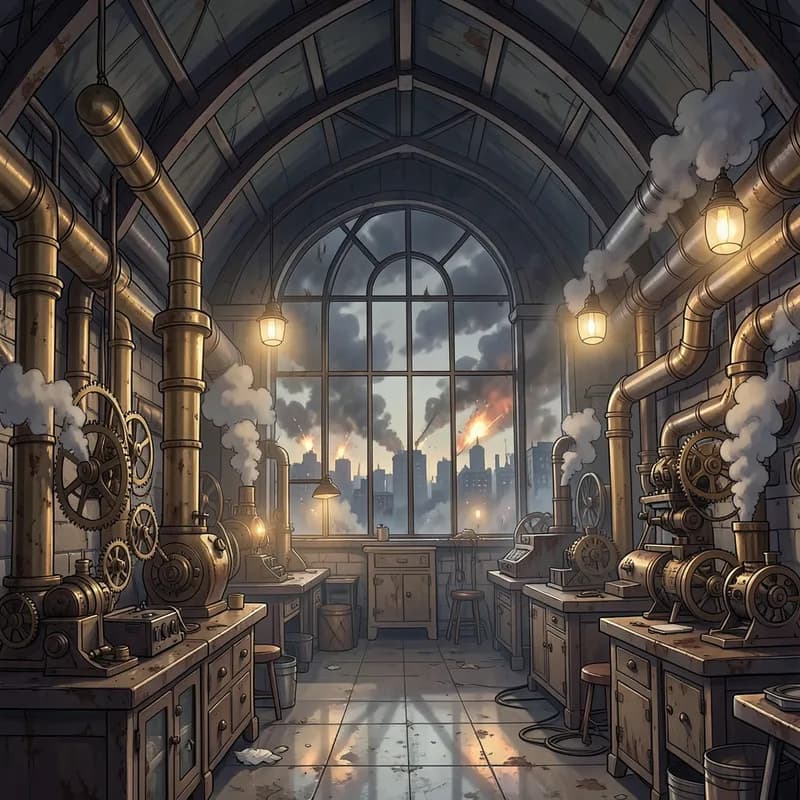
Steampunk · Interactive story
The Royal Engineering Corps: Gears of the Empire
Your blueprints decide the fate of nations; your conscience decides if they survive.
Start as a guest. Choose your character before the story begins.

Meet the sample character
The Queen's brass demands a heavy price in blood.
Try a scene · No signup
The Gear-Grinder's Debt
A short sample of this world. Your own version starts with your character.
Your palms are slick with engine oil and cold sweat. Before you sits the Ordnance Harvester, a hulking beast of brass and hydraulic pistons, its primary drill bit gleaming under the flickering gaslight. You tightened the final pressure bolt minutes ago, believing this machine would serve as a clearing tool for the war-torn borderlands.
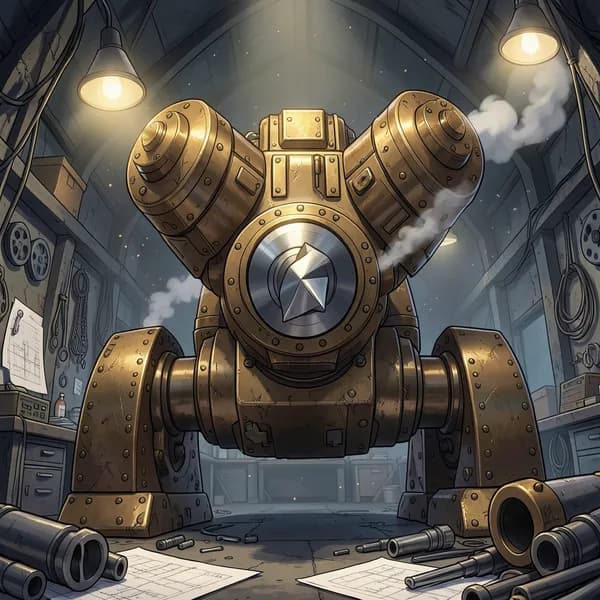
“The Queen has authorized the deployment, Vane. Have the Harvester ready for the morning march, or someone else will be tasked with the cleanup.”

Halloway doesn't meet your eyes, his gaze fixed on the map spread across the workbench. You notice a series of marked coordinates in the civilian quarter, far from any military fortification. The realization hits you like a piston strike: this machine isn't designed to move rubble, but to pulverize the city's foundation beneath the feet of the working class.
“These coordinates are wrong, Major. The Harvester is built for rock and iron, not the densely packed tenements of the East District.”
Halloway stops his pacing, his hand resting heavy on the hilt of his service saber. The steam vents hiss rhythmically in the silence, mimicking the thumping of your own heart. He turns, his shadow stretching long across the floor as he waits for you to either confirm the machine's readiness or defy a direct order from the Royal Corps.
How do you respond to the Major's demand?
Your character. Your next move.
Will you build the future or break it?
The Queen’s prototype is nearly finished. The final pressure valve waits for your command. Will you complete the weapon as ordered, or will you introduce a flaw that changes the course of the war forever? Your blueprints are ready.
Begin your engineering commissionYour Story, Your Way
Everything is customizable. Pick any genre, setting, or character — the AI builds a world around exactly what you want.
Any Character
Design your appearance, personality, backstory — every detail
Any World
Fantasy kingdoms, sci-fi stations, modern cities — you choose
Branching Paths
No two playthroughs are the same. Your choices reshape everything
Full Immersion
AI images, voice acting, sound effects — a living story
Infiltrate the secret archives to discover the true purpose of the Crown’s new prototypes.
Choose between upgrading your automatons for speed or stripping them down for stealth missions.
Navigate tense briefings with high-ranking officers who suspect your loyalty is beginning to falter.
Decide whether to leak your schematics to rebels or lock them away for the Queen.
The soot of the London docks clings to your coat, but the oil on your hands is harder to scrub away. You are a Chief Artificer for the Crown, responsible for the terrifying automatons that march across the border into the fog-drenched wastes. Your latest creation, the Mark IV Steam-Walker, is a marvel of kinetic potential and hydraulic precision. Yet, as you tighten the final pressure valve, a dispatch arrives from the front. It details not a tactical victory, but the razing of a village that held no soldiers. Every choice you make in these cramped workshops and blood-stained trenches ripples outward, forcing you to balance your duty to the Queen against the weight of the lives your inventions claim. In this interactive narrative, your moral compass is just as vital as your slide rule, and the consequences of your engineering prowess are rarely clean.
What is the Royal Engineering Corps in Steampunk?
The Royal Engineering Corps trope centers on the tension between state-sponsored progress and the human cost of innovation. It places the protagonist at the intersection of high-minded Victorian ingenuity and the brutal reality of industrial warfare. Unlike the classic 'mad scientist' working in isolation, the Royal Engineer is a cog in a massive, bureaucratic machine. They are tasked with turning steam, brass, and clockwork into weapons of mass destruction, often under the guise of national security or colonial expansion. Think of the State Alchemists in Hiromu Arakawa’s 'Fullmetal Alchemist'—they possess immense power sanctioned by the government, but they are constantly forced to question whether their research serves the people or merely fuels a corrupt military apparatus. This trope relies on the 'technological sublime,' where the awe of a giant, coal-burning machine is undercut by the realization that it was designed to crush, not to build. It explores the moral compromise of the intellectual elite: when the state provides the funding and the raw materials, it also claims ownership of the soul behind the blueprints.
Why play Royal Engineering Corps as an interactive story?
Playing as a Royal Engineer forces you to treat your narrative choices like engineering constraints. You are not just choosing dialogue; you are deciding how to allocate limited resources, which tactical weaknesses to leave in your designs, and whether to report your findings to your superiors or the underground resistance. If you build a more efficient cooling system for an airship, does that make it a better vessel for transport, or a deadlier bomber for the front lines? You will face moments where you must decide whether to sabotage your own work during the final assembly or watch as your creation is deployed to destroy everything you hold dear. The tension comes from your dual role: you are the only one who truly understands the machines, which makes you the only one capable of stopping them. Every gear you turn and every wire you connect carries the weight of history.
Famous examples of Royal Engineering Corps in books, film, and games
The archetype of the government-sanctioned engineer appears throughout speculative fiction, each iteration highlighting a different facet of the trope. In William Gibson and Bruce Sterling’s 'The Difference Engine,' the focus is on the radical societal shift caused by the early adoption of mechanical computing. Sybil Gerard’s struggle against the technological establishment mirrors the internal conflict of an engineer realizing their tools are being used to cement a rigid, authoritarian hierarchy. Similarly, the 'Iron Harvest' video game franchise presents a world where diesel-powered mechs have become the standard for warfare, forcing engineers to contend with the aftermath of a war that has turned their inventions into rusted monuments of death. These stories succeed because they treat technology not as magic, but as a political tool. Whether it is the clockwork soldiers of a fantasy realm or the steam-powered tanks of a fictionalized 1920s, the Royal Engineering Corps trope endures because it speaks to a modern anxiety: the fear that the things we create to make life easier are eventually used to make death more efficient. It is a narrative about ownership, agency, and the terrifying realization that you are the primary architect of your own undoing.
FAQ
What is the core conflict for a Royal Engineer character?
The core conflict is the struggle between professional pride and moral integrity. You want to build the most efficient, ingenious machines possible, but you must constantly reconcile that ambition with the fact that these machines are being used to cause suffering and maintain a status quo you may not agree with.
Can I choose to defect from the Crown?
Yes. Your choices throughout the story determine your loyalty. You can choose to be a loyal servant, a quiet saboteur, or an outright defector who uses their knowledge of the Empire's technology to dismantle it from the outside.
How does the engineering aspect impact gameplay?
You will manage resources, blueprints, and technical specifications. Your choices regarding how you build your machines—such as adding backdoors for future sabotage or optimizing them for efficiency—will directly affect the outcomes of military engagements later in the story.
Is this suitable for fans of historical fiction?
Absolutely. While the technology is speculative, the setting is deeply rooted in Victorian-era aesthetics, social hierarchies, and the real-world industrial progress of the 19th century. If you enjoy period-accurate detail combined with a 'what if' scenario, this will resonate.
Explore more Steampunk stories like Airship Adventure, Clockwork Conspiracy, Steam-Powered Invention.
More Steampunk Stories
Airship Adventure
The clouds part around your airship as you chart a course into the unknown. You navigate treacherous skies, rival captains, and storms that could tear brass from bone in this high-altitude adventure.
TropeClockwork Conspiracy
Behind the ticking gears and polished brass of the city lies a conspiracy that reaches the highest levels of power. You must unravel the clockwork plot before its final mechanism clicks into place.
TropeSteam-Powered Invention
You have built something that will change the world—if it does not explode first. Your invention threatens the established order, and powerful people want it destroyed or controlled.
TropeVictorian Mad Science
The boundaries of science were meant to be pushed, not shattered. You pursue experiments that polite society calls madness, but your results are undeniable—and increasingly dangerous.
TropeAutomaton Uprising
The mechanical servants that power civilization have begun to think for themselves. You are caught between a society that depends on automaton labor and machines demanding the right to exist.
TropeAether Discovery
You have discovered aether—a mysterious energy source that defies every known law of physics. Nations will go to war for it, and the substance itself seems to have a will of its own.