
Sports Drama · Interactive story
The Sand Demands Blood: A Roman Gladiator Story
One strike defines your legacy. Will you win the crowd or die in the dust?
Start as a guest. Choose your character before the story begins.
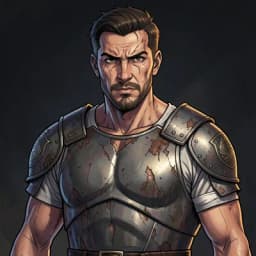
Meet the sample character
The crowd demands a spectacle, but the gods demand a sacrifice.
Try a scene · No signup
Blood for the Sand
A short sample of this world. Your own version starts with your character.
You stand in the shadow of the Colosseum’s outer wall. The smell of wet sand and metallic blood hangs thick in the air, heavy with the humidity of a Roman summer. Your lungs burn from a morning of grueling practice against rusted wooden dummies.

“You fight like a man who expects to die, Valerius. If you want the crowd's favor, you must give them a reason to cheer, not just a reason to pity.”

The weight of the short sword in your calloused hand feels like lead. You think of the silver signet ring hidden beneath your bandage—a mark of the treason that brought you here. Every swing is a gamble against the past.
“I don't need their cheers to survive the sand, Decimus. I only need my steel to stay sharper than my opponent's.”
The gates groan open, revealing the blinding, harsh glare of the arena floor. Thousands of voices roar like a gathering storm, a wall of sound that threatens to crush your resolve. A massive, scarred opponent steps into the light, blocking your exit and raising a heavy gladius. You have one heartbeat to decide your opening gambit before the match turns lethal.
The giant looms before you, his blade steady. How will you initiate the duel?
Your character. Your next move.
The crowd is waiting. Will you fight?
The iron gates are already opening. Your next choice could be the difference between becoming a legend of the arena or forgotten dust on the floor. Take your place in the sand and decide your fate now.
Step Into The ArenaYour Story, Your Way
Everything is customizable. Pick any genre, setting, or character — the AI builds a world around exactly what you want.
Any Character
Design your appearance, personality, backstory — every detail
Any World
Fantasy kingdoms, sci-fi stations, modern cities — you choose
Branching Paths
No two playthroughs are the same. Your choices reshape everything
Full Immersion
AI images, voice acting, sound effects — a living story
Manage your reputation with the crowd to influence the Emperor’s final verdict.
Choose between training for brute strength or tactical finesse before the big match.
Decide whether to spare or execute defeated rivals to alter your social standing.
Navigate political backroom deals with wealthy patrons to secure superior equipment.
The scent of copper and sweat hangs heavy in the air as the heavy iron gates groan open. Sunlight blinds you for a heartbeat before the roar of fifty thousand spectators hits your chest like a physical blow. You grip the hilt of your gladius, your knuckles white, feeling the uneven grit of the sand beneath your sandals. Across the arena, a hulking opponent circles, eyes fixed on your throat. You have seconds to decide: do you lunge with reckless aggression to earn the crowd’s immediate favor, or do you play a defensive game, waiting for a mistake that might never come? Every movement you make, from the way you parry a blade to the way you bow before the Emperor’s box, determines whether you leave this arena in glory or as a corpse dragged out by the hook. This is a life defined by the next heartbeat.
What is a Roman Gladiator in Sports Drama?
In the context of high-stakes sports drama, the Roman gladiator represents the ultimate test of human endurance, skill, and political maneuvering. Unlike modern athletes who compete for trophies, the gladiator competes for the right to see another sunrise. The archetype is defined by the tension between the physical brutality of the combat and the psychological pressure of the spectator. Historically, this archetype was popularized through works like Howard Fast’s novel 'Spartacus' and Ridley Scott’s 2000 epic film 'Gladiator'. These stories focus on the athlete as a tool of the state, a man or woman whose performance is scrutinized by an fickle, bloodthirsty audience. Whether you are a slave fighting for freedom or a disgraced soldier seeking redemption, the core of the gladiator story is the demand for excellence under the threat of total annihilation. It is a sport where the scoreboard is literal: survive, or cease to be.
Why play a Roman Gladiator as an interactive story?
Playing as a gladiator shifts the focus from simple combat to the management of reputation and risk. You are not just fighting; you are performing. Your choices dictate your path through the ludus, the training grounds of Rome. Do you spend your limited energy training with the veterans to improve your technique, or do you spend your evenings curating favor with local politicians to secure better armor? The tension arises when your athletic goals clash with your survival. Choosing to spare a fallen rival might earn you the cheers of the crowd, but it might also anger the betting syndicates who wanted a kill. Every match is a cascading series of decisions: how you taunt your enemy, which weapon you select for the specific terrain of the day, and how you react when the Emperor turns his thumb down. Your agency turns a static historical setting into a kinetic, high-pressure arena where one wrong step ends your career permanently.
The literary legacy of the Roman Gladiator
The gladiator has occupied a central place in the cultural imagination since the fall of the Republic. From the historical accounts of the Colosseum to the sensationalized portrayals in modern cinema, the figure of the fighter in the sand remains a powerful symbol of defiance against impossible odds. The original archetype, often rooted in the real-life insurrection of Spartacus, has evolved into a versatile vehicle for exploring themes of class struggle, personal integrity, and institutional violence. In the 1951 film 'Quo Vadis', the gladiator Marcus serves as a pivot point for the protagonist's internal conflict regarding duty and faith. Similarly, the series 'Those About to Die' highlights the complex intersection of sports, gambling, and imperial politics that defined the games. These adaptations show that the gladiator is more than a warrior; they are a mirror held up to society's darker impulses. Today, the fascination persists because the stakes remain relatable: when the world demands you perform, how much of yourself are you willing to sacrifice to stay on the stage? This interactive experience brings that pressure into the modern era, forcing you to balance the demands of your masters against your own desire for freedom.
FAQ
How does the crowd favor mechanic affect my survival?
The crowd acts as a secondary character in your story. If you fight with flair and engage the audience, you may earn their favor. This can lead to the Emperor granting you mercy even if you lose a match, or providing you with better resources for your next fight. Ignoring the audience might lead to a technically perfect victory that leaves you without supporters in the political arena.
Can I win my freedom in this gladiator choose your own adventure?
Freedom is the ultimate goal, but it is rarely given easily. You must accumulate enough influence, wealth, or favor to buy your way out of the ludus or win the support of powerful patrons who can grant you your wooden sword. Every decision you make brings you closer to the arena floor or to your liberation.
What is the difference between training and fighting?
Training is where you manage your health, relationships, and stats. You choose your mentors and your focus. Fighting is the high-stakes execution of those choices. During a match, your stats influence your success, but the tactical choices you make under pressure determine the outcome of the fight itself.
Is this game suitable for those who love historical accuracy?
The narrative draws heavily from historical context regarding the training schools and the politics of the Roman games. While the story is an interactive drama, the details of the gladiator life—the diet, the weaponry, and the social hierarchy of Rome—are grounded in the realities of the period to ensure an authentic experience.
Explore more Sports Drama stories like Underdog Comeback, Rivalry Match, Injury Recovery.
More Sports Drama Stories
Underdog Comeback
Nobody believes you can win. The odds are impossible, the critics are loud, and the clock is ticking. Prove them all wrong in an interactive story where heart matters more than talent.
TropeRivalry Match
This is not just a game. It is personal. Face your greatest rival in a showdown where pride, history, and legacy are on the line with every play.
TropeInjury Recovery
Your body broke but your spirit did not. Fight through grueling rehabilitation, self-doubt, and the fear that you may never compete again in this deeply personal sports journey.
TropeTournament Arc
The bracket is set and every match raises the stakes. Battle through rounds of increasingly dangerous opponents as the championship draws closer and the pressure becomes unbearable.
TropeTeam Captain Pressure
The armband is yours and so is every expectation that comes with it. Lead your team through crisis, conflict, and competition while carrying the weight of being the one everyone looks to.
TropeTransfer Drama
A new team wants you but leaving means betraying everything you built. Navigate agents, contracts, and loyalty in a high-stakes saga where your career hangs on one decision.