
Sports Drama · Interactive story
When the Whistle Blows: Surviving the Coaching Conflict
Every drop of sweat is judged. Every mistake is a permanent stain on your record.
Start as a guest. Choose your character before the story begins.

Meet the sample character
Try a scene · No signup
Bone and Breath
A short sample of this world. Your own version starts with your character.
The scent of floor wax and stale sweat clings to your lungs. Coach Vance looms over the center of the mat, his face a map of jagged, red-veined fury. He isn’t here to develop talent; he is here to prune the weak from the vine. Your shoulder throbs, a dull white heat that radiates down to your fingertips, but you know better than to wince in his presence.

“You’re moving like a rusted hinge, Tanaka. If you aren't going to give me 110 percent, get off my mat and let someone with a pulse take your spot.”
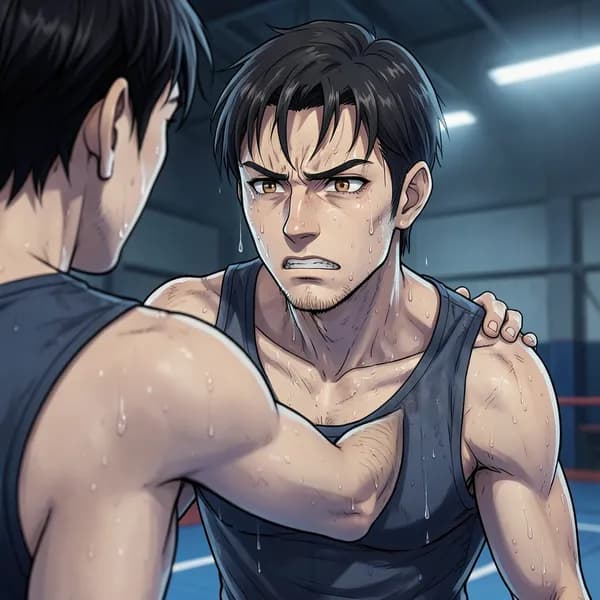
You taste copper in your mouth. The weight of your tuition, your family’s expectations, and the looming state championships press down on your chest, heavier than any opponent. You glance at the clock; there are three minutes left in the practice session, and Vance is holding the whistle like a weapon.
“I can finish the session, Coach. Just give me a second to reset my grip.”
Vance doesn't care about your grip or the popping sound echoing in your rotator cuff. He tosses a heavy medicine ball toward your feet, his eyes narrowing into cold slits. He signals for your sparring partner to move in, an aggressive bruiser who has been looking for any excuse to take your head off. You have seconds to decide how you will survive this drill.
How do you handle your sparring partner and the coach's watchful eyes?
Your character. Your next move.
The Championship Ring or Your Own Soul?
The coach is calling for a play you know will lead to disaster. The crowd is screaming, the clock is ticking down, and your future in the league hangs in the balance. Do you execute the command, or do you take control of your own destiny? Your career begins now.
Prove Them WrongYour Story, Your Way
Everything is customizable. Pick any genre, setting, or character — the AI builds a world around exactly what you want.
Any Character
Design your appearance, personality, backstory — every detail
Any World
Fantasy kingdoms, sci-fi stations, modern cities — you choose
Branching Paths
No two playthroughs are the same. Your choices reshape everything
Full Immersion
AI images, voice acting, sound effects — a living story
Choose to endure grueling extra sessions to gain the coach’s begrudging respect.
Decide whether to report a secret injury or hide it to maintain your starting spot.
Pivot your training strategy to defy the coach’s rigid, outdated playbooks.
Manage team morale while deciding whether to back your mentor or your teammates.
The locker room air is thick with the smell of stale tape and ozone. Coach Hideo stares at you, his eyes cold as glass, pointing to the scoreboard. You missed the game-winning play by three inches. He ignores your exhaustion and the bruised ribs you have been hiding for a week. He wants perfection, or he wants you off the roster. In this interactive story, your choices on and off the field determine your path. Will you swallow your pride and accept the grueling extra drills, or will you stand your ground and risk your spot on the starting lineup? The choice is yours, but the consequences are etched in the record books. You control the dialogue and the training regimen, deciding whether to be the obedient protégé or the defiant star who carves their own way to the podium.
What is Coaching Conflict in Sports Drama?
Coaching conflict defines the friction between an athlete’s individual potential and an authority figure’s rigid expectations. It is the crucible where talent is either forged into greatness or crushed under the weight of unrealistic demands. In sports narratives, this is not just about shouting matches; it is about the fundamental disagreement over what victory costs. Consider the film Whiplash, where the boundary between mentorship and abuse blurs entirely. The coach demands absolute subservience, forcing the protagonist to sacrifice their mental health for a shred of approval. This trope functions because it mirrors real-world power dynamics in high-stakes athletics. When the person holding the key to your success becomes your greatest obstacle, the tension becomes a physical presence. It turns the sport itself into a secondary concern, shifting the focus to the psychological battle happening in the film room, the practice gym, or the private office. The conflict forces the athlete to define their own worth outside of the coach’s validation, a theme that resonates across all competitive mediums.
Why play Coaching Conflict as an interactive story?
Agency changes everything. In a static story, you watch a character suffer under a tyrant. Here, you are the one deciding whether to push through the agony or challenge the authority. You might choose to stay late for extra reps, earning a momentary nod of approval, or you could skip a mandatory practice to address a personal injury, risking the coach’s wrath. Every decision ripples through the team’s morale and your own stamina stats. You will face moments where the coach demands you play through a concussion or sacrifice a teammate to secure a win. Do you prioritize the scoreboard or your integrity? The tension is heightened because the coach is not just a boss; they are the gatekeeper to your dreams. You have to decide if the cost of the championship is worth the price of your soul.
Famous examples of Coaching Conflict in books, film, and games
The coaching conflict trope has evolved from simple gruff mentor archetypes to complex studies of obsession. In the manga Haikyu!!, the relationship between Kageyama and his middle school teammates serves as a precursor to the coaching conflict; his demand for perfection alienated his team, forcing him to learn that a coach-like authority without trust leads to ruin. Conversely, in the film Moneyball, the conflict is not just with a person, but with the entire establishment of baseball scouts who refuse to see value in anything but traditional metrics. The general manager must fight a silent, bureaucratic coaching conflict, proving that his methods work despite the constant dismissal from those in power. Then there is Friday Night Lights, where the pressure from the town and the boosters acts as the ultimate coach. The coach must navigate the fine line between being a leader and being a scapegoat for a community that demands perfection. These examples show that the trope endures because it speaks to the universal experience of being judged by someone who holds power over your future. Whether it is a literal coach, a system, or a society, the conflict remains a vital test of character.
FAQ
What is the core of a coaching conflict story?
It is the intense friction between a mentor's high expectations and an athlete's personal limits, often forcing the protagonist to choose between success and self-respect.
Can I choose to defy the coach in these stories?
Yes, every interaction allows you to decide how to respond to authority, which directly shapes your character's trajectory and the team's internal dynamics.
Does the coach always have to be the villain?
Not always. Sometimes the coach is merely a pragmatist pushing for results, and the conflict arises from your own differing philosophies on how to achieve victory.
How do my decisions affect my teammates?
Choices that satisfy the coach might isolate you from the team, creating complex social dynamics that can either strengthen the group or tear it apart from within.
Explore more Sports Drama stories like Underdog Comeback, Rivalry Match, Injury Recovery.
More Sports Drama Stories
Underdog Comeback
Nobody believes you can win. The odds are impossible, the critics are loud, and the clock is ticking. Prove them all wrong in an interactive story where heart matters more than talent.
TropeRivalry Match
This is not just a game. It is personal. Face your greatest rival in a showdown where pride, history, and legacy are on the line with every play.
TropeInjury Recovery
Your body broke but your spirit did not. Fight through grueling rehabilitation, self-doubt, and the fear that you may never compete again in this deeply personal sports journey.
TropeTournament Arc
The bracket is set and every match raises the stakes. Battle through rounds of increasingly dangerous opponents as the championship draws closer and the pressure becomes unbearable.
TropeTeam Captain Pressure
The armband is yours and so is every expectation that comes with it. Lead your team through crisis, conflict, and competition while carrying the weight of being the one everyone looks to.
TropeTransfer Drama
A new team wants you but leaving means betraying everything you built. Navigate agents, contracts, and loyalty in a high-stakes saga where your career hangs on one decision.