
Space Opera · Interactive story
The Navigator: Charting Paths Through the Void
One wrong calculation sends the entire fleet into the heart of a dying sun.
Start as a guest. Choose your character before the story begins.
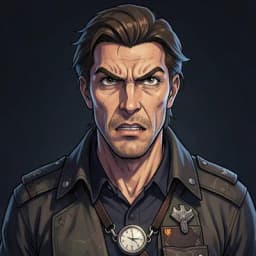
Meet the sample character
When the stars shift, only the navigator survives.
Try a scene · No signup
Vector of the Void
A short sample of this world. Your own version starts with your character.
You stand at the hololith, the cold light of the nebula’s collapse bathing the bridge in a violent violet hue. The Icarus Reach shudders as gravity wells warp the hull, the metal groaning under the pressure of a dying star. You are not just reading sensors; you are feeling the space-time curvature dragging at your nervous system, sensing the jump coordinates flickering between salvation and a permanent end within the singularity.

“The integrity field is down to twelve percent, Kross. If you don't lock that vector in the next ten seconds, we are becoming debris.”

Sweat beads on your brow, blurring your vision as you manipulate the navigation array. The ship’s AI shrieks in binary, protesting the impossible trajectory you are forced to calculate. You see the path—a hair’s breadth between a gravitational shear and a pulsar’s radiation blast. It is a route no sane captain would fly, but your gut insists it is the only way to outrun the approaching shockwave.
“I have the vector, Captain, but it requires threading the needle through the pulsar's flare. We either bank hard into the radiation or we get vaporized by the shockwave.”
Halloway freezes, staring at the telemetry display as the nebula’s core ignites, a blinding white sun expanding to swallow the sector. You feel the ship’s engines whining in sympathy with your own racing pulse. You have to lock the nav-computer now, but the choice of engine burn pattern will determine if you arrive at the fleet’s rendezvous intact or drift as frozen ghosts in the deep black.
Which navigation vector will you commit to before the pulsar flare strikes?
Your character. Your next move.
The fleet awaits your coordinates. Take the helm.
The engines are hot, the fuel is low, and an entire quadrant of uncharted space lies before you. Every jump is a gamble. Every decision could be your last. Will you lead your ship to glory or lose your way in the dark? Take control of the bridge and start your journey through the stars today.
Take the helm nowYour Story, Your Way
Everything is customizable. Pick any genre, setting, or character — the AI builds a world around exactly what you want.
Any Character
Design your appearance, personality, backstory — every detail
Any World
Fantasy kingdoms, sci-fi stations, modern cities — you choose
Branching Paths
No two playthroughs are the same. Your choices reshape everything
Full Immersion
AI images, voice acting, sound effects — a living story
Calculate jump coordinates through unstable nebulae to evade pursuing enemy capital ships.
Choose between saving precious fuel or ensuring the safety of your wounded crew.
Interpret mysterious spatial anomalies that could lead to shortcuts or total destruction.
Manage crew trust as you risk their lives on daring, unverified navigational routes.
The bridge lights dim, leaving only the pulsing blue glow of the star-charts reflecting in your eyes. Beyond the reinforced viewport, the fabric of reality stretches thin, a shimmering veil separating the ship from the crushing vacuum of hyperspace. You are the only one who perceives the shifting currents of the void—the subtle gravity wells and spatial anomalies that would tear any other vessel apart. As you lock the coordinates, the crew holds its breath, waiting for your final command to engage the warp drives. Every decision you make determines whether your ship returns home or vanishes into the dark forever. Your intuition isn't just a talent; it is the thin line between survival and total annihilation. The ship responds to your touch, vibrating with the energy of a thousand stars, waiting for you to define the route. Your choices dictate the fate of every soul on board as you calculate jumps through uncharted sectors, avoid enemy blockade patrols, and manage the volatile fuel levels of a long-range vessel. Whether you choose to risk a shortcut through an asteroid field or play it safe in the outer rim, the responsibility rests entirely on your shoulders.
What is The Navigator in Space Opera?
The Navigator represents the bridge between human ambition and the uncaring vastness of the cosmos. In the genre of space opera, this character archetype is the one who perceives the invisible geography of space. While others focus on combat or politics, the navigator possesses a specialized, often intuitive understanding of hyperspace, wormholes, or drift-lanes. This archetype appears prominently in Frank Herbert’s Dune, where the Spacing Guild Navigators use prescience to guide massive ships safely through the Fold. Similarly, in franchises like Star Trek, the role of the helmsman or navigator is essential, acting as the eyes of the fleet. A navigator often carries a heavy burden: they are the primary source of safety for a crew, yet their unique perspective can lead to isolation. They see what others cannot, making them both indispensable and occasionally feared. Whether they rely on advanced computer arrays or a mystical connection to the cosmos, the navigator is the character who decides where the story goes next—literally.
Why play The Navigator as an interactive story?
Playing as the navigator shifts the focus from simple combat to the tension of high-stakes logistics and environmental hazards. You aren't just reacting to enemies; you are deciding the environment in which those encounters take place. Do you jump into a dense nebula to escape a pursuer, knowing the radiation will damage your life support? Do you trust a strange signal from an uncharted planet because your gut tells you it leads to a shortcut? Each choice forces you to balance efficiency against the safety of your crew. You might have to choose between a fuel-efficient path through hostile territory or a long, safe route that leaves your cargo vulnerable to decay. The agency lies in your ability to read the star charts and weigh the cost of every light-year. You will face moments where the ship’s systems fail and you must rely on manual calculation, or instances where you have to decide if a mission is worth the risk of a blind jump into unknown space.
The psychology of The Navigator: why readers fall for this character
The Navigator archetype taps into the human desire for control over a chaotic universe. They embody the fantasy of being the one person who understands the rules of a dangerous world better than anyone else. This character type creates a unique psychological profile: they are often solitary, burdened by the weight of their duty, and possess a level of expertise that separates them from the rest of the crew. In The Expanse, the pilot's role is a constant reminder of the fragility of the crew's position in the void, where a single mistake results in death. In Mass Effect, the pilot serves as a grounding force, a constant presence that keeps the player tethered to the ship's mission. The navigator represents the intellectual and intuitive power needed to survive in the face of the unknown. They are the gatekeepers of progress. Readers and players gravitate toward this archetype because it offers a sense of agency that is both cerebral and exhilarating. You aren't just a passenger on the journey; you are the one holding the map, the one deciding when to push forward and when to retreat. This archetype activates the desire to be the 'brain' of the operation, the person whose quick thinking and sharp intuition save the day when the odds are stacked against them. It is a position of quiet power, where the most significant battles are fought not with blasters or swords, but with a series of precise, life-altering decisions made in the silence of the bridge.
FAQ
What is the primary role of a navigator in these stories?
The navigator is responsible for plotting safe courses through dangerous space, avoiding hazards like black holes, radiation clouds, and enemy patrols. They are the character who decides the route the ship takes, which often dictates the challenges the crew will face.
How do my choices as a navigator affect the story?
Your choices define the path and the risks. Choosing a dangerous shortcut might get you to your destination faster, but it could lead to ship damage or crew casualties. Every decision changes the narrative trajectory and the resources available to you.
Can I play as a navigator who relies on technology or intuition?
Yes. Depending on the story, your navigator can rely on advanced ship AI and sensor arrays, or a more intuitive, almost supernatural ability to sense the flow of space. The story adapts to your preferred style.
Is this archetype right for me if I prefer strategy over combat?
If you enjoy high-stakes decision-making, resource management, and environmental puzzles, the navigator is perfect for you. You will spend more time calculating risks and managing ship systems than in direct firefights.
Explore more Space Opera stories like Galactic Empire Politics, Starship Captain's Burden, Alien Alliance.
More Space Opera Stories
Galactic Empire Politics
The throne controls a thousand star systems, and every faction wants a piece. You are caught in the web of galactic intrigue where a single vote—or assassination—can reshape the known universe.
TropeStarship Captain's Burden
The crew looks to you for every impossible decision. Command your vessel through hostile space, manage dwindling resources, and bear the weight of lives that depend on your next order.
TropeAlien Alliance
Humanity cannot survive alone against what is coming. Forge alliances with alien species whose customs, biology, and motives are utterly unlike your own—and pray the coalition holds.
TropeSpace Pirate Fleet
You command a ragtag fleet of pirates prowling the shipping lanes between stars. Raid convoys, outrun navy patrols, and build your reputation as the most feared name in the void.
TropeInterstellar War
Entire star systems burn as civilizations clash across light-years. You are on the front lines of a conflict so vast that winning one battle means nothing if you lose the war for survival.
TropeRebellion Against the Empire
The empire's grip is iron, but cracks are forming. Join the rebellion, recruit allies from oppressed worlds, and strike at the heart of a regime that has ruled the galaxy for centuries.