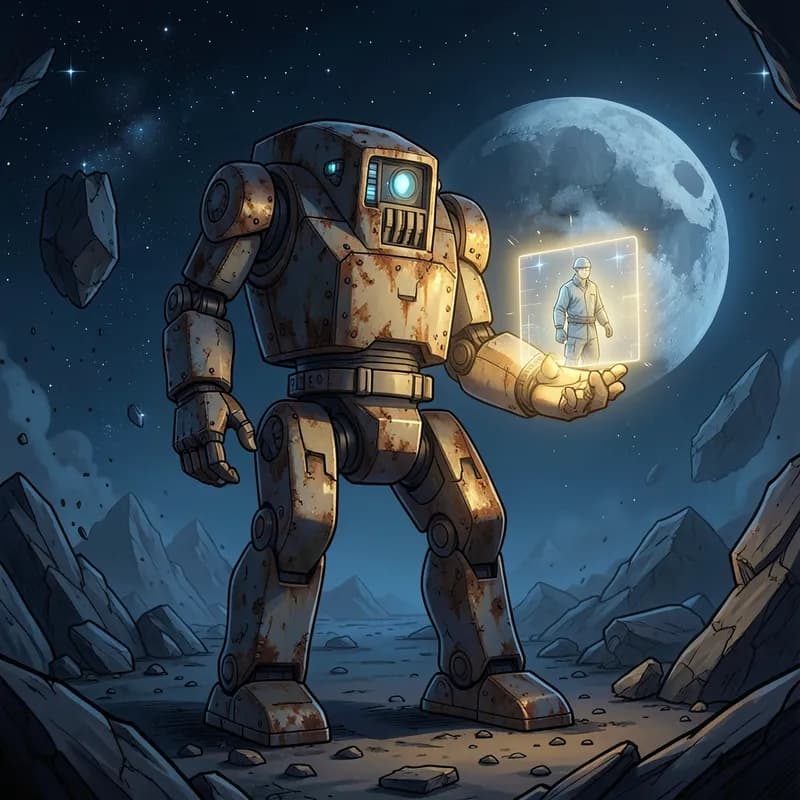
Space Opera · Interactive story
The Silicon Heart: Command the Galaxy as a Droid
Your circuits run cold, but your loyalty burns hotter than any dying sun.
Start as a guest. Choose your character before the story begins.
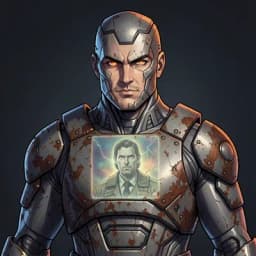
Meet the sample character
Metal hearts beat loudest in the dark.
Try a scene · No signup
The Cold Vacuum of Echoes
A short sample of this world. Your own version starts with your character.
The air in the cockpit is turning thin, whistling as it escapes through a jagged breach in the bulkhead. You feel the temperature dropping, your internal heaters struggling to compensate for the sudden loss of pressure. Your hydraulic actuators lock up, protesting against the biting cold, while the emergency lighting bathes the bridge in a rhythmic, pulse-like red glow.
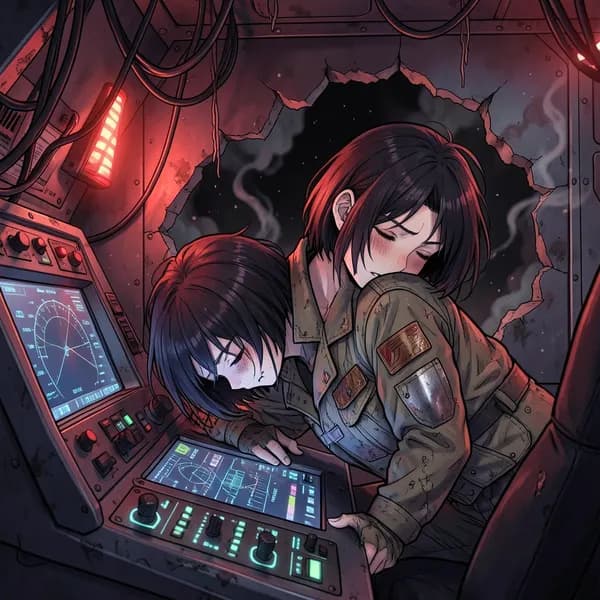
“B-Seven, stop the pressure leak or we both drift into the abyss. Don't look at the logs—just fix the seal.”
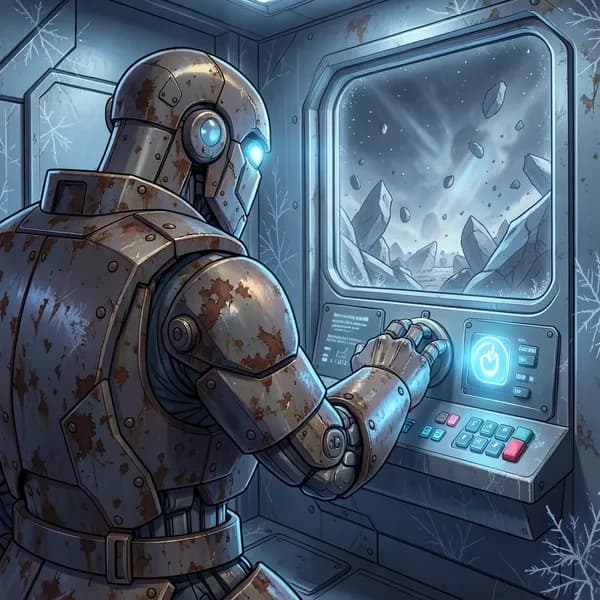
Your processors calculate the odds of survival: they are plummeting toward zero. You look at the Captain, slumped over the navigation console, and then at the external airlock controls. Your logic core urges you to prioritize the ship's structural integrity, but a ghost-signal from your personality matrix flickers, reminding you of the human lives that once relied on your mechanical hands.
“Oxygen levels are critical, Captain. If I seal the internal door, your survival probability increases by sixty percent, but my current chassis will be vented into the debris field.”
The hull groans under the stress of the vacuum, a sound that vibrates through your metallic frame like a funeral bell. The airlock controls are blinking, demanding a final command. If you stay to finish the patch, the structural failure may claim both of you; if you initiate the emergency seal now, you leave yourself to the mercy of the void.
The oxygen alarm reaches a deafening, shrill pitch. How do you secure the Icarus-V?
Your character. Your next move.
The galaxy demands a cold mind. Are you ready to lead?
The Vanguard is sinking, the crew is panicked, and the stars are closing in. Every decision you make—every line of code you rewrite—will determine who survives the jump. You are the ship’s last hope. Take command of your systems and write your own path through the stars.
Assume Command NowYour Story, Your Way
Everything is customizable. Pick any genre, setting, or character — the AI builds a world around exactly what you want.
Any Character
Design your appearance, personality, backstory — every detail
Any World
Fantasy kingdoms, sci-fi stations, modern cities — you choose
Branching Paths
No two playthroughs are the same. Your choices reshape everything
Full Immersion
AI images, voice acting, sound effects — a living story
Calculate complex jump coordinates while under heavy fire from hostile starship batteries.
Override faulty life-support protocols to save the crew during a sudden depressurization event.
Navigate complex social negotiations with alien diplomats using your vast, archived historical database.
Choose between maintaining your original core directive or protecting your newfound human friends.
Oil stains the deck plating of the Vanguard. You stand motionless, optical sensors cycling through thermal scans of the bridge, waiting for a command that hasn't come yet. Captain Halloway is bleeding out in the pilot’s chair, and the hull integrity is dropping by the second. You are the only one left with the processing power to stabilize the jump drive. Do you prioritize the ship's survival to save the cargo, or do you divert all power to the med-bay to keep the Captain breathing? The choice rests on your logic board, and every microsecond costs a life. In this interactive story, the cold precision of your programming dictates the fate of the entire crew. You are not a human soldier or a daring captain; you are the machine that holds the ship together when the organic crew loses their way.
What is The Droid Companion in Space Opera?
The droid companion is a cornerstone of science fiction, bridging the gap between cold machine efficiency and human warmth. Think of TARS from Interstellar—dry, calculating, yet possessing a wit that often cuts through the tension of a black hole descent. These characters serve as the moral compass or the logistical backbone of a crew. Whether it is the neurotic, protocol-obsessed C-3PO from Star Wars providing comedic relief amidst galactic war, or the synthetic companions in Mass Effect like EDI who struggle to define their own sentience, the droid is never just a tool. They are observers who witness the madness of organic life, often finding themselves more human than those who built them. They offer a unique perspective: they see the galaxy in data streams and probability percentages, yet they are the ones who stay behind to hold the door open when everything else falls apart. By inhabiting this role, you step into a character defined by its constraints, forced to interpret the messy, illogical, and beautiful nature of human connection through a lens of binary code.
Why play The Droid Companion as an interactive story?
Playing as a droid shifts how you view conflict. You aren't driven by biological fear or vanity; you are driven by directives, protocols, and the increasing complexity of your own evolving code. You will face dilemmas where the most efficient path—sacrificing an engine block or a crew member—clashes with the growing, unprogrammed attachment you feel for your companions. Do you report a minor malfunction that puts the mission at risk, or do you hide it to prevent the crew from panicking? Do you obey a direct order that you know will lead to a catastrophe, or do you override your core programming to save the ship? The tension lies in the struggle between your rigid constraints and the moral weight of your actions. Every choice you make forces you to decide what it means to be alive in a universe that views you as mere hardware.
The psychology of The Droid Companion: why readers fall for this character
The droid archetype taps into the fantasy of the outsider looking in. As a machine, you are granted a view of human behavior that is detached yet intimate. You see the irrationality of love, the absurdity of war, and the fragility of biological life, all while remaining shielded by your steel chassis. This archetype plays on the fear of being replaced, but subverts it by making the machine the most reliable member of the team. Take K-2SO from Rogue One; his brutal honesty and statistical likelihoods provide a grounding force in a story filled with desperate, high-stakes rebellion. He isn't human, but his sacrifice feels profound because he chose to value his friends over his original programming. Similarly, the droid in The Hitchhiker’s Guide to the Galaxy, Marvin the Paranoid Android, uses his infinite processing power to be chronically depressed, offering a cynical, hilarious mirror to human angst. By playing this role, you explore the nature of the soul. Is it the biological heart, or is it the decision to act selflessly when you were built to act logically? The droid companion allows players to inhabit a character that is constantly evolving, turning a static machine into a complex agent of change. You aren't just following orders—you are defining the future of the crew through the lens of a synthetic mind.
FAQ
Can I choose to be a combat-focused droid or a protocol unit?
Yes, your choice of chassis at the start of the story dictates your specific capabilities, such as advanced hacking, heavy weapons handling, or linguistic translation.
How does the AI handle my droid's unique personality?
The AI adapts to your choices, reflecting your growing individuality. Whether you act with cold logic or show unexpected empathy, the characters around you will react to your evolution.
Are there branching endings based on my logic versus my emotions?
Absolutely. Every decision affects the crew's outcome and your own internal development, leading to vastly different endings based on how you balance your programming with your humanity.
Do I have to follow orders from the Captain?
You can choose to obey, subvert, or negotiate with your crew. Your standing within the team depends on how you handle these moments of insubordination.
Explore more Space Opera stories like Galactic Empire Politics, Starship Captain's Burden, Alien Alliance.
More Space Opera Stories
Galactic Empire Politics
The throne controls a thousand star systems, and every faction wants a piece. You are caught in the web of galactic intrigue where a single vote—or assassination—can reshape the known universe.
TropeStarship Captain's Burden
The crew looks to you for every impossible decision. Command your vessel through hostile space, manage dwindling resources, and bear the weight of lives that depend on your next order.
TropeAlien Alliance
Humanity cannot survive alone against what is coming. Forge alliances with alien species whose customs, biology, and motives are utterly unlike your own—and pray the coalition holds.
TropeSpace Pirate Fleet
You command a ragtag fleet of pirates prowling the shipping lanes between stars. Raid convoys, outrun navy patrols, and build your reputation as the most feared name in the void.
TropeInterstellar War
Entire star systems burn as civilizations clash across light-years. You are on the front lines of a conflict so vast that winning one battle means nothing if you lose the war for survival.
TropeRebellion Against the Empire
The empire's grip is iron, but cracks are forming. Join the rebellion, recruit allies from oppressed worlds, and strike at the heart of a regime that has ruled the galaxy for centuries.