
Regency Romance · Interactive story
Stranded at the Coaching Inn
One broken wheel, a torrential downpour, and a stranger who knows too much.
Start as a guest. Choose your character before the story begins.

Meet the sample character
A storm, a single room, and the ruin of your reputation.
Try a scene · No signup
Mud on the Hem, Fire in the Hearth
A short sample of this world. Your own version starts with your character.
The wind howls through the gaps in the floorboards at The Rusty Spur, forcing you closer to the fire. You clasp your tea, the porcelain biting into your gloved fingers. Across the hearth, the man who arrived on the same stalled coach watches you with an unsettling, steady focus. He has not spoken for an hour, yet his presence fills the small room like a static charge.
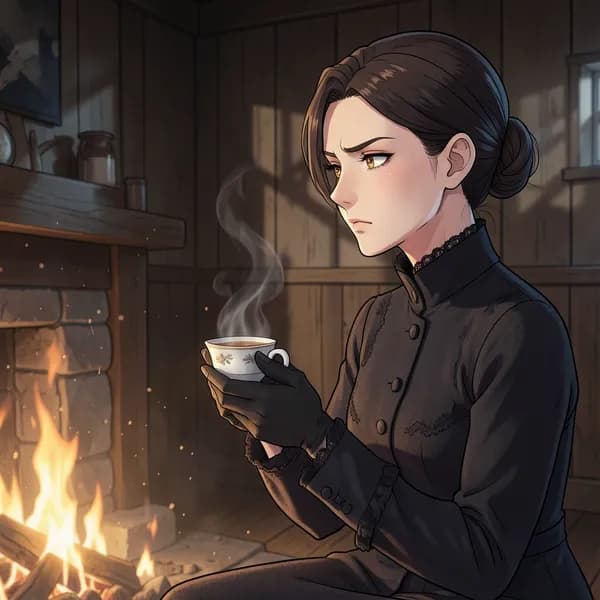
“Surely, Miss Finch, you do not intend to spend the entire night staring into the flames as if they hold the answers to your inevitable scandal.”

The heat rises in your cheeks, less from the fire and more from his observation. Your secret—the reason you are traveling alone toward the border—feels fragile under his sharp gaze. You shift, the silk of your skirts whispering against the rough wood, acutely aware that the innkeeper has only one guest room left, and the roof is leaking in every other corner of the house.
“My plans are my own affair, Mr. Vane. And I find the flames far more predictable than the company forced upon me by this deluge.”
He rises, the movement fluid and predatory, and crosses the floor until he stands barely a foot away. The innkeeper enters, clutching a single iron key and looking between the two of you with a knowing, weary smirk. You realize you have a choice: maintain the pretense of propriety, or accept the dangerous proximity offered by the storm.
The innkeeper holds the key to the only dry room; how do you handle this forced intimacy?
Your character. Your next move.
The Storm is Rising. Will You Stay?
The carriage is disabled, the rain is unforgiving, and the gentleman in the corner is waiting for your next move. Will you share the fire or keep your distance? Every word you speak tonight could change your future. Step into the parlor and see where the night takes you.
Enter the InnYour Story, Your Way
Everything is customizable. Pick any genre, setting, or character — the AI builds a world around exactly what you want.
Any Character
Design your appearance, personality, backstory — every detail
Any World
Fantasy kingdoms, sci-fi stations, modern cities — you choose
Branching Paths
No two playthroughs are the same. Your choices reshape everything
Full Immersion
AI images, voice acting, sound effects — a living story
Decide whether to maintain social propriety or lean into the dangerous, quiet intimacy.
Choose how much of your personal history to reveal to a complete stranger.
Manage the risk of being discovered by other travelers arriving at the inn.
Navigate subtle dialogue options that either encourage or discourage the gentleman's romantic advances.
The mud-splattered carriage wheel groaned, then snapped, leaving you shivering in the relentless English rain. Before you looms The King’s Head, a drafty coaching inn offering little more than a dying fire and a single, private parlor. Inside, a gentleman sits by the hearth, his coat damp, his gaze uncomfortably sharp. You are miles from the nearest ballroom and leagues away from the watchful eyes of your chaperone. Every decision you make—from how you greet him to whether you accept a glass of lukewarm port—alters the course of this encounter. In this interactive story, the isolation of the road strips away the posturing of the marriage market. You are no longer defined by your family name or your social standing, but by the choices you make while the storm rages outside.
What is a Coaching Inn in Regency Romance?
A coaching inn was the essential waypoint of the Regency era, a place where travelers paused to change horses, find a hot meal, or escape the elements. In literature and film, these inns serve as pressure cookers. Take Jane Austen’s 'Northanger Abbey' or the atmospheric tension in the 2005 film adaptation of 'Pride & Prejudice' when travel forces unexpected proximity; the inn is where the social mask slips. Unlike a grand estate where servants and family are always present, the coaching inn is a liminal space. It is temporary, lawless, and delightfully precarious. It is where a lady might be forced to share a table with a gentleman of questionable reputation, or where a secret letter might be intercepted while the landlord is distracted by the ale. These inns were not always comfortable—often smelling of wet wool, stable hay, and woodsmoke—but they were the rare spots in 19th-century England where the rigid rules of hierarchy felt just a bit more porous. They represent a rare moment of freedom, where characters are cut off from the suffocating expectations of the ton.
Why play Coaching Inn as an interactive story?
Playing through a coaching inn scenario forces you to navigate the friction between desire and reputation. You are not just observing; you are managing the fallout of being caught alone. Will you maintain an icy, distant facade to preserve your virtue, or will you use the cover of the storm to ask the questions that would be forbidden in a London drawing room? You might decide to share a meal, allowing the conversation to shift from the weather to the gentleman's true intentions for his journey. Perhaps you choose to hide your identity to avoid judgment, or reveal a scandalous truth that could ruin your season if overheard. Every choice tests your resolve. Do you keep your gloves on, or do you let your guard down as the fire burns low? The agency you possess turns a simple evening into a high-stakes psychological game where your words define your fate.
What makes Coaching Inn work: the worldbuilding
The coaching inn functions as a narrative catalyst because it disrupts the status quo. In historical fiction, specifically in works like Georgette Heyer’s 'The Corinthian' or the film 'Sense and Sensibility', the journey is often where the real romance develops. The inn acts as a neutral ground where the usual social signifiers—wealth, family pedigree, and connections—are obscured by the dust of the road. This setting generates conflict through enforced proximity. You cannot simply walk away when things get awkward. You must negotiate space, share resources, and endure the scrutiny of the staff. Sensory details are vital here: the rhythmic thud of horses in the stable yard, the clatter of pewter plates, the draft that whistles through the floorboards. Characters in this setting are often at their most authentic because they are tired, vulnerable, and out of their element. Whether it is a rake hiding from his creditors or a lady escaping an unwanted betrothal, the coaching inn is the perfect crucible for a slow-burning attraction. It demands that characters shed their pretenses, not because they want to, but because the storm leaves them no other choice. When you strip away the ballroom floor and the chaperones, you are left with the raw truth of human connection.
FAQ
What is a coaching inn?
A coaching inn was a wayside stop in 19th-century England where stagecoaches stopped to change horses. They provided travelers with lodging, food, and drink while on long journeys between major cities.
Why is this setting popular in romance?
It creates 'forced proximity,' a trope that breaks down the rigid social barriers of the Regency era. Because characters are stuck together in a private or semi-private space, they are able to have honest conversations they could never have in polite society.
Can I change the outcome of the story?
Yes. Your dialogue and action choices determine how the relationship with the stranger develops, leading to multiple potential endings based on how you handle the pressure of the situation.
Is this game historically accurate?
It captures the atmosphere, social pressures, and sensory details of the Regency era while prioritizing player agency and narrative flow to ensure a compelling experience.
Explore more Regency Romance stories like Society Debut, Arranged Marriage Regency, Dance Card Intrigue.
More Regency Romance Stories
Society Debut
Step into the glittering whirlwind of your first London Season, where every introduction could make or ruin you. Navigate the treacherous waters of high society as you decide which alliances to forge and which suitors to encourage.
TropeArranged Marriage Regency
Your family has promised your hand to a stranger of rank and fortune. Decide whether to submit gracefully, rebel scandalously, or slowly discover that your betrothed may be exactly what you never knew you wanted.
TropeDance Card Intrigue
Every name on your dance card is a calculated move in the ballroom's silent war of courtship. Choose your partners wisely, for a single waltz can spark a scandal or seal a match that changes your life forever.
TropeLove Letters
A secret correspondence ignites a passion too dangerous to speak aloud. Craft your replies carefully, because one intercepted letter could destroy your reputation or deliver you into the arms of your anonymous admirer.
TropeScandalous Reputation
Your name is on every gossip's lips and your reputation hangs by a thread. Decide whether to fight the rumors, embrace the infamy, or use the scandal as a weapon to seize what you truly desire.
TropeWallflower Transformation
Overlooked and underestimated, you've spent seasons blending into the wallpaper. This year everything changes — your choices determine whether you blossom into the season's most unexpected diamond.