
Psychological Thriller · Interactive story
The Stranger Behind Your Own Eyes
You aren't alone in your own mind, and the other person is done waiting.
Start as a guest. Choose your character before the story begins.
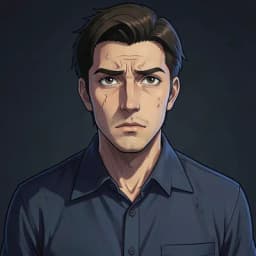
Meet the sample character
The reflection isn't doing what you are.
Try a scene · No signup
The Glass Between Mirrors
A short sample of this world. Your own version starts with your character.
You wake up on the kitchen tile, the cold ceramic biting into your cheek. The overhead light hums with a frequency that makes your teeth ache. Beside your hand, a bottle of vintage scotch sits uncorked, half-empty, though you haven't touched alcohol in years. You feel a rhythmic, wet thumping against the inside of your skull, a heartbeat that is distinctly out of sync with your own.

“You were talking to the walls again, Julian. I hope you were at least telling them something interesting.”

Arthur stands in the doorway, his silhouette blocking the hall light. His eyes remain fixed on your hands, not your face. You look down and see ink staining your fingers—black, permanent, and still wet. A scrap of paper lies beneath your palm. In your own handwriting, but scrawled with a jagged, unfamiliar pressure, it reads: Do not look at the mirror. He is watching from the other side.
“I don't remember writing this. Arthur, why is there a note on the floor?”
Arthur walks forward, the floorboards silent under his feet. He reaches down, but before he can take the paper, the light flickers, plunging the room into darkness. In the split second of strobe-like illumination, you see your own reflection in the oven glass. It is standing perfectly still, arms crossed, while you are reaching out. Your reflection smiles, and its eyes are not yours.
The reflection remains frozen in the glass, a mockery of your physical form. How do you respond to the thing wearing your face?
Your character. Your next move.
Someone is watching from behind your eyes.
You wake up in a room you don't recognize. The door is locked, and there is a note on the table in your handwriting, warning you not to trust yourself. Will you find the truth before the other person takes the wheel for good? Start your story now and decide who survives.
Begin the internal investigationYour Story, Your Way
Everything is customizable. Pick any genre, setting, or character — the AI builds a world around exactly what you want.
Any Character
Design your appearance, personality, backstory — every detail
Any World
Fantasy kingdoms, sci-fi stations, modern cities — you choose
Branching Paths
No two playthroughs are the same. Your choices reshape everything
Full Immersion
AI images, voice acting, sound effects — a living story
Select which persona takes control during high-stakes social interactions to manipulate the outcome.
Decipher cryptic journals written by your alter ego to unlock forgotten childhood memories.
Manage your stress levels to prevent a forced 'switch' that could ruin your plans.
Choose to seek medical help or keep your condition hidden from those closest to you.
The mirror shows a face you recognize, but the expression is wrong. A smirk you don’t remember making. A bruise on your wrist you cannot explain. Every time you blink, time skips—minutes, hours, entire days vanish. You find notes in your own handwriting that you never wrote, threatening people you have never met. There is someone else behind your eyes, and they are tired of staying quiet. Your choices determine whether you reclaim the steering wheel or let the other persona drive you off a cliff. This is a story where your past is a lie, and your future depends on identifying the enemy sharing your skin.
What is Split Personality in Psychological Thrillers?
In fiction, the split personality trope explores the terrifying concept of internal fragmentation. It suggests that the human psyche is not a singular, unified entity but a fragile structure that can shatter under extreme stress or trauma. Unlike simple memory loss, this trope posits that a distinct, often antagonistic identity occupies the same physical vessel, operating with its own motives, knowledge, and memories. Take Robert Louis Stevenson’s 'The Strange Case of Dr. Jekyll and Mr. Hyde.' The narrative functions as a cautionary tale about the duality of man, where the transformation is a literal manifestation of suppressed urges. Similarly, the series 'Mr. Robot' uses this framing to force the audience to question the reliability of the narrator, Elliot Alderson. The tension arises not from an external monster, but from the realization that the primary protagonist may be the villain’s greatest accomplice. In these stories, the lack of control is the primary engine of fear. When the character wakes up in a locked room or with a weapon in hand, they are forced to confront the reality that their own mind is a labyrinth they can no longer map.
Why play Split Personality as an interactive story?
Agency is the most dangerous tool in a psychological thriller. When you are forced to make decisions for a character who is actively fighting a shadow, every choice feels tainted. You aren't just deciding what to say or where to go; you are deciding which version of the self gets to exist in that moment. You might choose to hide the evidence of your alter’s actions to protect your reputation, only to realize that by concealing the truth, you have given them more power to influence your surroundings. Or perhaps you attempt to communicate with the internal entity, risking a total mental collapse for the sake of uncovering the original trauma that fractured your consciousness. The game tracks your consistency, noting when your behavior deviates from your established character, which in turn triggers shifts in how the world reacts to you. You will face moments where you must choose whether to trust your own senses or the frantic, contradictory warnings left by your other self.
Famous examples of Split Personality in books, film, and games
The endurance of the split personality trope comes from its ability to turn the most intimate human experience—self-consciousness—into a source of horror. In Chuck Palahniuk’s 'Fight Club,' the narrator’s lack of awareness regarding his own actions serves as the ultimate plot twist, reframing every preceding scene. The narrative works because it mimics the protagonist's own confusion, forcing the reader to re-evaluate the entire timeline. In the realm of modern psychological thrillers, the film 'Shutter Island' utilizes this trope to explore grief and the mind’s desperate attempts to shield itself from unbearable reality. The protagonist constructs an elaborate, detective-fueled fantasy to avoid acknowledging his own history. It is a masterful use of the trope, where the 'split' is a defensive mechanism against trauma. Similarly, Marvel’s 'Moon Knight' explores the trope through the lens of Marc Spector, where the different identities are not just facets of a personality but distinct manifestations of service to a supernatural entity. Each work uses the trope differently—some as a cautionary tale of morality, others as a tragic response to trauma, and some as a high-octane thriller engine. Regardless of the genre, the trope survives because it taps into a universal, quiet fear: that we are not entirely in control of who we are.
FAQ
How does the AI handle conflicting memories?
The narrative engine tracks your choices across the story. If you choose to ignore or suppress your alter ego, the AI will provide clues or consequences based on that choice, such as 'lost time' events or unexpected changes in your character's inventory and status.
Can the alter ego actually win the game?
Yes. Depending on your decisions, it is possible for the primary persona to be completely suppressed, leading to a narrative conclusion where the alter ego takes permanent control of your life.
Is this type of story suitable for horror fans?
If you enjoy psychological horror, gaslighting, and unreliable narrators, this genre is a perfect fit. It focuses on existential dread and mental tension rather than jump scares.
What is the difference between this and a standard mystery game?
In a standard mystery, you are investigating an external criminal. In a split personality story, the mystery is internal. You are the detective, the witness, and the primary suspect simultaneously.
Explore more Psychological Thriller stories like Unreliable Narrator, Gaslighting, Missing Memory.
More Psychological Thriller Stories
Unreliable Narrator
Nothing you remember can be trusted. You must piece together reality from contradictory clues while questioning whether your own perceptions are the greatest lie of all.
TropeGaslighting
Someone close to you is rewriting your reality one small lie at a time. You must hold onto what you know is true while the ground shifts beneath your feet and everyone insists you are the problem.
TropeMissing Memory
Hours, days, maybe years are missing from your mind. You must reconstruct what happened during the gaps while discovering that some memories were erased for a very good reason.
TropeStalker
Someone is watching your every move and they know things about you that no stranger should. You must unmask your stalker before their obsession escalates from surveillance to something far worse.
TropeGone Girl Style Disappearance
Someone has vanished and all the evidence points to you. You must prove your innocence while unraveling the elaborate scheme behind a disappearance designed to destroy your life.
TropeLocked Room Psychological
You are trapped in a confined space with people you cannot trust. Paranoia builds with every passing hour as you realize someone in this room is not who they claim to be, and escape requires confronting the darkest truths.