Mystery / Detective · Interactive story
The Coroner: Reading the Silent Testimony of the Dead
The truth is hidden under the skin. How deep are you willing to look?
Start as a guest. Choose your character before the story begins.

Meet the sample character
The dead leave marks that only you can read.
Try a scene · No signup
Cold Steel, Blue Lips
A short sample of this world. Your own version starts with your character.
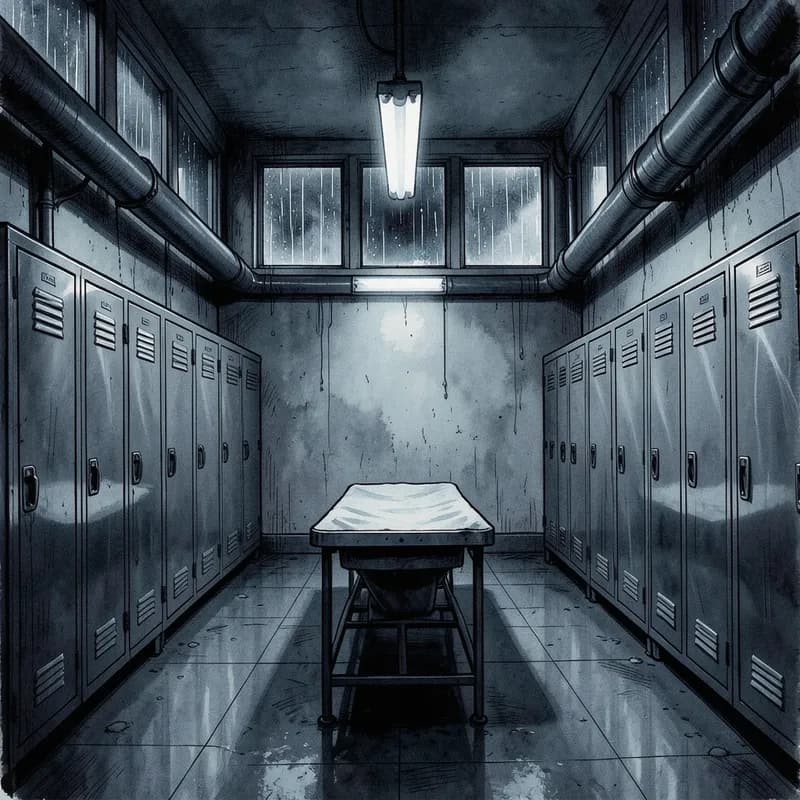
The overhead light flickers, casting long, frantic shadows across the grey skin of the body on your slab. You pull on a fresh pair of latex gloves, the snap echoing off the tiled walls. The corpse is cold, stiffening in a way that suggests he died hours before he was found, despite what the paperwork claims.

“Don't bother looking for a struggle, Vane. He was dead before he hit the pavement. Just sign the report so we can close this.”

You ignore the detective's pacing, your fingers tracing a jagged, unnatural laceration at the base of the victim's skull. It wasn't a fall; it was a surgical removal of something vital, disguised as an accident. Your heart rate hitches as you feel a hard, metallic lump lodged deep beneath the cartilage.
“If this was a fall, Detective, then gravity has developed a very specific, very sharp sense of humor. This man didn't just die—he was harvested.”
Miller stops pacing, his hand drifting toward his holster. You grip your scalpel, the metal cold against your thumb. If you cut into the wound now, you confirm a homicide that the precinct clearly wants buried, but if you stop, the truth dies with the man on your table.
The detective is watching your hands. How do you proceed with the evidence?
Your character. Your next move.
The scalpel is in your hand.
The victim is waiting, and the evidence is beginning to degrade. Every minute you hesitate, the trail goes colder. Step into the morgue, pick up your tools, and find the truth that no one else can see. Will you follow the evidence to justice, or will you be led astray by a clever killer?
Start the autopsyYour Story, Your Way
Everything is customizable. Pick any genre, setting, or character — the AI builds a world around exactly what you want.
Any Character
Design your appearance, personality, backstory — every detail
Any World
Fantasy kingdoms, sci-fi stations, modern cities — you choose
Branching Paths
No two playthroughs are the same. Your choices reshape everything
Full Immersion
AI images, voice acting, sound effects — a living story
Select specific instruments to perform detailed dissections on complex crime victims.
Choose to preserve or prioritize evidence when your department demands a quick conclusion.
Compare forensic findings against conflicting witness testimonies to catch liars in the act.
Navigate professional ethics when your findings implicate powerful figures in the city.
The overhead light flickers, casting long shadows across the cold, stainless steel table. Dr. Silas Vane pulls on his latex gloves, the snap echoing in the sterile silence of the morgue. Beneath the white sheet lies a life that ended abruptly, a story that the official police report got entirely wrong. You are the only person left who can listen to what the body has to say. In this interactive story, your observations dictate the trajectory of the investigation. The choices you make—from the specific tissue samples you prioritize to the way you interpret anomalous bruising—shift the narrative, pulling you closer to a truth hidden in plain sight. As the clock ticks toward the next autopsy, you must decide whether to trust the obvious evidence or follow the subtle, unsettling discrepancies that point toward a much larger conspiracy. The morgue is quiet, but the dead are far from silent.
What is The Coroner in Mystery / Detective?
The Coroner archetype represents the intersection of clinical science and raw human tragedy. Unlike the lead detective who chases suspects through rain-slicked alleys, the coroner operates in the sanctuary of the laboratory. They are the final authority on a victim's last moments, acting as a bridge between the living and the dead. In fiction, this character is often portrayed as detached and hyper-rational, yet deeply burdened by the secrets they uncover. Consider Dr. Kay Scarpetta from Patricia Cornwell’s long-running series, whose meticulous forensic analysis often reveals the criminal's identity long before the police have a viable lead. Similarly, Dr. Temperance Brennan in the show 'Bones' exemplifies the way a coroner can reconstruct entire lives from skeletal remains. This archetype thrives on the premise that the body cannot lie. While witnesses can be coerced and suspects can be cunning, the physical evidence—the angle of a blade, the trace of a rare toxin, the specific pattern of livor mortis—tells a singular, objective truth. The coroner’s role is to translate that truth into a language the rest of the world can understand, often placing them in direct conflict with those who would prefer the truth stay buried.
Why play The Coroner as an interactive story?
Taking on the role of a medical examiner transforms the mystery genre into a process of discovery rather than just a race to the finish. You are not just observing a crime; you are conducting the investigation through the lens of forensic science. Agency matters here because your interpretation of the facts directly influences the police department's next move. If you misidentify a cause of death or overlook a subtle trace of chemical residue, the wrong suspect might be apprehended, or the real culprit might slip through the cracks. Tension arises from the pressure of the autopsy room. You face constant, high-stakes decisions: do you rush the results to satisfy a demanding police captain, or do you take extra time to perform a microscopic analysis that might reveal a crucial detail? You must weigh the ethics of your profession against the urgency of the investigation. Every interaction with the body is a branch in the story, allowing you to prioritize your own detective instincts over standard procedure.
The psychology of The Coroner: why readers fall for this character
The appeal of the coroner archetype lies in the human desire for order within the chaos of mortality. By breaking down a death into manageable, scientific components, the coroner provides a sense of control over the one thing that terrifies us most: the unknown. This character embodies the fantasy of the 'ultimate witness.' They are the person who sees what no one else can, transforming the gruesome end of a life into a coherent narrative. This archetype resonates because it satisfies a specific kind of intellectual curiosity. We want to believe that there is a rational explanation for every tragedy, and the coroner is the figure who finds that explanation. Look at characters like Dr. Maura Isles from 'Rizzoli & Isles' or the forensic team in 'Silent Witness'; their allure comes from their ability to remain objective while surrounded by the most subjective of all human experiences. They act as a mirror to our own anxieties about death, proving that even in the finality of an autopsy, there is still something to be learned. The coroner represents the triumph of knowledge over fear. They do not look away when others do, and that unflinching gaze is what makes them such compelling protagonists. Readers are drawn to this archetype because it suggests that even in death, a person’s story can be reclaimed and understood, provided you have the patience and the skill to look closely enough.
FAQ
How does the coroner archetype differ from a traditional detective?
A traditional detective focuses on human behavior, interrogations, and external motives. The coroner, however, focuses on the physical evidence left on the body. While a detective asks 'who had the motive?', the coroner asks 'how did this happen?' and lets the biological facts dictate the direction of the case.
Can I solve the case solely by performing autopsies?
While the autopsy is your primary tool, the investigation requires you to synthesize your findings with other data. You will often need to reconcile your forensic results with police reports, environmental evidence, and suspect profiles to reach a definitive conclusion.
Is this story right for someone who enjoys procedural dramas?
If you enjoy the technical aspects of forensic science and the methodical pace of a police procedural, this experience is designed for you. It rewards attention to detail and a logical, step-by-step approach to problem-solving.
What happens if I make a mistake during an autopsy?
Mistakes have consequences. A misidentified wound or a missed trace of evidence can lead to a dead-end investigation or, worse, the pursuit of an innocent person. Your choices ripple through the entire story, potentially changing the final outcome.
Explore more Mystery / Detective stories like Locked Room Mystery, Classic Whodunit, The Heist.
More Mystery / Detective Stories
Locked Room Mystery
A crime committed in an impossible space with no way in or out. Examine every detail of the sealed room and deduce the solution that defies logic.
TropeClassic Whodunit
Everyone has a motive and no one is telling the whole truth. Gather clues, catch liars, and unmask the killer before they strike again.
TropeThe Heist
Plan the perfect crime or stop it from happening. Assemble a crew, bypass security, and execute a scheme where one wrong move brings everything crashing down.
TropeCold Case
The trail went cold years ago, but someone just found a new lead. Reopen a long-dead investigation and disturb secrets people thought were buried forever.
TropeUnreliable Witness
Every witness tells a different story and none of them match. Sift through contradictions, half-truths, and outright lies to find the thread that leads to the truth.
TropeSerial Killer Hunt
The bodies are piling up and the pattern is clear to you alone. Race to decode the killer's signature before they complete their gruesome masterpiece.