
Monster Hunting · Interactive story
The Hunt Beneath the Earth
The walls bleed secrets, and the creature you are hunting has been watching you arrive.
Start as a guest. Choose your character before the story begins.

Meet the sample character
The salt mines keep what they swallow.
Try a scene · No signup
Grit in the Marrow
A short sample of this world. Your own version starts with your character.
Your boots grind against calcified marrow, the sound echoing too loudly in the narrow limestone throat of the mine. Above, the shaft is a distant, pinprick memory of sunlight. Your carbide lamp sputters, casting long, frantic shadows against walls scored with vertical gouges—clean, rhythmic, and deep enough to suggest a limb the size of a tree trunk.

“Keep that light focused on the floor, Hannes. If it’s awake, it doesn't need to see us to know we’re bleeding.”
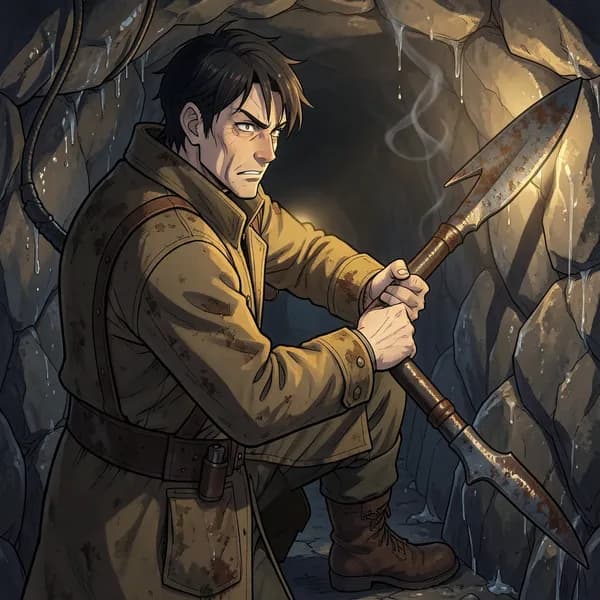
You stop, your breath hitching as you check the seal on your sidearm. The dampness here isn't just humidity; it’s a thick, oily film coating the rock, slicking your palms. You weigh the heavy harpoon in your hand, feeling the balance of the steel. The rhythmic thrumming against the rock floor has ceased, replaced by a silence so heavy it makes your ears ache.
“It’s not hunting us yet. It’s waiting for us to cross the threshold into the main chamber. I can smell the musk.”
A sudden, sickening crack of vertebrae echoes from the darkness ahead. A massive, pale shape shifts behind a curtain of hanging rock, blocking the only exit. You have enough powder for one explosive charge, or you can risk a direct strike with the harpoon. If you miss, the narrow tunnel will become your tomb.
The creature shifts, its bulk threatening to bring the ceiling down upon you. How do you initiate the strike?
Your character. Your next move.
Descend into the dark and claim your bounty.
The scraping sound is getting louder. Do you plant the explosive and wait for the creature to emerge, or do you creep forward into the darkness with only your blade? Your hunt begins now. Every choice you make will echo through these tunnels.
Start Your HuntYour Story, Your Way
Everything is customizable. Pick any genre, setting, or character — the AI builds a world around exactly what you want.
Any Character
Design your appearance, personality, backstory — every detail
Any World
Fantasy kingdoms, sci-fi stations, modern cities — you choose
Branching Paths
No two playthroughs are the same. Your choices reshape everything
Full Immersion
AI images, voice acting, sound effects — a living story
Choose to navigate narrow tunnels by sound alone or risk using a limited light source.
Decide whether to set traps for an ambush or track the beast to its nest.
Manage dwindling oxygen levels while deciding how deep into the den to pursue prey.
Balance the need for a clean kill against the risk of structural cave collapses.
The sulfurous stench hits you first, a thick, cloying miasma that clings to the back of your throat. Ahead, the limestone tunnel narrows into a jagged throat of rock, slick with a bioluminescent slime that pulses like a dying heart. You check your lantern, adjusting the shutter to keep the beam focused; the light reveals claw marks gouged inches deep into the solid stone. These marks are not fresh, but they are deep enough to suggest a creature of immense size and terrifying power. Somewhere ahead, in the suffocating silence, a rhythmic scraping sound starts—the sound of talons dragging against grit. You have two choices: extinguish the light and rely on your other senses, or charge forward to catch the beast before it retreats further into the abyss. Every decision you make in this dark, shifting environment ripples through the hunt, altering the creature's behavior and your own survival odds. The hunter often becomes the prey in these tunnels, and the path you choose determines your final outcome.
What is Underground Lair in Monster Hunting?
An underground lair is a distinct tactical environment where the prey holds the advantage of home-field knowledge. Unlike open-field tracking, this setting forces a shift from long-range precision to close-quarters combat and environmental awareness. In cinema and literature, the most effective depictions of this setting focus on the physical toll of the environment. Think of the claustrophobic terror in Neil Marshall’s 'The Descent,' where the cave system itself feels like an active antagonist, or the hive-like nests in the 'Alien' franchise, where the walls are coated in biological refuse that signals the presence of a lethal predator. In these stories, the lair is not merely a location; it is a manifestation of the monster’s biology. A lair might be a damp, echoing cavern filled with the bones of previous victims, or a complex warren of tunnels designed to ambush intruders. The key to this setting is the constant tension—the hunter knows the creature is nearby, but the darkness and the labyrinthine architecture make it impossible to know from which direction the strike will come. Success requires more than just a sharp blade or a loaded weapon; it requires patience, careful observation of the terrain, and the ability to distinguish between harmless shadows and a predator lying in wait.
Why play Underground Lair as an interactive story?
Playing in an underground lair forces you to manage resources under extreme pressure. Unlike traditional games that provide a map, here you are limited by your light source and your intuition. You will encounter moments where you must decide whether to pursue a wounded beast into a narrow crawlspace—risking a trap—or hold your position and force the creature to come to you. Agency is the most dangerous tool in your inventory. If you choose to use explosives to collapse a tunnel, you might trap the monster, but you also risk burying yourself alive or triggering a cave-in that reveals even deeper, more dangerous chambers. You will face dilemmas such as deciding whether to leave a wounded companion behind to secure the kill or risking your own life to drag them out of the den. The environment reacts to your choices; if you move too loudly, the creature will relocate to a more defensible position, forcing you to start the hunt from scratch in a new, more dangerous section of the cave. Every interaction with the environment, from picking a lock on a subterranean gate to setting a pressure-sensitive trap, carries the weight of potential failure.
What makes Underground Lair work: the worldbuilding
Effective lair design relies on sensory manipulation and the subversion of safety. In the 'Gears of War' series, the 'Hollow' functions as an underground society that feels alien and threatening because it defies human architectural logic. Similarly, 'The Witcher 3' uses monster nests as environmental puzzles that require specific preparation before the combat even begins. A well-constructed lair should feel like an extension of the monster's character. If you are hunting a subterranean insectoid, the lair should be filled with sticky, chitinous secretions and vibration-sensitive webbing. If the target is a predator that uses sound to hunt, the lair should be designed with acoustics that echo footsteps and amplify the sound of your own breathing, creating a psychological feedback loop that makes you feel constantly monitored. Character types that thrive here are those with high perception and tactical flexibility—the scouts, the trappers, and the demolition experts. The conflict in these stories is defined by the transition from hunter to hunted. When you first enter the lair, you are the intruder. As you progress and damage the creature’s home, you force it to adapt. If you kill its offspring or destroy its food source, the creature shifts from a defensive posture to an aggressive, desperate state. This progression keeps the story dynamic, ensuring that the final confrontation is not just a fight, but a culmination of the choices you made throughout your descent. The best writers for this setting understand that the environment should tell the story of the monster before you ever see it—the claw marks, the smell, the way the light dies. By focusing on these details, you create a sense of history and danger that makes the eventual encounter feel earned and inevitable.
FAQ
What makes an underground lair different from other settings?
An underground lair is defined by verticality, claustrophobia, and sensory deprivation. Unlike a forest or city, the lair is an enclosed, hostile ecosystem where the monster has built-in advantages. You cannot easily retreat, and every choice has immediate, high-stakes consequences.
How does the AI handle choices in this setting?
The AI tracks your movement, noise levels, and environmental interactions. If you choose to be aggressive, the creature may flee to a more dangerous tunnel. If you are cautious, the creature may attempt to stalk you from the shadows, leading to a tense, psychological confrontation.
Can I use stealth instead of direct combat?
Absolutely. Stealth is often the preferred strategy in a lair. You can choose to place traps, track the creature's movement patterns, or lure it into a vulnerable position. Combat is often the last resort when stealth fails or the creature corners you.
Is this setting suitable for new players?
Yes, the setting provides clear, immediate feedback. While the environment is dangerous, the linear nature of tunnels allows for focused decision-making, making it a great place to learn how your choices impact the outcome of a hunt.
Explore more Monster Hunting stories like Bounty on the Beast, Monster Tracker, Silver Bullet Hunt.
More Monster Hunting Stories
Bounty on the Beast
A price has been placed on the head of something that should not exist, and you are the one collecting. You study the creature's habits, prepare your weapons, and ride into territory where the locals have already given up hope and barricaded their doors.
TropeMonster Tracker
You follow claw marks in tree bark, tufts of fur on barbed wire, and prints that no known animal could leave. Tracking this creature is equal parts science and instinct, and the closer you get, the more you realize it may be tracking you in return.
TropeSilver Bullet Hunt
Conventional weapons are useless against this creature and you need something specific to kill it. You scour old texts, consult alchemists, and forge the one weapon that can end the monster, all while it continues to hunt the people you are trying to protect.
TropeMonster Nest Discovery
You stumble upon a nest and the realization hits like a punch: there is not one monster, there are dozens. Eggs, young, and the territorial fury of a parent creature turn a simple hunt into a desperate fight for survival in the heart of the hive.
TropeMonster Breeding Ground
Deep in the wilderness, monsters gather to breed, and their numbers are growing faster than hunters can thin them. You must infiltrate the breeding ground and disrupt the cycle before the next generation overruns the surrounding settlements.
TropeCursed Village Monster
A village lives in terror of a creature that returns every cycle to claim victims. You arrive to break the curse and discover that the monster and the village share a history darker than anyone will admit, and killing the beast may not end the horror.