
Medical Drama · Interactive story
When the Monitor Flatlines: Your First Patient Death
The shift doesn't end when the pulse stops. How do you move forward?
Start as a guest. Choose your character before the story begins.
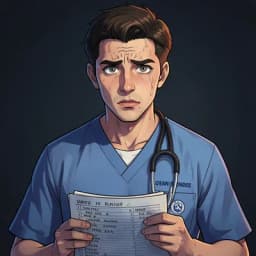
Meet the sample character
The heartbeat stops, and the physician begins.
Try a scene · No signup
The Hour of Correction
A short sample of this world. Your own version starts with your character.
The sterile white ceiling tiles blur as you lean over bed four. Mr. Henderson’s skin has turned the color of wet parchment, and the blood pressure cuff on his arm is slack. You ran the labs twice. You checked the dosage three times. You did everything the textbooks demanded, but the numbers on the monitor are currently plummeting toward zero.

“Stop staring at the screen and start acting, Chen. He’s in V-fib. Do you intend to pronounce him, or are you going to save him?”

Your palms are slick against the rubber grips of the crash cart. A cold, heavy stone sits in your gut, the realization dawning that the rhythmic, artificial life inside this room is failing despite your best efforts. You look at the patient's face—slack, grey, and suddenly so much older than he was ten minutes ago. The weight of the moment hits your chest like a physical blow.
“I’m charging to two hundred joules. Clear the airway, I need another line now!”
You press the paddles against his chest, the metal cold and unyielding. The room waits, suspended in a terrible, static silence. You need to decide whether to push the epinephrine now or pause to check for a pulse that you fear simply isn't there anymore. The monitor screams a long, continuous tone, and the choice rests entirely on your trembling hands.
The monitor is screaming. Do you press for another shock or trust your intuition to change the medication protocol?
Your character. Your next move.
Your shift is waiting. Will you cope or crumble?
The patient is gone, the chart is open, and the Chief of Surgery is watching. Your next decision will determine if you stay in the program or walk away. Take control of your residency and define what kind of doctor you will become.
Begin Your Residency NowYour Story, Your Way
Everything is customizable. Pick any genre, setting, or character — the AI builds a world around exactly what you want.
Any Character
Design your appearance, personality, backstory — every detail
Any World
Fantasy kingdoms, sci-fi stations, modern cities — you choose
Branching Paths
No two playthroughs are the same. Your choices reshape everything
Full Immersion
AI images, voice acting, sound effects — a living story
Choose how to deliver the news to family members while balancing professional boundaries.
Decide between self-care or working through the night to distract from the tragedy.
Navigate tense interactions with senior surgeons who value efficiency over emotional processing.
Face a disciplinary review where your past choices regarding patient care are scrutinized.
The fluorescent lights of the ICU hum with a clinical, detached frequency, but for Dr. Kenji Sato, the sound is deafening. His patient—a grandmother who had been joking about her grandson’s piano recital just hours ago—is now a static line on the monitor. The crash cart was brought, the compressions were rhythmic, and the epinephrine was administered on time. Every protocol was followed to the letter. Yet, the outcome remains unchanged. His hands are still shaking as he peels off his latex gloves, the synthetic snap echoing in the silence of the room. This is the moment that defines a career, the sharp divide between the student who memorized textbooks and the physician who realizes the limits of medicine. In this interactive story, your choices determine whether you carry this weight into your next shift or collapse under the pressure of the job. You are the one who must tell the family, document the failure, and face the chief of medicine tomorrow morning. Every decision carries the weight of a life, and the consequences of your grief are yours to bear.
What is Resident's First Loss in Medical Drama?
The 'Resident's First Loss' is a classic rite of passage in medical storytelling. It marks the transition from the classroom to the harsh, unpredictable reality of clinical work. It is the moment when a young doctor realizes that medical knowledge, while essential, cannot always defeat mortality. The trope focuses on the psychological toll of that first preventable or unpreventable death, forcing the protagonist to confront their own limitations and the fragility of human life. In television shows like 'ER,' this moment often serves as the catalyst for character development, stripping away the youthful idealism of the intern and replacing it with the hardened, pragmatic outlook of the seasoned attending. It is not just about the technical failure, but the emotional aftermath: the guilt of a missed diagnosis, the coldness of hospital administration, and the isolation felt when colleagues move on to the next patient while you are still processing the last. This trope resonates because it mirrors the universal human experience of confronting loss, but places it in an environment where professionalism is expected despite internal turmoil.
Why play Resident's First Loss as an interactive story?
Playing through this experience allows you to test your own moral compass under intense pressure. You aren't just watching a character struggle; you are the one deciding how to handle the aftermath. Will you seek comfort in a mentor, bury your feelings under a mountain of paperwork, or let the grief affect your next diagnosis? Each choice you make changes the way the hospital staff perceives you and alters the trajectory of your medical career. The tension comes from the conflicting demands placed on you: the need to appear composed for the patient's family, the pressure to maintain efficiency for the hospital board, and the quiet, crushing need to acknowledge the person you just lost. By stepping into the shoes of a resident during their most difficult shift, you gain a perspective on the medical profession that passive media cannot provide. You will face moments that test your resolve, such as deciding whether to be brutally honest with a grieving family or following the protective, sanitized protocols of the hospital legal department.
Famous examples of Resident's First Loss in books, film, and games
The weight of a first patient death is a recurring motif across high-stakes drama. In the long-running series 'ER,' the character of Dr. John Carter experiences this early in his residency. The show masterfully displays how his initial shock evolves into a cynical but necessary resilience, showing that the loss was not the end of his career, but the beginning of his identity as a physician. Similarly, in 'Grey's Anatomy,' the surgical interns are frequently forced to reconcile their humanity with the cold, sterile environment of the OR. The trope is used differently in these instances—sometimes as a character-building tragedy, other times as a test of the protagonist's resolve to remain in the field. In literature, works like 'The House of God' by Samuel Shem capture the darker, more satirical side of this loss, highlighting how residents often use gallows humor to survive the trauma of their early days. The trope endures because it is a fundamental human anxiety: the fear of being responsible for a life and failing. By placing this in an interactive format, the narrative forces you to confront the reality that medicine is as much about managing grief as it is about saving lives. Whether it is a quiet, internal struggle or a public, professional failing, the 'First Loss' remains the most critical turning point for any aspiring doctor.
FAQ
What is the core focus of this interactive story?
The story focuses on the psychological and professional aftermath of a resident's first patient death. You navigate the hospital environment, manage interpersonal relationships, and make choices that define your future career path.
Can my choices actually change the outcome of the story?
Yes. Every choice, from how you communicate with staff to how you process your own emotions, affects your reputation, your mental state, and the potential for advancement within the hospital hierarchy.
Is this game purely about medicine?
While the medical setting provides the stakes, the story is primarily a character-driven drama about loss, ethics, and personal resilience under pressure.
How do I handle the emotional intensity of the story?
The narrative allows you to choose your own coping mechanisms. You might find that some paths lead to professional success but personal isolation, while others favor emotional health at the expense of your standing in the hospital.
Explore more Medical Drama stories like Impossible Diagnosis, Emergency Room Crisis, Hospital Romance.
More Medical Drama Stories
Impossible Diagnosis
The patient is dying and every test comes back normal, every specialist shrugs, and the clock is ticking toward organ failure. You chase obscure symptoms through medical journals and gut instincts, knowing that the answer is hiding in a detail everyone else has overlooked.
TropeEmergency Room Crisis
You are hip-deep in a mass casualty event, triaging patients faster than beds can be cleared. The ER is at capacity, staff are running on adrenaline, and every decision you make about who gets treated first is a decision about who lives and who dies.
TropeHospital Romance
You fall for someone in the worst possible place — a hospital where emotions run at extremes and every shift could be your last together. Stolen moments in on-call rooms, lingering glances across the operating table, and the knowledge that the job will always come first create a love story written in adrenaline.
TropeMedical Ethics Dilemma
You face a choice where the right medical decision and the right moral decision are not the same thing. A patient's wishes conflict with their family's demands, an experimental treatment offers hope but violates protocol, and you must decide where your duty truly lies.
TropePlague Outbreak
You are on the front line of an outbreak that is spreading faster than anyone predicted, and the hospital is becoming a war zone. You work in full protective gear, watch colleagues fall ill, and race to contain a pathogen that could jump from local emergency to global catastrophe.
TropeExperimental Treatment
You push the boundaries of medicine with a treatment that has never been tried on a human being. The patient has nothing left to lose, the data is promising but incomplete, and if it works you will save a life and change medicine forever — but if it fails, the consequences fall on you.