
Medical Drama · Interactive story
The Hospital Rooftop: Where Medicine Meets Reality
The city lights blur below while your patient’s fate hangs in the balance above.
Start as a guest. Choose your character before the story begins.
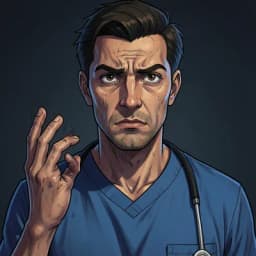
Meet the sample character
The cost of playing God before the sun rises.
Try a scene · No signup
Cold Air, Hot Blood
A short sample of this world. Your own version starts with your character.
The wind whips your scrub top against your ribs, chilling the sweat you accumulated during the last six hours of thoracic surgery. You lean against the safety railing, clutching a lukewarm cup of vending machine coffee. Your hands are shaking, not from the cold, but from the memory of the arterial spray that hit your visor when the suture failed.

“Stop staring at the ledge, Kenji. The patient is stable. For now.”

You turn to see Maya standing in the shadows of the ventilation shaft, her own coat stained with dried blood. She looks like a ghost, eyes hollowed out by back-to-back shifts. She isn't just here for the air; she’s waiting for the board to find out who authorized the experimental bypass that almost killed the senator on the table.
“If I hadn't made the call, he would have been dead before the anesthesia wore off, Maya. What did you tell the Chief?”
Maya steps forward, the light from the helipad beacon casting long, jagged shadows across her face. She pulls a digital recorder from her pocket, the red light blinking rhythmically. She has already spoken to the board, and the weight of her next words will decide whether you keep your medical license or lose everything you’ve sacrificed your life to build.
The recorder clicks in her hand. How do you handle the woman holding your career in her palm?
Your character. Your next move.
The Skyline Awaits Your Decision
The patient is stabilizing, but the choice you make on the roof will change your career trajectory forever. Will you step back into the chaos as a hero or someone hiding a secret? The elevator is waiting.
Step into the ORYour Story, Your Way
Everything is customizable. Pick any genre, setting, or character — the AI builds a world around exactly what you want.
Any Character
Design your appearance, personality, backstory — every detail
Any World
Fantasy kingdoms, sci-fi stations, modern cities — you choose
Branching Paths
No two playthroughs are the same. Your choices reshape everything
Full Immersion
AI images, voice acting, sound effects — a living story
Confront a colleague about a medical error while the city watches from below.
Choose between career advancement and the ethical duty to report a peer.
Balance your personal exhaustion against the critical needs of a pediatric trauma case.
Decide whether to embrace isolation or seek guidance from a seasoned mentor.
The asphalt beneath your shoes is still warm from the day’s heat. You push open the heavy steel door, the screech of metal against concrete echoing into the night sky. Downstairs, the monitors are screaming, and the surgical team is waiting for your final call on a high-risk cardiac procedure. Here, under the hum of the ventilation fans, you have sixty seconds to breathe. This is an interactive story where your choices determine whether you return to the operating room with a steady hand or break under the pressure of the Hippocratic Oath. The city is indifferent, but the patient in room 402 is counting on you to make the right move.
What is Hospital Rooftop in Medical Drama?
Hospital rooftops are the silent witnesses of medical history. They represent the thin line between professional detachment and personal burnout. In shows like Grey’s Anatomy or ER, the roof is a character in its own right—a place where the rigid hierarchy of the ward dissolves. It is where a weary resident might sit in silence after a failed resuscitation or where surgeons whisper secrets that could end their careers. In fiction, this space allows for a shift in rhythm, moving away from the sterile, fluorescent-lit corridors to the vast, cold reality of the city. It is the only place where a doctor can truly acknowledge the weight of the lives they hold in their hands. By stepping away from the monitors and the endless beeping of pagers, the character is forced to confront their own limitations. Whether it is a place for a quiet breakdown or a tense confrontation with a mentor, the rooftop serves as the setting where the facade of the medical professional finally cracks.
Why play Hospital Rooftop as an interactive story?
Your time on the rooftop is limited. The pager on your belt buzzes, a constant reminder that life does not wait for your epiphany. Will you use these moments to reconcile with a colleague after a botched diagnosis, or will you stare at the skyline, debating if you have the emotional capacity to save the patient currently on the table? You might choose to ignore the pager entirely, risking your reputation for a moment of peace, or rush back to the trauma bay to lead an emergency thoracotomy. The tension comes from the mismatch between the silence of the roof and the chaos of the hospital floor. Every decision carries the weight of a life, and your agency determines if you remain a respected surgeon or become the reason a malpractice suit is filed. You are not just observing the drama; you are the one holding the scalpel and the responsibility.
What makes Hospital Rooftop work: the worldbuilding
The hospital rooftop functions as a crucible for character development. It is a liminal space—neither fully part of the hospital’s bureaucratic structure nor entirely disconnected from the patients. In works like The Good Doctor or the film The Verdict, high-pressure environments require these pressure release valves to maintain realism. The setting forces characters to strip away the 'doctor' persona. The sensory details—the scent of rain on gravel, the distant sirens, the flick of a lighter, the cold wind—contrast sharply with the sterile smell of antiseptic and the harsh artificial light of the surgery room. Good storytelling in this setting relies on the juxtaposition of the infinite horizon against the microscopic detail of a human life. It is where the 'god complex' of a surgeon is challenged by the indifference of the urban landscape. When a player stands on that roof, they are forced to weigh the cold logic of a diagnosis against the messy, unpredictable reality of human emotion. This contrast creates a natural narrative engine, pushing the player to make decisions that feel earned, difficult, and permanently impactful on the story arc.
FAQ
What makes the hospital rooftop a good setting for interactive stories?
It provides a quiet, high-contrast space that allows for character reflection and intense dialogue. It breaks up the monotony of the hospital floor, forcing the player to make decisions that define their character's moral compass.
Can I play as different medical roles in this setting?
Yes. Your background as a resident, attending surgeon, or chief of medicine will alter the dialogue options and the weight of the decisions you face on the rooftop.
Does the rooftop scene affect the outcome of medical cases?
Absolutely. The emotional state you cultivate during your time on the rooftop impacts your performance in the OR. Choosing to clear your head can improve your focus, while choosing to dwell on mistakes may lead to errors during surgery.
How do I handle the pressure when the pager goes off?
You are presented with a timer and a set of choices. You must decide whether to prioritize your own mental state, address a social conflict, or drop everything to handle an emergency call.
Explore more Medical Drama stories like Impossible Diagnosis, Emergency Room Crisis, Hospital Romance.
More Medical Drama Stories
Impossible Diagnosis
The patient is dying and every test comes back normal, every specialist shrugs, and the clock is ticking toward organ failure. You chase obscure symptoms through medical journals and gut instincts, knowing that the answer is hiding in a detail everyone else has overlooked.
TropeEmergency Room Crisis
You are hip-deep in a mass casualty event, triaging patients faster than beds can be cleared. The ER is at capacity, staff are running on adrenaline, and every decision you make about who gets treated first is a decision about who lives and who dies.
TropeHospital Romance
You fall for someone in the worst possible place — a hospital where emotions run at extremes and every shift could be your last together. Stolen moments in on-call rooms, lingering glances across the operating table, and the knowledge that the job will always come first create a love story written in adrenaline.
TropeMedical Ethics Dilemma
You face a choice where the right medical decision and the right moral decision are not the same thing. A patient's wishes conflict with their family's demands, an experimental treatment offers hope but violates protocol, and you must decide where your duty truly lies.
TropePlague Outbreak
You are on the front line of an outbreak that is spreading faster than anyone predicted, and the hospital is becoming a war zone. You work in full protective gear, watch colleagues fall ill, and race to contain a pathogen that could jump from local emergency to global catastrophe.
TropeExperimental Treatment
You push the boundaries of medicine with a treatment that has never been tried on a human being. The patient has nothing left to lose, the data is promising but incomplete, and if it works you will save a life and change medicine forever — but if it fails, the consequences fall on you.