
Medical Drama · Interactive story
The Triage Tent: Life and Death in the Field Hospital
The generator is failing, the supplies are gone, and the line never ends.
Start as a guest. Choose your character before the story begins.
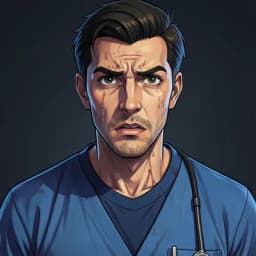
Meet the sample character
Medicine ends where the supplies run out.
Try a scene · No signup
Triage at Zero-Point
A short sample of this world. Your own version starts with your character.
The generator stutters, plunging the triage tent into a flickering, sickly yellow haze. You wipe sweat from your brow, leaving a streak of grime against your forehead. Outside, the rain pounds against the canvas, but it cannot mask the rhythmic, wet gasps of the man on your table. You have three liters of blood, two sutures, and a patient with a gut torn open by jagged shrapnel.

“Dr. Sato, we are out of local anesthetic. If you do not start the repair now, he will go into irreversible shock.”

You look at your hands. They remain steady, but the scalpel feels like a lead weight in your grip. Protocols were written for sterilized operating rooms, not this wind-whipped nylon grave. The patient’s pulse is a thready, erratic flutter against your fingertips, a frantic rhythm that signals his life is slipping away with every breath.
“I cannot perform an invasive repair while he is conscious, Sarah. The pain alone will cause his heart to quit.”
The patient lets out a ragged, choking sound, his eyes wide and fixed on the shadows above. You possess exactly one dose of ketamine, but the radio just crackled with news of three more critical incoming casualties at the perimeter. If you burn your last sedative now, you leave those coming in completely exposed. If you wait, this man dies on your table.
The patient's breathing is hitching; how do you handle the immediate crisis?
Your character. Your next move.
The next convoy is arriving. Are you ready?
The generator is sputtering, and your supply of anesthesia is nearly gone. A dozen wounded soldiers are waiting outside. Every second you spend hesitating is a second a life hangs in the balance. Step into the triage tent, grab your equipment, and start making the calls that define who survives the night.
Begin Your TriageYour Story, Your Way
Everything is customizable. Pick any genre, setting, or character — the AI builds a world around exactly what you want.
Any Character
Design your appearance, personality, backstory — every detail
Any World
Fantasy kingdoms, sci-fi stations, modern cities — you choose
Branching Paths
No two playthroughs are the same. Your choices reshape everything
Full Immersion
AI images, voice acting, sound effects — a living story
Allocate limited morphine and antibiotics between competing trauma cases in the triage tent.
Choose between risky experimental surgery or stabilizing a patient for a dangerous transport.
Manage staff burnout by selecting who takes the next shift in the operating theater.
Navigate military politics when a high-ranking officer demands priority over a civilian child.
The smell of ozone and antiseptic clings to the canvas walls, fighting a losing battle against the scent of wet soil and copper. Outside, the distant rumble of artillery vibrates the tray of scalpels, each tremor a reminder that time is a finite resource. You stand over the patient, a young soldier whose life is pinned to a failing pressure bandage. In this setting, your choices dictate the outcome of every operation. You decide which wounds take priority, which supplies to ration, and who receives the final dose of morphine. There is no waiting room here, only the immediate, grinding pressure of a trauma ward under siege. Every decision you make ripples through the ward, affecting patient survival rates and the morale of your exhausted staff. You are the final line of defense against the chaos of war, and the next casualty is already being carried through the flaps.
What is Field Hospital in Medical Drama?
A field hospital setting strips away the sterile safety of a civilian clinic, placing practitioners in the most volatile environments imaginable. Unlike a traditional hospital drama, this setting focuses on extreme resource scarcity and the psychological toll of triage. The genre gained prominence through shows like M*A*S*H, which highlighted the dark humor needed to survive, and films like The English Patient, which explored the intimacy of care in isolated, war-torn regions. In games like Trauma Center, players learn that surgical precision is only half the battle; the real challenge is managing the environment itself. A field hospital scenario forces you to prioritize survival over perfection. You are not just a surgeon; you are a logistics officer, a counselor, and a desperate problem-solver. When you only have one clean bandage and three open wounds, the ethics of medicine become a brutal game of calculation. This setting forces you to confront the reality that saving one life often means letting another slip away, a burden that defines the genre's highest tension.
Why play Field Hospital as an interactive story?
Playing through a field hospital scenario changes how you view medical drama. Instead of watching a protagonist make impossible choices, you are the one holding the scalpel. When a convoy arrives with more wounded than you have beds, you must decide who gets the operating table first. Will you prioritize the soldier with the highest chance of recovery, or the one whose vital signs are dropping fastest? The tension arises from the constant threat of failure. You might face a critical power outage during a delicate procedure, forcing you to choose between finishing the stitch by flashlight or moving the patient to a safer area. Every decision impacts the story, from the supplies available in the next chapter to the trust your team places in your leadership. You will experience the weight of command, where a single misdiagnosis or a hesitation during a surge can lead to a casualty you could have prevented. Agency here means owning the consequences of your medical ethics.
What makes Field Hospital work: the worldbuilding
The effectiveness of the field hospital setting relies on sensory constraints and high-stakes conflict. The environment is defined by its impermanence; the canvas walls, the humming generators, and the constant dust are all cues that the situation is deteriorating. Successful storytelling in this setting uses these details to build pressure. In the book 'The Nightingale' or the game 'This War of Mine', the environment is an antagonist in its own right. The cold, the hunger, and the noise of conflict are always present, dictating the pace of the narrative. Character archetypes thrive here, such as the cynical veteran surgeon, the idealistic newcomer, and the battle-hardened medic who has seen too much. These characters provide the necessary friction to generate drama. A good field hospital story doesn't just focus on the surgery; it focuses on the silence after the sirens stop. It is about the humanity that persists when the world is breaking. By forcing characters into close quarters under duress, the setting ensures that every interaction is charged with meaning. Whether it is a conversation over a shared meal or a disagreement about medical ethics, the setting ensures that the stakes are always visible. When you write or play in this environment, focus on the contrast between the clinical, cold reality of the medicine and the messy, chaotic reality of the conflict. The friction between these two worlds is where the most compelling stories are born.
FAQ
What makes a field hospital setting different from a standard hospital?
In a standard hospital, you have access to labs, specialized departments, and administrative support. In a field hospital, you are isolated. You lack advanced diagnostics, supplies are strictly limited, and the surrounding environment is hostile. You must rely on intuition and basic tools to solve complex problems under active threat.
Are these stories historically accurate?
While the narratives focus on dramatic tension and player choice, they are grounded in the realities of combat medicine. You will encounter genuine medical dilemmas, such as the principles of triage used by military doctors to maximize survival in mass-casualty events.
Can I lose patients in this game?
Yes. Failure is a core component of the experience. The survival of your patients depends on your diagnostic choices, your resource management, and your ability to keep your team functioning during crises.
Is this setting right for me?
If you enjoy high-stakes decision-making and ethical dilemmas, this is a perfect fit. It is designed for those who want to feel the pressure of being the final authority in a life-or-death situation.
Explore more Medical Drama stories like Impossible Diagnosis, Emergency Room Crisis, Hospital Romance.
More Medical Drama Stories
Impossible Diagnosis
The patient is dying and every test comes back normal, every specialist shrugs, and the clock is ticking toward organ failure. You chase obscure symptoms through medical journals and gut instincts, knowing that the answer is hiding in a detail everyone else has overlooked.
TropeEmergency Room Crisis
You are hip-deep in a mass casualty event, triaging patients faster than beds can be cleared. The ER is at capacity, staff are running on adrenaline, and every decision you make about who gets treated first is a decision about who lives and who dies.
TropeHospital Romance
You fall for someone in the worst possible place — a hospital where emotions run at extremes and every shift could be your last together. Stolen moments in on-call rooms, lingering glances across the operating table, and the knowledge that the job will always come first create a love story written in adrenaline.
TropeMedical Ethics Dilemma
You face a choice where the right medical decision and the right moral decision are not the same thing. A patient's wishes conflict with their family's demands, an experimental treatment offers hope but violates protocol, and you must decide where your duty truly lies.
TropePlague Outbreak
You are on the front line of an outbreak that is spreading faster than anyone predicted, and the hospital is becoming a war zone. You work in full protective gear, watch colleagues fall ill, and race to contain a pathogen that could jump from local emergency to global catastrophe.
TropeExperimental Treatment
You push the boundaries of medicine with a treatment that has never been tried on a human being. The patient has nothing left to lose, the data is promising but incomplete, and if it works you will save a life and change medicine forever — but if it fails, the consequences fall on you.