
Medical Drama · Interactive story
The Surgeon’s Scalpel and the Detective’s Lens
When the evidence is hidden in the wound, only a doctor can find the truth.
Start as a guest. Choose your character before the story begins.
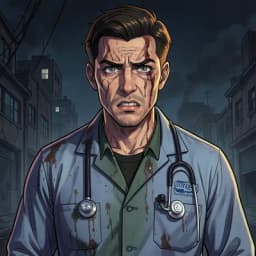
Meet the sample character
One breath between life and an unsolved death.
Try a scene · No signup
The Arterial Silence
A short sample of this world. Your own version starts with your character.
You kneel on the blood-slicked floor of the isolation ward. The gaslight flickers, casting jittery shadows against the peeling wallpaper. A soldier’s uniform lies in a heap, soaked in a dark, viscous liquid that defies standard hemorrhage patterns. Your hands remain steady—a habit drilled into you by the heat of the Khyber Pass—but the patient before you is fading, his respiration shallow and irregular.

“Doctor, his throat is closing—I cannot get the tube in, the swelling is too rapid!”

The room feels humid with the ragged breath of the dying. You study the patient's neck, then the tray of instruments. Time slows, the frantic heartbeat of the man beneath your hands echoing the rhythmic ticking of the clock on the mantle. You have seconds before his airway is completely compromised.
“Step back, Higgins. If we cannot clear the passage, we must bypass the obstruction entirely.”
You reach for the scalpel, your grip firm. Suddenly, a frantic, rhythmic pounding rattles the double doors. It is Holmes, demanding entry with news that could alter the entire diagnosis. If you make the incision now, you save the man but lose the information; if you open the door, the patient will surely perish on the table.
The scalpel is poised; the door shakes under the weight of the knock. How do you proceed?
Your character. Your next move.
Step into the surgeon's coat today.
A fresh body has been found in the docks, and the police are baffled. The patient needs immediate care, and the killer is still nearby. Will you prioritize the life in your hands, or follow the trail of blood to catch the culprit? Your medical expertise is the only thing standing between justice and a cold trail. Start your investigation now.
Begin the medical mysteryYour Story, Your Way
Everything is customizable. Pick any genre, setting, or character — the AI builds a world around exactly what you want.
Any Character
Design your appearance, personality, backstory — every detail
Any World
Fantasy kingdoms, sci-fi stations, modern cities — you choose
Branching Paths
No two playthroughs are the same. Your choices reshape everything
Full Immersion
AI images, voice acting, sound effects — a living story
Analyze bullet wounds to determine the caliber of the weapon and the killer's height.
Perform emergency field surgery under dim gaslight to save a key witness’s life.
Decide whether to withhold medical information from Scotland Yard to protect a patient's privacy.
The scent of stale tobacco and antiseptic fills the cramped room at 221B Baker Street. Across from you, Sherlock Holmes is already pacing, his mind racing through the clues of a bizarre poisoning. Your hands, once steady on the battlefields of Afghanistan, now hold a cold steel scalpel, ready to examine the victim’s remains. A life hangs in the balance, and the local police are looking in the wrong direction. Every observation you make, every stitch you place, and every choice you dictate will determine if a killer walks free or faces justice. You are not merely an observer; you are the one keeping the pulse of the investigation steady. In this interactive story, your medical background is the key to unlocking secrets that even the most brilliant detective might overlook.
What is Dr. Watson in Medical Drama?
John Watson is the quintessential medical professional in literature, first appearing in Arthur Conan Doyle’s 1887 novel, A Study in Scarlet. While Holmes represents the detached, cold logic of deduction, Watson represents the human element—the surgeon who understands the fragility of life and the chaos of trauma. In adaptations like the BBC’s Sherlock or CBS’s Elementary, the character is often reimagined as a modern doctor or trauma expert, highlighting the essential role of medical knowledge in solving crimes. He is the grounded voice in a world of eccentric brilliance, ensuring that the human cost of violence is never forgotten. Without his surgical precision and his ability to read human behavior, the detective’s genius would often drift into cold abstraction. Watson brings the reality of the hospital and the battlefield to the crime scene, forcing the narrative to confront the physical consequences of the villain's actions.
Why play Dr. Watson as an interactive story?
Playing as Dr. Watson forces you to reconcile two distinct callings: the duty to heal and the hunger for truth. You will face moments where a patient’s survival depends on your quick thinking, yet the killer is slipping out the back door. Do you prioritize the emergency tracheotomy, knowing the suspect might escape, or do you trust your partner to apprehend them while you work under pressure? These choices create a unique tension between clinical ethics and the demands of justice. You aren't just reading a mystery; you are deciding how the medical evidence is interpreted and how the victim’s final moments are accounted for in the broader investigation. Your decisions dictate the health of your patients, the success of your partner, and the final outcome of the case.
The literary legacy of Dr. Watson
Created by Arthur Conan Doyle, Dr. John Watson was initially conceived as a narrative device—a way for the reader to experience Holmes’s genius through a relatable lens. However, over the past century, the character has evolved into a powerhouse of literary archetype. In the original short stories, Watson’s military background and medical training provided the necessary context for the grisly nature of Victorian crimes. Later reinterpretations, like the 2009 film Sherlock Holmes starring Jude Law, emphasized Watson’s capability as a man of action rather than just a chronicler. Even shows like House M.D., which positions Dr. Wilson as the 'Watson' to an antisocial, brilliant lead, prove that the dynamic of a genius paired with a grounded medical professional remains one of the most compelling structures in fiction. Watson works because he is the audience’s proxy. He is the person who reminds us that behind every cold calculation and brilliant deduction, there is a body, a life, and a story that ends in blood. Whether he is in a trenches-worn uniform or a modern scrub top, he remains the heart of the mystery, grounding the high-stakes drama in the tangible reality of the human condition.
FAQ
Can I choose my own medical procedures?
Yes. When you examine a patient or victim, you will be presented with options based on your surgical training. Your choices, such as how you treat a wound or what poison you suspect, directly influence the evidence you uncover.
How does Dr. Watson differ from other detective game protagonists?
Unlike a traditional detective, you possess medical training. This allows you to interact with crime scenes through a biological lens, focusing on causes of death, injury patterns, and physiological evidence that others might miss.
Is this story historically accurate?
The narrative draws heavily from Victorian medical practices and the original literary tone established by Arthur Conan Doyle, while balancing the pace for an engaging interactive experience.
Do I have to play alongside Sherlock Holmes?
The story centers on your role as Dr. Watson, but your interactions with the detective are a major part of the experience. You can choose how much you support his methods or challenge his cold, analytical approach.
Explore more Medical Drama stories like Impossible Diagnosis, Emergency Room Crisis, Hospital Romance.
More Medical Drama Stories
Impossible Diagnosis
The patient is dying and every test comes back normal, every specialist shrugs, and the clock is ticking toward organ failure. You chase obscure symptoms through medical journals and gut instincts, knowing that the answer is hiding in a detail everyone else has overlooked.
TropeEmergency Room Crisis
You are hip-deep in a mass casualty event, triaging patients faster than beds can be cleared. The ER is at capacity, staff are running on adrenaline, and every decision you make about who gets treated first is a decision about who lives and who dies.
TropeHospital Romance
You fall for someone in the worst possible place — a hospital where emotions run at extremes and every shift could be your last together. Stolen moments in on-call rooms, lingering glances across the operating table, and the knowledge that the job will always come first create a love story written in adrenaline.
TropeMedical Ethics Dilemma
You face a choice where the right medical decision and the right moral decision are not the same thing. A patient's wishes conflict with their family's demands, an experimental treatment offers hope but violates protocol, and you must decide where your duty truly lies.
TropePlague Outbreak
You are on the front line of an outbreak that is spreading faster than anyone predicted, and the hospital is becoming a war zone. You work in full protective gear, watch colleagues fall ill, and race to contain a pathogen that could jump from local emergency to global catastrophe.
TropeExperimental Treatment
You push the boundaries of medicine with a treatment that has never been tried on a human being. The patient has nothing left to lose, the data is promising but incomplete, and if it works you will save a life and change medicine forever — but if it fails, the consequences fall on you.