
Martial Arts · Interactive story
Where Honor Meets the Blade: The Ancient Arena
The crowd falls silent. Your pulse slows. One strike decides who leaves the sand.
Start as a guest. Choose your character before the story begins.
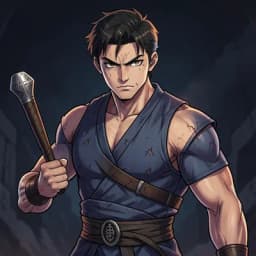
Meet the sample character
Honor is a blade that cuts both ways.
Try a scene · No signup
The Sand’s Verdict
A short sample of this world. Your own version starts with your character.
The heat radiating from the sand beneath your sandals is blistering. You adjust your stance, letting the roar of the spectators fade into a rhythmic thrum. In front of you, the opponent shifts his weight, his calloused palms open and ready. You smell the copper scent of old blood soaked into the earth, a reminder that the arena keeps everything fed.

“Your lungs are tight, Koji. If you cannot control your breathing, the earth will claim you before the sun sets.”

You inhale, pulling the scorching air into your diaphragm, forcing your heart rate to steady. The tension in your shoulders dissipates, leaving only the cold logic of the strike. Across the circle, your opponent feints, a subtle twitch of his left shoulder meant to bait you into a reckless opening. You see the deception, but your muscles are burning for movement.
“I do not hunt for openings; I create them.”
The opponent surges forward, a blur of muscle and raw aggression. He commits to a downward strike that would shatter your collarbone if it connects. You have a fraction of a heartbeat to decide how you will answer this display of force, knowing that a single error means your end.
The opponent closes the distance. How do you respond?
Your character. Your next move.
Step into the sand and claim your legacy.
The crowd is waiting, and your opponent is already circling. Will you be the one to leave the arena with your honor intact, or will your name be forgotten in the dust? Your choices in the heat of battle determine the outcome. Step onto the sand now and prove your mastery.
Enter the ArenaYour Story, Your Way
Everything is customizable. Pick any genre, setting, or character — the AI builds a world around exactly what you want.
Any Character
Design your appearance, personality, backstory — every detail
Any World
Fantasy kingdoms, sci-fi stations, modern cities — you choose
Branching Paths
No two playthroughs are the same. Your choices reshape everything
Full Immersion
AI images, voice acting, sound effects — a living story
Read your opponent’s stance to predict their next strike and counter with precision.
Manage your limited stamina against the environmental toll of the scorching arena heat.
Decide the fate of defeated rivals to shift the favor of the roaring crowd.
Choose between heavy, defensive gear or light, agile weapons to customize your combat style.
The scent of sun-baked stone and iron fills your nostrils. Around you, the stadium walls rise like jagged teeth, trapping the heat of the noon sun. You stand in the center of the sand, your feet feeling the subtle shifts of the ground beneath you. A hundred feet away, your opponent shifts their weight, a blade glinting in the harsh light. This is not a place for mercy or hesitation. Every movement you make, from the way you hold your guard to the rhythm of your breathing, dictates whether you survive the next ten seconds. In this story, you are the architect of your own fate. Your choices define your path: will you fight with the cold precision of a master, or rely on the raw, desperate strength of a survivor? The history of this arena is written in the scars of those who stood here before you. Now, it is your turn to pick up the weapon and decide how your chapter ends.
What is Ancient Arena in Martial Arts?
The Ancient Arena is a setting defined by isolation, spectacle, and the brutal finality of one-on-one combat. It is a stage where social status, politics, and history are stripped away, leaving only the fighter and their opponent. Unlike modern sports, the Ancient Arena operates on a philosophy of life-or-death stakes, echoing the tension found in films like Gladiator or the brutal, tactical combat depicted in the series Spartacus. In these stories, the environment itself—the shifting sand, the blinding sun, the deafening roar of the spectators—becomes a character. It forces the protagonist to manage their internal focus against the chaotic external pressures of the crowd. Whether it is a Roman-inspired colosseum or a hidden, subterranean pit in a forgotten kingdom, the Ancient Arena focuses on the technical mastery of the body. You are not just swinging a weapon; you are managing your stamina, calculating the reach of your opponent, and identifying the split-second openings that define a victory. Understanding this setting means respecting the weight of your gear and the cost of your errors.
Why play Ancient Arena as an interactive story?
Agency is the difference between a spectator and a survivor. When you step into the sand, you are not following a scripted path; you are reading your opponent’s body language and choosing your response in real-time. You might choose to feint a strike to bait a reckless lunge, or decide to conserve your energy by playing a defensive game, waiting for the opponent to exhaust themselves in the heat. The tension comes from the weight of your decisions. If you choose to show mercy to a defeated rival, the crowd might turn against you, changing the political landscape of the arena itself. If you prioritize speed over armor, you are faster but significantly more vulnerable to a single, well-placed blow. You will face moments that test your moral code as much as your physical prowess, forcing you to choose between winning at any cost and maintaining your honor. Every encounter is a puzzle of physics and psychology, where your decision to strike, parry, or retreat creates a unique narrative outcome.
What makes Ancient Arena work: the worldbuilding
The strength of the Ancient Arena setting lies in its inherent conflict: the tension between the individual’s desire for survival and the crowd’s demand for spectacle. This creates a natural narrative engine. You are never just fighting for yourself; you are fighting for the entertainment of others who view your life as a commodity. This power dynamic is what makes the setup so effective. To write a compelling story in this space, one must focus on sensory details that ground the reader in the physical reality of the fight. Think of the dust that clogs the throat, the rhythmic, metallic thumping of shields, and the way the sun creates silhouettes that make it impossible to see an enemy’s eyes. These elements are mastered in games like Shadow of the Colossus, where the scale of the environment makes every movement feel significant, and the historical realism of Kingdom Come: Deliverance, which treats every sword swing as a calculated risk rather than an arcade button-mash. A great arena story uses these details to raise the stakes. If the ground is uneven, your footing matters. If the crowd is hostile, your morale will drop. If your blade is chipped, your damage output decreases. By grounding the narrative in these mechanical realities, the story gains a weight that fantasy often lacks. Character archetypes here range from the disgraced noble seeking redemption to the captive warrior fighting for freedom, all bound by the same set of unforgiving rules. The setting does not need to be complex to be effective; it only needs to be consistent. When the rules of the arena are clear, the player’s choices become the only variable that matters.
FAQ
How does combat work in the Ancient Arena?
Combat is based on tactical choices and resource management. You must balance your stamina, health, and position. By analyzing your opponent's posture and weapon choice, you select moves that exploit their weaknesses while protecting your own vulnerabilities.
Can I lose a fight in the story?
Yes. The Ancient Arena is unforgiving. Poor tactical decisions or a failure to maintain your stamina can lead to defeat. However, every loss provides a new path for your character, whether through recovery, capture, or a shift in the story's direction.
Is this story historically accurate?
The setting draws inspiration from historical gladiatorial combat and ancient martial arts traditions. While it prioritizes a compelling narrative and intense gameplay over strict historical simulation, the combat techniques and environmental pressures remain grounded in reality.
What kind of weapons can I use?
You can specialize in various disciplines, from heavy broadswords and shields to agile spears or dual daggers. Your weapon choice dictates your combat style, speed, and how you manage your stamina during each match.
Explore more Martial Arts stories like Tournament Championship, Dojo Challenge, Forbidden Technique.
More Martial Arts Stories
Tournament Championship
The brackets are set and fighters from every discipline have gathered for the ultimate test of skill. You fight your way through rounds of escalating difficulty, where each opponent reveals a new style and every match could end your championship dream or cement your legend.
TropeDojo Challenge
A stranger walks into your dojo and challenges everything you have built. You must defend your school's honor on the mat, where a single loss means your students leave and your legacy crumbles. The fight is about more than technique; it is about what your martial art means to you.
TropeForbidden Technique
Your master sealed away a technique so dangerous it was erased from the scrolls. Now you face an enemy that no conventional skill can defeat, and the forbidden move is your only option. You must decide if the power is worth the price it extracts from your body and your soul.
TropeMaster's Final Lesson
Your master is dying and there is one last lesson to impart, but it cannot be spoken, only understood through combat. You spar with your aging teacher one final time, and in the exchange of blows you discover the truth about your art that words could never convey.
TropeRival School War
Two martial arts schools have coexisted in uneasy peace for years, and now that peace is shattered. You stand at the center of an escalating conflict where honor, territory, and ancient grudges drive students and masters toward a confrontation that could destroy both schools.
TropeStreet Fighting
There are no rules, no referees, and no bell to save you on the streets. You fight in alleyways and parking lots where anything goes and the only technique that matters is the one that keeps you standing. Every encounter tests whether your training survives contact with raw, unfiltered violence.