
Magical Realism · Interactive story
Where the Heat Hides Secrets: Tropical Village Tales
Where butterflies are the size of dinner plates and the ocean hums in forgotten languages.
Start as a guest. Choose your character before the story begins.
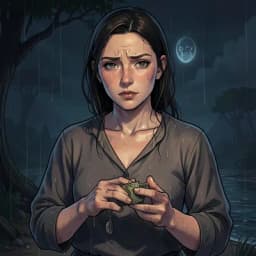
Meet the sample character
Some things belong to the tide, others belong to the past.
Try a scene · No signup
The Salt-Stained Hour
A short sample of this world. Your own version starts with your character.
The ocean didn't just deposit seaweed and shells this morning. Nestled between a jagged piece of driftwood and a rusted fishing net sat a gold pocket watch, its casing warm to the touch as if it had been resting against a heartbeat. The second hand didn't sweep forward; it stuttered backward, marking seconds that had already slipped into the ether.

“Don't touch it, Beatriz. That watch belongs to the man who vanished during the Great Storm, and the tide only returns what it intends to keep.”

I looked up at Tio Mateo, his skin mapped with deep wrinkles that seemed to shift like sand dunes. He wouldn't meet my eyes, staring instead at the horizon where the water turned an unnatural, bruised purple. The watch hummed against the sand, a low vibration that made my teeth ache and my memories of a childhood drowning feel dangerously vivid.
“If the tide wants it back, Tio, why is it shaking my hand like it’s trying to wake me up?”
The watch suddenly snapped open. Instead of gears, a tiny, saltwater-soaked letter was tucked inside, addressed in my mother's unmistakable, looping handwriting—a woman who had supposedly been lost to the deep twenty years ago. The waves behind me grew unnaturally silent, waiting for me to choose whether to open the past or let the tide reclaim it forever.
The watch is beginning to smoke, the smell of burnt paper and ozone rising from the casing. What do you do?
Your character. Your next move.
Step Into the Humid Unknown
The jasmine is blooming, and the tide is bringing something strange to the shoreline. Your arrival has already shifted the balance of the village. Will you uncover the truth behind the whispers in the banyan trees, or will you let the heat swallow your questions? The villagers are waiting for a new story to begin.
Start Your Story NowYour Story, Your Way
Everything is customizable. Pick any genre, setting, or character — the AI builds a world around exactly what you want.
Any Character
Design your appearance, personality, backstory — every detail
Any World
Fantasy kingdoms, sci-fi stations, modern cities — you choose
Branching Paths
No two playthroughs are the same. Your choices reshape everything
Full Immersion
AI images, voice acting, sound effects — a living story
Negotiate with a village elder who speaks exclusively in metaphors about the tide.
Decide whether to harvest fruit that grants visions of a future that never happened.
Choose how to handle a ghost who insists on attending the evening communal dinner.
Navigate the consequences of breaking local taboos regarding the sacred banyan grove.
The humidity clings to your skin like a damp silk sheet. Above the rusted tin roofs, the sun bleeds a deep, bruised purple, and the jasmine—intoxicating and heavy—seems to pulse with a heartbeat of its own. You stand at the edge of the village square, watching as the local healer stitches a wound not with thread, but with starlight and patience. In this place, the boundary between the living and the spectral is porous, frayed by the relentless salt air. Every decision you make ripples through the humid stillness. Will you trust the river that flows backward at midnight, or will you listen to the whispers coming from the ancient banyan tree? The village holds its breath, waiting for your next move. This is an interactive story where the choices you make determine whether the village thrives or fades into the encroaching jungle.
What is Tropical Village in Magical Realism?
Magical realism in a tropical setting takes the ordinary rhythms of village life—fishing at dawn, market haggling, the slow crawl of the afternoon—and grafts them onto an impossible architecture. It is not high fantasy; there are no dragons or epic quests to save the world. Instead, the magic is domestic and intimate. It is reminiscent of Gabriel García Márquez’s 'One Hundred Years of Solitude,' where the supernatural is treated with the same nonchalance as a rainstorm. In a tropical village, the environment acts as a living character. It is a place where a grandmother might keep her memories in glass jars under the floorboards, or where the tide brings back objects lost decades ago. Think of the lush, dreamlike landscapes in the film 'Cemetery of Splendour' by Apichatpong Weerasethakul, where the jungle swallows the history of the people living within it. This genre thrives on the sensory overload of the tropics—the rot and the bloom, the vibrant colors and the deep shadows—to ground the fantastical in something visceral. When the impossible happens, the villagers do not scream; they pour another cup of coffee and adjust their hats, because here, the strange is simply the way the world breathes.
Why play Tropical Village as an interactive story?
Playing a story set in a tropical village demands a shift in perspective. You are not a hero conquering a land, but a guest navigating a web of long-standing, quiet enchantments. Agency here is not about brute force; it is about observation and alignment. When the village elders ask you to resolve a dispute between the living and the restless spirits of the cove, your choice determines whether the village prospers or slips into legend. You might spend an afternoon bartering with a merchant who only accepts secrets as currency, or deciding whether to intervene when the moon refuses to set. The tension arises from knowing that every interaction alters the delicate ecosystem of the town. If you choose to ignore the omens, the village may turn its back on you, or worse, the jungle might simply grow over your tracks, erasing your presence entirely.
What makes Tropical Village work: the worldbuilding
The architecture of a tropical magical realism story relies on the friction between the mundane and the impossible. To make this setting function, the world must feel lived-in and weathered. The heat is a physical presence, often used to mirror the lethargy or the intense emotional outbursts of the characters. Take, for instance, Isabel Allende’s 'The House of the Spirits' or the atmospheric, humid tension found in the game 'Sunless Skies,' which captures the colonial-tropical weirdness perfectly. In these stories, the magic is tied to lineage, blood, and the land itself. The conflict should never be about the magic itself, but about how the characters cope with it. A character might be bothered by the fact that their shadows detach at noon, not because it is supernatural, but because it makes them late for work. This deadpan approach to the surreal is essential. The most compelling characters in this setting are those who act as bridges—the local midwife who knows which herbs treat a fever and which ones communicate with the ancestors, or the fisherman who knows which currents lead to the afterlife. By keeping the stakes personal—a lost heirloom, a strained relationship, a forgotten promise—the story remains grounded. When building these narratives, focus on the sensory details: the smell of wet earth, the sound of insects that seem to be chanting in a human dialect, and the way light filters through canopy leaves to create patterns that look like maps. The world should be a place where logic is secondary to legacy and where the past is never truly buried.
FAQ
What makes a tropical village setting unique for a story?
Unlike high fantasy, a tropical village setting uses the environment to ground the surreal. It focuses on the domestic, the ancestral, and the slow, heavy atmosphere of the tropics to make the impossible feel like a natural part of daily life.
Do my choices really change the story?
Yes. Your interactions with the environment and the villagers dictate the flow of events. Choosing to honor a local tradition or ignoring a supernatural warning can lead to vastly different outcomes for your character and the village.
Is this genre similar to horror?
Not necessarily. While there may be unsettling moments, magical realism prioritizes a sense of wonder, melancholy, or quiet curiosity over fear. The strange occurrences are treated as facts of life, not threats to be overcome.
Can I play this if I prefer slow-paced, atmospheric stories?
Absolutely. This setting is designed for those who enjoy lingering in a scene, soaking up the sensory details, and unraveling mysteries at their own pace rather than rushing through action sequences.
Explore more Magical Realism stories like Impossible Garden, Time-Touched Family, Prophetic Dreams.
More Magical Realism Stories
Impossible Garden
Flowers bloom in impossible colors, vines grow in the shape of memories, and the garden responds to your emotions. Tend a living miracle that reveals the deepest truths about your family with every petal that opens.
TropeTime-Touched Family
Your family does not experience time the way others do. Grandmothers age backwards, twins live decades apart, and the family tree branches through centuries that overlap in the same house. Navigate the beautiful chaos of a bloodline time cannot contain.
TropeProphetic Dreams
Every night your dreams show you fragments of a future that has not happened yet. The visions are never complete, always cryptic, and the more you try to change what you see, the more inevitable it becomes.
TropeGhost at the Dinner Table
The dead do not leave your family. They sit in their usual chairs, comment on the cooking, and refuse to move on until their unfinished business is resolved. Living with ghosts is ordinary here, but what they want from you is anything but.
TropeMagical Inheritance
When the matriarch dies, she leaves you something that cannot be put in a will: a gift that skips generations, a curse that passes through the blood, or a secret that rewrites everything you thought you knew about your family.
TropeEnchanted Everyday Object
A teacup that shows the drinker's true feelings. A mirror that reflects yesterday instead of today. An ordinary object in your home holds extraordinary power, and using it will quietly unravel the fabric of your carefully maintained normal life.