
Magical Realism · Interactive story
The Walls Remember: Tales from the Ancestral Hacienda
Where the floorboards groan with secrets and the bougainvillea blooms with lost memories.
Start as a guest. Choose your character before the story begins.

Meet the sample character
Where the walls remember what the occupants try to forget.
Try a scene · No signup
The Salt-Stained Ledger
A short sample of this world. Your own version starts with your character.
Dust motes dance in the sliver of sunlight piercing the shutters, though outside, the afternoon is entirely overcast. Beside me, the heavy mahogany table begins to sweat salt, forming patterns that resemble a map of the valley. The house has been agitated since the tremors started, its architecture shifting inches while I sleep.

“You should stop trying to patch the cracks, Mateo; the house is simply rearranging its rooms to better suit the guests who are coming tonight.”
Don Teodoro stands in the corner, his silhouette flickering like a candle flame in a draft. He has been dead for forty years, yet he still insists on polishing the same silver tray until his knuckles bleed phantom blood. I feel the floorboards tilt, a gentle slope pulling me toward the dark, unmapped wing of the servant quarters.
“I am not here to entertain ghosts, Teodoro. I am here to ensure this structure stays standing for the living.”
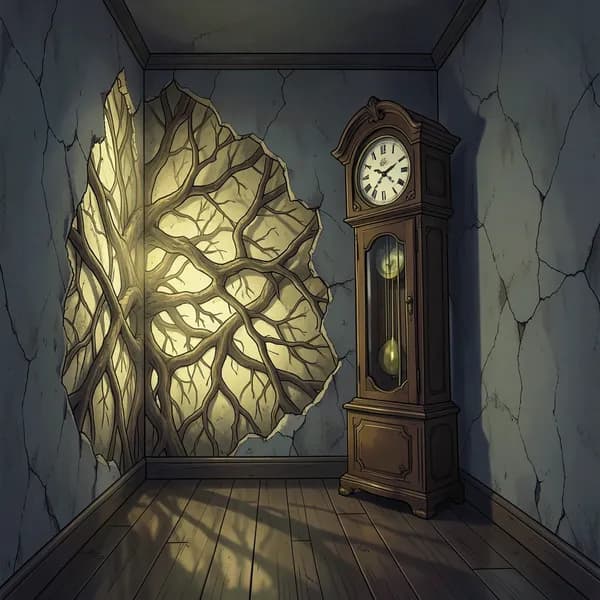
The wall behind the grandfather clock begins to peel away like dried skin, revealing not brick, but a pulsing, vein-like network of roots that smell of wet earth. A soft, rhythmic thumping emanates from deep behind the plaster—a heartbeat that syncs perfectly with my own. The hallway light flickers out, leaving me in the sudden, suffocating dark.
The wall is wide open now, and the heartbeat is growing louder, rattling the very floorboards under your boots. How do you respond to the sudden exposure of the house's internal organs?
Your character. Your next move.
Inherit the Keys to the Impossible
The front door is unlocked, and the candles are already lit. Whether you choose to confront the spirit in the kitchen or wander the garden of silver vines, the house is waiting for your command. Your legacy is built into these walls, and it is time to see what happens when you finally open the forbidden wing.
Claim Your InheritanceYour Story, Your Way
Everything is customizable. Pick any genre, setting, or character — the AI builds a world around exactly what you want.
Any Character
Design your appearance, personality, backstory — every detail
Any World
Fantasy kingdoms, sci-fi stations, modern cities — you choose
Branching Paths
No two playthroughs are the same. Your choices reshape everything
Full Immersion
AI images, voice acting, sound effects — a living story
Decide whether to appease the restless spirits or silence their whispers forever.
Modify the estate's floor plan by resolving or ignoring deep-seated family secrets.
Harvest magical fruit from the courtyard to influence the house's current mood.
Choose which ancestral heirloom to keep, each holding a different, volatile memory.
The scent of overripe citrus hangs heavy in the courtyard, thick enough to taste. You stand before the iron gates of the hacienda, a structure that seems to breathe with the rhythm of the valley. Every shuttered window hides a face from a century ago, and the fountain in the center runs with water that tastes like forgotten promises. This is not merely a house; it is a repository of everything your ancestors refused to burn. As you step across the threshold, the choice of which room to enter first ripples through the foundation, changing the very geometry of the hallways. Your decisions dictate whether the shadows remain stagnant or begin to whisper the truths they have guarded for generations. You are not just a visitor; you are the latest chapter in a story that refuses to end.
What is Ancestral Hacienda in Magical Realism?
The ancestral hacienda is a staple of magical realism, functioning as a sentient character rather than a mere backdrop. It represents the intersection of history and the impossible. Think of the sprawling, unstable house in Gabriel García Márquez’s One Hundred Years of Solitude, where the architecture seems to mirror the psychological state of the Buendía family. Or consider the atmosphere in Laura Esquivel’s Like Water for Chocolate, where the kitchen of the De la Garza estate becomes a crucible for emotions that manifest as physical phenomena. In these settings, the supernatural is not a shock; it is a domestic chore. A ghost might be asked to help with the laundry, or a hallway might stretch indefinitely during a funeral. The hacienda is a vessel for lineage, trapping the joys and tragedies of the past in its plaster and stone. It is a place where family trauma is literally built into the architecture, and the inhabitants must learn to negotiate with their own heritage to survive the day.
Why play Ancestral Hacienda as an interactive story?
In this interactive story, you are the latest caretaker of a legacy that refuses to stay buried. You aren't just moving through rooms; you are auditing the history of your own bloodline. When you encounter a locked door, you must decide whether to pry it open with the rusty key found in a grandmother’s jewelry box or to leave it sealed, knowing the secrets inside might reshape the house’s layout tomorrow. You will face moments that demand a delicate balance: do you invite the spectral inhabitant of the library to share tea, or do you attempt to banish the memories they represent? The tension stems from the fact that the house responds to your internal state. If you are anxious, the stairs might become steep and treacherous; if you are nostalgic, the rooms might fill with the golden light of a decade long gone. Every interaction—from pruning the vines that grow silver leaves to answering the telephone when it rings at 3 AM—alters the stability of the estate. You must determine if you are the master of this domain or merely the latest resident to be consumed by its history.
What makes Ancestral Hacienda work: the worldbuilding
The power of the ancestral hacienda lies in its ability to externalize internal conflict. In magical realism, the setting is a projection of the protagonist’s psyche. When a character in The House of the Spirits by Isabel Allende interacts with the family estate, the architecture responds to the political and personal upheaval of Chile. The hacienda provides a contained space where time can loop, expand, or compress. This is crucial for interactive fiction because it creates a high-stakes environment where the player's agency directly influences the laws of the setting. The conflict is rarely external; it is a negotiation with the past. The hacienda requires characters who are deeply tied to their lineage—people whose identities are forged by the stories they were told as children. Sensory details are paramount: the smell of damp earth after a rain that only falls in the nursery, the sound of a piano playing in a room that hasn't been used since the revolution, or the way the mirrors show the reflection of someone who died thirty years ago. Works like Guillermo del Toro’s The Devil’s Backbone masterfully use a single, isolated location to focus the narrative on the intersection of trauma and the supernatural. To write for this setting, one must prioritize the domestic: how does the ghost affect the morning coffee? What happens to the furniture when a secret is revealed? By grounding the impossible in the mundane, the hacienda becomes a place where the player feels the weight of every choice.
FAQ
What is an ancestral hacienda in this context?
It is a living, breathing house that acts as a repository for family history and supernatural events, where the building itself reacts to the player's choices and emotional state.
How does the house change based on my choices?
The layout, atmosphere, and spectral activity shift in response to your decisions. Opening a door or acknowledging a ghost can permanently alter the geometry or mood of the estate.
Is this a horror game?
It leans into magical realism, focusing on the beautiful, strange, and melancholic rather than jump scares or typical horror tropes.
Can I interact with the ghosts?
Yes, you can choose to communicate, ignore, or attempt to resolve the unfinished business of the spirits residing within the walls.
Explore more Magical Realism stories like Impossible Garden, Time-Touched Family, Prophetic Dreams.
More Magical Realism Stories
Impossible Garden
Flowers bloom in impossible colors, vines grow in the shape of memories, and the garden responds to your emotions. Tend a living miracle that reveals the deepest truths about your family with every petal that opens.
TropeTime-Touched Family
Your family does not experience time the way others do. Grandmothers age backwards, twins live decades apart, and the family tree branches through centuries that overlap in the same house. Navigate the beautiful chaos of a bloodline time cannot contain.
TropeProphetic Dreams
Every night your dreams show you fragments of a future that has not happened yet. The visions are never complete, always cryptic, and the more you try to change what you see, the more inevitable it becomes.
TropeGhost at the Dinner Table
The dead do not leave your family. They sit in their usual chairs, comment on the cooking, and refuse to move on until their unfinished business is resolved. Living with ghosts is ordinary here, but what they want from you is anything but.
TropeMagical Inheritance
When the matriarch dies, she leaves you something that cannot be put in a will: a gift that skips generations, a curse that passes through the blood, or a secret that rewrites everything you thought you knew about your family.
TropeEnchanted Everyday Object
A teacup that shows the drinker's true feelings. A mirror that reflects yesterday instead of today. An ordinary object in your home holds extraordinary power, and using it will quietly unravel the fabric of your carefully maintained normal life.