
LitRPG / GameLit · Interactive story
Death Is Only the Loading Screen
Your death is calculated, but your memory is the currency for your next attempt.
Start as a guest. Choose your character before the story begins.
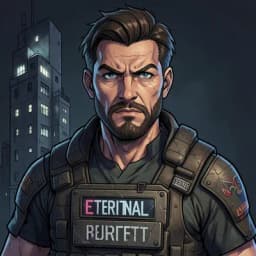
Meet the sample character
Death is the cost, but forgetting is the price.
Try a scene · No signup
System Error: The Memory Debt
A short sample of this world. Your own version starts with your character.
Cold air scrapes against your lungs. You wake up on the cracked marble floor of the Checkpoint Monolith. The system notification blares in your vision: DEATH COUNT: 14. MEMORY FRAGMENTATION: 12%. Your sword is gone, left somewhere on the 42nd floor, and your health bar is blinking a sickly, translucent red.

“You're late, meat-shield. That guardian didn't wait for your respawn. It’s already tearing through the lobby.”

You try to recall the boss's attack patterns, but the data smears like wet ink. The sensation of being crushed by the guardian’s hammer lingers in your nerves, a phantom pain that won't dissipate. Vax is already moving toward the exit, his armor clanking. He doesn't care that you're missing chunks of your tactical training, only that you’re cannon fodder for the next phase.
“Hold your position, Vax. My inventory is wiped. If I go in there naked, I’m just a loot box for that monstrosity.”
The lobby doors groan under the force of a heavy impact. Dust falls from the vaulted ceiling, and the giant shadow of the guardian looms through the translucent barrier. You have seconds before the seal breaks. If you rush in, you might recover your corpse, but your memory—and your remaining sanity—might not survive another death.
The seal is fracturing. How do you prepare for the incoming onslaught?
Your character. Your next move.
How many lives will you burn to win?
You are staring at the dungeon gate, knowing exactly what lies behind it. You have died here four times already. Your memory of your home is fading, but your sword skill is sharper than ever. Step into the loop. Make your next life count, or lose yourself to the void.
Start Your First LoopYour Story, Your Way
Everything is customizable. Pick any genre, setting, or character — the AI builds a world around exactly what you want.
Any Character
Design your appearance, personality, backstory — every detail
Any World
Fantasy kingdoms, sci-fi stations, modern cities — you choose
Branching Paths
No two playthroughs are the same. Your choices reshape everything
Full Immersion
AI images, voice acting, sound effects — a living story
Analyze enemy attack patterns across multiple lives to unlock secret weaknesses and stat buffs.
Trade fragments of your character’s backstory for permanent skill point modifiers during the respawn phase.
Navigate branching dialogue paths while retaining knowledge from previous lives to bypass lethal traps.
The screen flickers—a sharp, digital red. System Failure. Your stats drop to zero as the dungeon boss looms over your cooling corpse. Then, the familiar hum of the respawn chamber vibrates through your skull. You are back at the entrance, level one, health full. But when you reach for your memories of the boss's attack pattern, there is a hollow space. You know you fought him, but you cannot recall how he moved. This is the cost of the loop. In this interactive story, you decide which memories are worth sacrificing to claim victory. Every reset makes you stronger in stats but lighter in soul. You are not just grinding for experience points; you are managing the erosion of your own consciousness to overcome an impossible challenge.
What is Respawn Mechanic in LitRPG / GameLit?
The Respawn Mechanic is a staple of GameLit, functioning as both a safety net and a psychological horror element. In traditional games like Dark Souls, death is a teacher; you repeat the struggle until you memorize the enemy's rhythm. In fiction, this trope takes a darker turn. Think of Edge of Tomorrow (based on the light novel All You Need Is Kill), where the protagonist resets time upon death, becoming a master strategist through sheer repetition. The narrative tension shifts from 'Can I survive?' to 'What will I lose to survive?' It turns the concept of a game over into a resource management puzzle. You aren't just grinding for gear; you are grinding for the perfect run, knowing that each failure erodes the person you were at the start. It is a high-stakes trade-off that forces you to weigh your character's humanity against their objective. You aren't just a player; you are a test subject in a system that demands perfection at the cost of your identity.
Why play Respawn Mechanic as an interactive story?
Playing a loop-based story shifts your agency toward extreme optimization. You aren't just picking dialogue; you are analyzing the environment for clues that persist through your resets. You might encounter a locked vault that requires a key you only find by dying at the hands of a specific guardian. The tension lies in the degradation of your character's internal monologue. As you progress, the choices you make become more cold and calculated. You stop caring about the NPCs you have met ten times before because you have seen their dialogue trees a dozen times over. You are hunting for the golden path to the end. Do you prioritize gear upgrades that require a high-level grind, or do you focus on gathering intel that makes the next run faster? The system tracks your Memory Integrity stat—let it drop too low, and you might forget your own objective entirely.
Famous examples of Respawn Mechanic in books, film, and games
The Respawn Mechanic is perfected when the narrative embraces the cost of repetition. In Re:Zero - Starting Life in Another World, the protagonist Subaru Natsuki experiences the 'Return by Death' ability. Unlike a standard gamer, he retains his trauma, making his resets a source of immense psychological distress rather than a simple convenience. He is trapped in a loop where his survival is guaranteed, but his sanity is not. Contrast this with Hades, the roguelike video game where death is the primary narrative engine. Every time the protagonist falls, he returns to the House of Hades, where his failure triggers new dialogue and relationship progression with the gods. The game uses the respawn not as a punishment, but as a deliberate way to drip-feed the plot. These stories endure because they mirror the human experience of learning through failure. We all wish for a second chance, but these narratives force us to confront the reality of what that second chance might actually steal from us. Whether it is the desperate survival of a sci-fi soldier or the mythological struggles of a god, the mechanic forces the protagonist to become something more than human—or lose their humanity in the process.
FAQ
How does the memory loss mechanic change gameplay?
It turns your character sheet into a living document. As memories fade, you might lose access to specific dialogue options or NPC relationships, forcing you to prioritize essential survival skills over personal history.
Is the respawn mechanic always a punishment?
Not necessarily. In many stories, it acts as a tactical advantage, allowing you to brute-force complex puzzles or learn boss mechanics that would be impossible to clear on a single life.
Does every death count the same?
Usually no. Context matters. Dying to a boss might lose you a combat memory, while dying to a trap might strip away a piece of your character's motivation or core backstory.
Can I beat the game without dying?
In most high-difficulty LitRPG loops, death is baked into the progression. You often need to trigger specific death events to unlock new paths or information that you cannot acquire otherwise.
Explore more LitRPG / GameLit stories like Level Up System, Stat Screen Awakening, Dungeon Dive.
More LitRPG / GameLit Stories
Level Up System
Every monster slain and quest completed fills your experience bar, pushing you toward the next breakthrough. You feel the rush of leveling up as new abilities unlock and the world's challenges scale to match your growing power.
TropeStat Screen Awakening
A glowing blue screen appears in your vision displaying your stats, skills, and a health bar you desperately hope stays full. You've awakened to a game-like system overlaid on reality, and the tutorial is already over.
TropeDungeon Dive
You descend into a procedurally shifting labyrinth where every floor holds deadlier monsters and richer loot. The dungeon tests your build, your party, and your nerve as you push deeper than anyone has survived.
TropeBoss Fight
The health bar fills the top of your vision and the boss music kicks in. You face a titanic enemy with attack patterns to memorize and a single devastating ability you absolutely cannot afford to tank.
TropeClass Selection
The system presents you with a choice that will define everything — warrior, mage, rogue, or something far more exotic. Your class shapes your abilities, your role in the party, and the very way the world responds to you.
TropeSkill Tree Unlock
A branching constellation of abilities stretches before you, each node representing a new power waiting to be claimed. You invest your hard-earned skill points and watch your character evolve in directions no one predicted.