
Horror / Thriller · Interactive story
The Paranormal Researcher: Science Against the Void
Logic is a fragile shield when the walls start bleeding.
Start as a guest. Choose your character before the story begins.
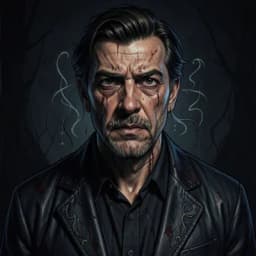
Meet the sample character
The data never lies, but it can deceive.
Try a scene · No signup
Frequency of the Forgotten
A short sample of this world. Your own version starts with your character.
Your magnetic tape recorder whirs, a steady, rhythmic pulse in the silence of the vault. You adjust the gain on your spectrum analyzer, eyes locked on the needle. It flickers—not from a draft, but from a deliberate, heavy pressure against the floorboards. The temperature drops until your breath blooms in front of you, thick and white.

“Stop staring at the readings, Arthur. Look at the wall behind the microfilm reader.”

The hairs on your neck prickle. You turn slowly, the heavy equipment bag dragging at your shoulder. A distortion hangs in the air, a tear in the darkness that seems to absorb the beam of your flashlight. The machine on your desk suddenly shrieks, a high-pitched, metallic wail that vibrates in your very teeth.
“It’s just an electromagnetic surge, Halloway. The wiring in this basement is ancient and failing.”
You reach for the manual kill-switch, but the needle on the analyzer snaps off. The jagged metal piece begins to move on its own, carving a symbol into the desk—a shape that looks exactly like your own heartbeat, rapidly accelerating to a lethal pace. If you don't cut the power now, the surge might burn the building down; if you touch it, the resonance will shatter your bones.
The machine is vibrating violently, threatening to explode. How do you stop the surge?
Your character. Your next move.
Grab your sensors. The ghosts are waiting.
The basement door is locked, the temperature is plummeting, and your EMF meter is redlining. This isn't just a reading—it's a warning. Will you document the final moments of your career, or will you find a way to break the cycle of the haunting? The equipment is in your hands.
Start the investigationYour Story, Your Way
Everything is customizable. Pick any genre, setting, or character — the AI builds a world around exactly what you want.
Any Character
Design your appearance, personality, backstory — every detail
Any World
Fantasy kingdoms, sci-fi stations, modern cities — you choose
Branching Paths
No two playthroughs are the same. Your choices reshape everything
Full Immersion
AI images, voice acting, sound effects — a living story
Calibrate your equipment to identify specific spectral frequencies before the entity manifests.
Choose between gathering hard evidence for your archives or fleeing to preserve your sanity.
Analyze EVP recordings to decode whispered warnings from entities trapped in the architecture.
Manage your remaining battery life while exploring pitch-black, labyrinthine structures.
The static on your recorder isn't random. It’s rhythmic. Dr. Hideo Tanaka taps the glass of the EMF meter, his knuckles white against the cold plastic. Behind him, the door to the basement slams shut, locking with a finality that defies mechanical explanation. The air temperature drops twenty degrees in a heartbeat, turning his breath into a ragged, grey mist. He didn't come to this derelict asylum to scream; he came to record data. But as the shadows in the corner of the room detach themselves from the peeling wallpaper, the scientific method feels like a pathetic defense. In this interactive story, your choices dictate whether you become a footnote in a medical report or a cautionary tale carved into the floorboards. You hold the equipment, but the house holds the power. Every decision you make—whether to stand your ground for one more reading or abandon your gear to save your skin—will ripple through the dark, leading to a conclusion written in blood and static.
What is The Paranormal Researcher in Horror / Thriller?
The Paranormal Researcher archetype represents the collision of rational inquiry and irrational terror. Unlike characters who stumble into horror by accident, this archetype enters the darkness with intent. They bring cameras, audio recorders, thermal sensors, and a stubborn refusal to accept the supernatural without evidence. They seek to quantify the unquantifiable. This character type creates a unique tension: they are the most prepared person in the room, yet their tools often fail them when they are needed most. Think of the investigative rigor seen in films like 'The Conjuring' or the high-stakes, frantic data collection in the game 'Phasmophobia.' In these stories, the researcher's greatest strength—their reliance on logic—becomes their fatal flaw. They try to categorize entities that exist outside the laws of physics. When the lights flicker and the EVP captures a voice that knows their name, the researcher must decide if their belief in science is worth their life.
Why play The Paranormal Researcher as an interactive story?
Playing as a paranormal investigator forces you to balance your professional curiosity against the primal instinct to run. You aren't just a victim; you are an observer trying to document the impossible. The tension comes from the agency you have over your equipment and your proximity to the threat. Do you stay in the room to capture a high-definition image of the apparition, even as the room begins to collapse around you? Do you trust the readings on your monitor, or do you listen to the scratching coming from inside the walls? Every choice shifts the narrative, determining whether you uncover the truth behind a haunting or become the next subject of a spectral obsession. You will face moments where the cold, hard data contradicts your own eyes. Deciding how to react to these anomalies defines your survival. Will you be the researcher who finds the ghost, or the one who is found by it?
The psychology of The Paranormal Researcher: why readers fall for this character
The appeal of the paranormal researcher lies in the human desire to master the unknown. We fear what we cannot explain, and this archetype promises to strip away the mystery through sheer force of intellect. It is a power fantasy built on the hope that if we understand a ghost, we can control it. This is why characters like the Warrens in 'The Conjuring' or the investigators in 'House of Leaves' resonate so deeply. They represent our collective attempt to turn terror into a subject of study. However, these stories provide the most satisfaction when that control is systematically dismantled. There is a specific kind of dread that occurs when a character who prides themselves on being the smartest person in the room realizes that the laws of their world no longer apply. It is the transition from 'I can explain this' to 'I am going to die.' Readers find this compelling because it mirrors the fragility of our own modern worldview. We live in an age of data and information, yet we remain terrified of the dark. The researcher acts as a proxy for our own skepticism, making their inevitable breakdown feel more personal. Whether they are driven by academic prestige, a tragic past, or a desperate search for proof of an afterlife, their journey into the dark is a mirror for our own curiosity about what lies beyond the veil. When you inhabit this role, you aren't just fighting a monster; you are fighting the idea that some things simply cannot be understood.
FAQ
What is the primary challenge of playing a Paranormal Researcher?
The primary challenge is managing your obsession with data collection against the immediate need for survival. You are often rewarded for staying in dangerous areas to gather evidence, which creates a constant tug-of-war between high scores and staying alive.
Can I succeed as a researcher without fighting the entities?
Yes. The stories are designed to reward different playstyles. You can focus on stealth, environmental analysis, and avoiding direct contact, or you can take a more aggressive approach to documenting the entity's behavior.
How does the AI handle the paranormal equipment in the story?
The AI dynamically updates the status of your gear based on your location and the intensity of the haunting. If you are in a high-activity area, your equipment may malfunction, providing erratic readings that force you to interpret the data yourself.
Is this experience suitable for someone who prefers psychological horror over jump scares?
Absolutely. The focus is on the mounting dread of the investigation. While there are moments of sudden terror, the core of the story revolves around the slow-burn realization that your scientific assumptions are failing.
Explore more Horror / Thriller stories like Haunted House, Survival Horror, Psychological Thriller.
More Horror / Thriller Stories
Haunted House
The house has been waiting for you. Explore rooms that should not exist, hear voices that should not speak, and decide whether to flee or uncover the truth.
TropeSurvival Horror
Resources are scarce and something is hunting you. Every bullet, every hiding spot, every ally could mean the difference between survival and a gruesome end.
TropePsychological Thriller
Trust no one, not even yourself. Reality bends and paranoia mounts as you navigate a story where the greatest threat might be inside your own mind.
TropeFinal Girl
Friends are dropping one by one and you might be next. Outsmart the killer, make impossible choices, and fight to be the last one standing.
TropeEldritch Horror
Some knowledge was never meant for mortal minds. Encounter cosmic horrors beyond comprehension and decide how much sanity you are willing to sacrifice for the truth.
TropeDemonic Possession
Something ancient and malevolent has taken hold of someone you care about. You must decide whether to fight the demon, bargain with it, or risk losing everything to save a soul.