Horror / Thriller · Interactive story
Echoes in the Void: Surviving the Deep Space Station
The air is running thin and something else is breathing on the deck.
Start as a guest. Choose your character before the story begins.

Meet the sample character
The station is breathing for you, and it's starting to wheeze.
Try a scene · No signup
Oxygen Debt
A short sample of this world. Your own version starts with your character.
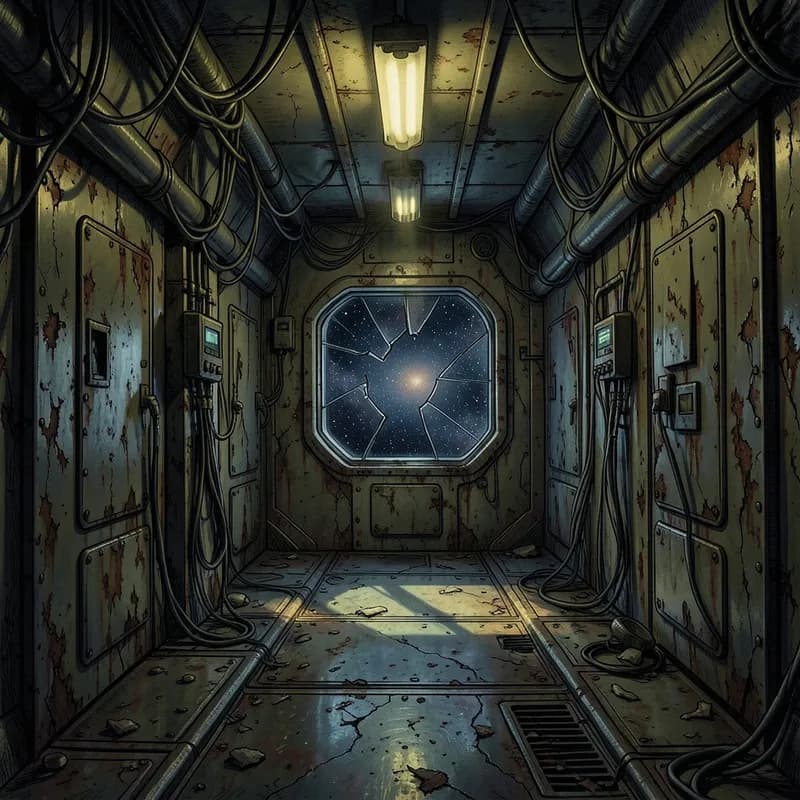
Cold air bites at your skin, tasting of recycled ozone and copper. You press your back against the vibrating bulkhead as the lights flicker, casting long, frantic shadows. Somewhere above, the ventilation ducts groan under the weight of something that shouldn't exist. Your flashlight beam cuts through the gloom, settling on the mangled, twisted remains of the service hatch.

“Don't move, Vane. It tracks the sound of your heartbeat, and it's listening.”

Halloway’s voice is a wet rasp, barely audible over the station's dying hum. Blood droplets catch the dim emergency light, floating in the low gravity like tiny, jagged rubies. You stare at the control panel flickering in your peripheral vision. If you force the override, the station’s atmospheric stabilizer might reboot, or it might vent the entire deck into the vacuum.
“If I don't vent the air, we're both just waiting to be harvested. I'm taking the chance.”
The screeching from the vents intensifies, metal buckling against a force that is far too strong. A heavy claw—too many joints, too much chitin—pierces the plating just inches from your head. The emergency lights shift to a sickly, pulsing red. You have seconds before the seal fails completely, and your fingers hover over the terminal, trembling.
The claw retracts, and the hatch begins to peel open. How do you respond to the incoming breach?
Your character. Your next move.
Can You Survive the Silence?
The oxygen alarm is sounding. The ventilation system has failed. You are the only one left on this station, and the air is turning stale. Every hallway you turn into could be your last. Will you fight to restart the reactor, or will you drift into the dark? Make your move before the lights flicker out for good.
Start Your Survival MissionYour Story, Your Way
Everything is customizable. Pick any genre, setting, or character — the AI builds a world around exactly what you want.
Any Character
Design your appearance, personality, backstory — every detail
Any World
Fantasy kingdoms, sci-fi stations, modern cities — you choose
Branching Paths
No two playthroughs are the same. Your choices reshape everything
Full Immersion
AI images, voice acting, sound effects — a living story
Reroute limited power between life support, comms, and internal security systems.
Decide whether to investigate mysterious, blood-smeared logs in the dark medical bay.
Choose to trust a malfunctioning AI that claims to have your best interests.
Navigate crumbling corridors while a relentless, unseen entity hunts you by sound.
The metal wall groans, a sound like grinding teeth that vibrates through your boots. You check the oxygen levels again—12% and falling. The emergency lights flicker, casting long, frantic shadows across the corridor of the Aethelgard research outpost. You are alone, or at least that is what the manifest claimed before the comms went dark. A wet, rhythmic thud echoes from the maintenance shaft behind you. Silence is a luxury you cannot afford. You have seconds to decide: seal the bulkhead and lock yourself in, or risk the service tunnel to reach the reactor core. This is an interactive story where every choice matters. Your decision dictates whether you become a ghost in the machine or the survivor who makes it home.
What is Deep Space Station in Horror / Thriller?
The deep space station setting functions as the ultimate pressure cooker. It is a sterile, technological environment contrasted against the absolute, freezing vacuum of space. Think of the isolation in Alien (1979) or the claustrophobia found in the Dead Space video games. These stories rely on a lack of exit options; when you are thousands of miles from the nearest human, you are trapped in a tomb of your own making. The Deep Space Station trope thrives on the fragility of life support systems. It is not just about monsters in the dark; it is about the cold, unfeeling nature of the universe. In Sunshine (2007), the station is a character itself, indifferent to the crew's survival. When you step into this setting, you enter a closed loop where the architecture is as much of a threat as any intruder. The vacuum outside represents ultimate death, forcing occupants to cherish every breath of recycled air while the station slowly tears itself apart.
Why play Deep Space Station as an interactive story?
You are not just watching a character suffer; you are the one holding the wrench as the hull integrity fails. The tension comes from the weight of your agency. Will you prioritize fixing the life support, knowing it leaves the navigation systems vulnerable, or do you chase a signal that might be a trap? You might find yourself locked in a dark cargo bay with a malfunctioning security drone, or staring down a bulkhead that refuses to open as the temperature drops. Every decision counts. Do you sacrifice a crewmate to save the ship, or do you try to save everyone and risk total system collapse? The stakes are immediate. You feel the dread of a failing battery or the panic of a seal breach. Because your choices dictate the outcome, the terror feels personal. There is no script to hide behind when the air alarm begins to scream.
What makes Deep Space Station work: the worldbuilding
The Deep Space Station relies on environmental storytelling. The setting must feel lived-in and decaying. It draws from the same well as the System Shock series, where the environment is a puzzle to be solved and a prison to escape. The conflict stems from the intersection of human fallibility and cold, hard science. Characters in these stories are often experts—engineers, scientists, pilots—forced into roles they are ill-equipped for. The sensory details are paramount: the hum of fans, the smell of ozone, the flickering of cathode-ray tubes, and the crushing weight of silence. Works like Event Horizon (1997) masterfully use the station to represent madness, while the Alien franchise emphasizes the industrial horror of space. To make this setting function, the writer must establish a baseline of normalcy—the routine of the shift—before stripping it away. Once the environment turns against the occupant, the story shifts from a workplace drama to a fight for survival. The vacuum outside represents ultimate death, forcing the player to cherish every breath of recycled air. By focusing on the mechanical failure of the station, the horror becomes grounded. When the heat goes out or the oxygen scrubbers fail, the threat is no longer theoretical; it is a ticking clock that dictates your next move.
FAQ
What makes the Deep Space Station setting so effective for horror?
It combines total isolation with mechanical dependency. Because you are trapped in a vacuum, you cannot simply run away. Your survival depends on the very machines that are malfunctioning or turning against you.
How does my agency impact the story?
Every choice, from which room to unlock to which system to prioritize, changes the flow of the narrative. A bad decision might cost you your life support, while a smart one might reveal a hidden escape pod.
Is this setting suitable for psychological horror?
Absolutely. The combination of silence, darkness, and the breakdown of communication systems creates the perfect environment for hallucinations and paranoia.
Can I play this if I prefer sci-fi over traditional horror?
Yes. While the setting is horror-focused, the sci-fi elements provide a grounded, technical experience that emphasizes survival and problem-solving over supernatural jump scares.
Explore more Horror / Thriller stories like Haunted House, Survival Horror, Psychological Thriller.
More Horror / Thriller Stories
Haunted House
The house has been waiting for you. Explore rooms that should not exist, hear voices that should not speak, and decide whether to flee or uncover the truth.
TropeSurvival Horror
Resources are scarce and something is hunting you. Every bullet, every hiding spot, every ally could mean the difference between survival and a gruesome end.
TropePsychological Thriller
Trust no one, not even yourself. Reality bends and paranoia mounts as you navigate a story where the greatest threat might be inside your own mind.
TropeFinal Girl
Friends are dropping one by one and you might be next. Outsmart the killer, make impossible choices, and fight to be the last one standing.
TropeEldritch Horror
Some knowledge was never meant for mortal minds. Encounter cosmic horrors beyond comprehension and decide how much sanity you are willing to sacrifice for the truth.
TropeDemonic Possession
Something ancient and malevolent has taken hold of someone you care about. You must decide whether to fight the demon, bargain with it, or risk losing everything to save a soul.