
Historical Fiction · Interactive story
Crown of Iron, Heart of Fire: Rise as a Warrior Queen
History remembers the victors, but it fears the queens who refuse to kneel.
Start as a guest. Choose your character before the story begins.
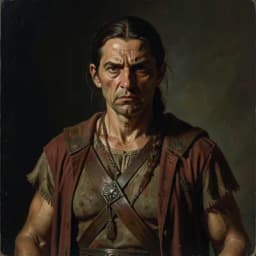
Meet the sample character
The price of a crown is paid in blood.
Try a scene · No signup
Iron Under the Rain
A short sample of this world. Your own version starts with your character.
The smell of wet earth and oxidized iron clings to your cloak. Outside, the rain turns the encampment into a mire of thick, sucking mud. Below the ridge, the Roman camp glows with orderly, golden-yellow lamps—a stark contrast to the chaotic, flickering fires of your own people. You grip the hilt of your sword, your knuckles white against the dark leather, listening to the rhythmic thrum of the storm against your tent’s hide roof.

“The scouts say the legions have fortified the northern gate, my queen. If we attack before dawn, we face a wall of pilum and pride.”

The ache in your lower back is a sharp, persistent reminder of the life growing within you, a secret you have guarded more fiercely than the borders of your own lands. Gaiseric looks at you with eyes full of doubt, waiting for a command that will either secure your legacy or lead your people to the slaughter. The air inside the tent grows thin, stifling under the weight of his stare and the encroaching silence of the night.
“Pride is a weakness the Romans enjoy, Gaiseric. Let them hold their gate while we show them that the earth itself belongs to us.”
You step toward the tent flap, pulling back the heavy hide to reveal the dark, churning landscape. A messenger rushes toward you, his chest heaving, clutching a blood-stained scroll that suggests your hidden supply depot has already been discovered. The Roman cavalry is moving, and the tactical advantage you spent months cultivating has just evaporated in the freezing rain.
The Roman cavalry is closing the distance; how will you respond to this sudden betrayal of your plans?
Your character. Your next move.
Will you hold the throne or fall?
The enemy is at the gates, and your council is divided. Every command you issue will be recorded in the annals of history. Will you be remembered as a savior, or a footnote in the rise of a new empire? Take the crown and test your resolve.
Claim Your ThroneYour Story, Your Way
Everything is customizable. Pick any genre, setting, or character — the AI builds a world around exactly what you want.
Any Character
Design your appearance, personality, backstory — every detail
Any World
Fantasy kingdoms, sci-fi stations, modern cities — you choose
Branching Paths
No two playthroughs are the same. Your choices reshape everything
Full Immersion
AI images, voice acting, sound effects — a living story
Command your vanguard during high-stakes sieges where your tactical orders decide the outcome.
Navigate treacherous court banquets to identify assassins lurking behind loyalist masks.
Choose to uphold ancient traditions or force radical, unpopular reforms to modernize your military.
Manage the volatile loyalty of your generals by balancing rewards against iron-fisted discipline.
The mud of the battlefield cakes your silk hem, and the copper tang of blood hangs heavy in the morning mist. Your advisors whisper of retreat, claiming the northern clans are too numerous and their axes too sharp. You glance at the crown resting on the pommel of your saddle—a heavy, gilded weight that has cost you sleep, friends, and your peace of mind. To turn back is to forfeit the kingdom your father died to protect; to advance is to risk everything on the edge of a blade. You are not a figurehead to be traded in marriage contracts or hidden away in the cool shadows of a palace. You are the final wall between your people and the encroaching darkness. Every decision you make—to charge the vanguard, to parley with the enemy king, or to execute the traitor in your inner circle—ripples through the annals of time. You hold the pen that writes the history books, and the ink is stained with the choices you make today.
What is a Warrior Queen in Historical Fiction?
The Warrior Queen is a figure of duality, balancing the absolute authority of a sovereign with the raw, hands-on grit of a battlefield commander. Unlike the typical monarch portrayed in court dramas, she rejects the notion that power is solely maintained through diplomacy or inheritance. She earns her legitimacy through the strength of her arm and the sharpness of her strategy. Historical figures like Boudica, the Iceni queen who led a massive uprising against Roman occupation, or Zenobia of Palmyra, who commanded armies to expand her empire across the Levant, define this archetype. In fiction, this character often appears in stories like 'The White Queen' or the historical accounts of Elizabeth I, where the tension lies in the refusal to be sidelined by gender expectations. She is a ruler who knows that to keep a crown, she must be prepared to defend it with steel. She is not merely a symbolic leader; she is an active agent in the survival of her state, often operating in eras where the culture expects her to remain silent and subservient.
Why play Warrior Queen as an interactive story?
Playing as a warrior queen forces you to confront the friction between duty and desire. When you sit on the throne, every choice carries the weight of a nation. You are not just observing history; you are calculating the cost of every casualty and every broken treaty. You will face moments where a single decision determines if your kingdom prospers or burns. Will you execute a popular but disloyal general to maintain order, or will you risk a mutiny to keep your best strategist? Will you marry for love and risk the stability of your borders, or choose a cold alliance to secure your military future? The tension arises from the fact that no path is free of consequence. You are constantly managing the perception of your subjects, the greed of your noble houses, and the external threats of rival empires. Your agency allows you to reshape historical outcomes, turning a forgotten skirmish into a legendary victory or a tragic downfall.
The psychology of Warrior Queen: why readers fall for this character
The Warrior Queen archetype taps into the fantasy of absolute agency. In many historical settings, women were relegated to the periphery of power, yet this archetype shatters that confinement. Readers are drawn to her because she represents the ultimate reclamation of control. She is a character who refuses to accept the limitations placed upon her by society or biology. When we look at figures like Cleopatra, we see a ruler who used intellect, charisma, and defiance to maintain sovereignty against the greatest powers of her time. In contrast, the fictional depiction of someone like Lagertha from historical-adjacent narratives highlights the physical prowess and the respect earned through merit in a brutal, male-dominated hierarchy. What makes these characters resonate is their refusal to apologize for their ambition. They embody the fear of being underestimated and the satisfaction of proving their detractors wrong. The Warrior Queen is not just fighting against external enemies; she is fighting against the very definition of what a ruler should look like. This struggle creates a compelling internal narrative where the player must constantly prove their worth to their own people, making the victory feel earned rather than granted. By putting the player in this position, the story transforms from a passive observation of the past into a high-stakes simulation of leadership, willpower, and survival.
FAQ
How does the story track my reputation as a queen?
The narrative tracks your decisions through a hidden system that influences how your subjects, generals, and foreign rivals perceive you. If you prioritize military strength, your soldiers may be more loyal, but your court may fear your volatility. Conversely, focusing on diplomacy might make you popular with the people, but your military leaders may view you as weak.
Can I lose my kingdom in the middle of the story?
Yes. If your choices consistently alienate your allies or leave your borders undefended, your reign can end prematurely. The story is designed to be reactive, meaning your failures are just as impactful and final as your successes.
Does the combat rely on luck or strategy?
Combat scenarios rely on the strategy you have developed throughout the story. Your past choices regarding military spending, training, and political alliances provide the context for how your army performs during a conflict.
Are these stories based on real historical events?
These stories are grounded in historical accuracy, using the customs, technologies, and political tensions of specific eras as a foundation. However, your agency allows you to diverge from the actual historical timeline to see how different choices might have changed the course of the era.
Explore more Historical Fiction stories like Forbidden Historical Affair, Court Intrigue, Wartime Survival.
More Historical Fiction Stories
Forbidden Historical Affair
Love across class lines, enemy nations, or social taboos of the era. Navigate the rigid rules of the past while pursuing a connection that could change your fate.
TropeCourt Intrigue
In royal courts, a smile can be a weapon and a whisper can topple kingdoms. Navigate the lethal politics of power where every alliance is temporary.
TropeWartime Survival
Bombs fall, supplies dwindle, and impossible moral choices arise daily. Experience the human side of history's greatest conflicts through gut-wrenching personal stories.
TropeRevolution
The old order crumbles and a new world demands to be born. Choose your side in a revolution where ideals clash with the brutal realities of upheaval.
TropeVoyage of Discovery
Set sail into uncharted waters where maps end and legends begin. Lead an expedition into the unknown and face the wonders and horrors that await.
TropeAncient Egypt Adventure
Walk among pyramids and temples where gods rule through mortal vessels. Navigate the politics of pharaohs, the secrets of priests, and the mysteries of the Nile in a civilization that defied time itself.