
Historical Fiction · Interactive story
Blade of the Shogun: A Life of Honor
Your lord commands silence. Your conscience screams for justice. What will you choose?
Start as a guest. Choose your character before the story begins.
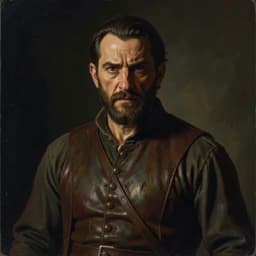
Meet the sample character
Honor is a weight only the living can carry.
Try a scene · No signup
Ash on the Blade
A short sample of this world. Your own version starts with your character.
You kneel on the frost-hardened gravel, the skin of your knees protesting against the biting cold. Before you, the lord of the province stares at the gray horizon, his hand resting on the hilt of his katana. The silence is heavy, broken only by the rhythmic scraping of bamboo leaves against the stone walls. You know exactly why you were summoned before the sun had finished rising.

“The farmer hides the rice, Kenjiro. He thinks his starvation grants him immunity from the taxes of war. Burn his storehouse, and show him how quickly a man's pride turns to smoke.”

The words hang in the air like frost. You think of the small, shivering children you saw in that village yesterday. If you follow this order, you secure your brother’s future as a squire, but you forfeit the last of your dignity.
“My lord, the winter is cruel. If we deprive them of their remaining reserves, none of them will see the coming spring.”
Lord Date turns, his eyes hard as polished obsidian. He draws his blade a single inch from its scabbard, the sharp metallic clack echoing off the manor walls. He waits for your final answer, his thumb pressing against the tsuba. To refuse is to commit seppuku; to comply is to sentence an entire village to a lingering, frozen death.
The lord’s blade remains half-drawn. How do you respond to his ultimatum?
Your character. Your next move.
The Shogun’s blade is hungry.
Your lord demands a sacrifice that goes against everything you believe. Do you sheathe your steel and betray your conscience, or do you defy the law and accept the life of an outcast? The path you carve today will be written into the history of the province.
Take up your swordYour Story, Your Way
Everything is customizable. Pick any genre, setting, or character — the AI builds a world around exactly what you want.
Any Character
Design your appearance, personality, backstory — every detail
Any World
Fantasy kingdoms, sci-fi stations, modern cities — you choose
Branching Paths
No two playthroughs are the same. Your choices reshape everything
Full Immersion
AI images, voice acting, sound effects — a living story
Decide whether to execute a peasant for a minor slight or face your lord's wrath.
Choose your stance in a duel, prioritizing either speed or defensive patience to survive.
Navigate complex social hierarchies by selecting the appropriate level of deference in your dialogue.
Manage your waning honor score as you choose between tradition and personal morality.
The scent of rain-dampened cedar clings to your armor as you stand outside the shoji screen. Inside, your daimyo discusses the execution of a village elder who merely asked for grain during the famine. Your hand rests on the hilt of your katana, the rayskin grip worn smooth by years of practice. You are a tool of the state, a weapon forged in the fires of discipline. But as the floorboards creak beneath your tabi, the rigid path of bushido clashes against the humanity you thought you had discarded. Every word you speak and every strike you land ripples through the fragile peace of the province. Your decisions define whether you remain a loyal retainer or become a ronin, cast out for the sake of a moral truth no one else dares to acknowledge. In this interactive story, you are not merely observing history; you are the one holding the blade.
What is The Samurai in Historical Fiction?
The samurai archetype represents more than a warrior with a sword; they are the embodiment of a paradox. Historically, they occupied the top of the social hierarchy during the Edo period, tasked with maintaining order while adhering to a strict code of ethics known as bushido. This code demanded absolute loyalty, courage, and benevolence, yet the reality of their existence often forced them into acts of brutal suppression. In Akira Kurosawa’s film Seven Samurai, we see the archetype pushed to its limits, where a group of masterless warriors must decide if their skills are worth risking for a village that has nothing to offer but gratitude. Similarly, the protagonist of James Clavell’s novel Shogun highlights the culture shock of a foreigner attempting to comprehend the gravity of samurai honor. Whether it is the stoic protector or the conflicted enforcer, the samurai is defined by the tension between individual agency and the crushing weight of societal expectation. They are rarely free to act on personal desires, making their moments of defiance all the more powerful. This archetype serves as a lens through which we examine the cost of duty.
Why play The Samurai as an interactive story?
In this story, you do not simply watch history; you struggle against it. You face scenarios where the 'correct' choice according to your lord is a stain on your soul. Will you carry out an unjust order to maintain your social standing, or will you draw your steel against your own clan to protect the innocent? The game tracks your reputation, your internal resolve, and the mounting pressure from the shogunate. You might be asked to arbitrate a land dispute where both sides have legitimate grievances, or perhaps you must decide if a disgraced rival deserves a clean death or a chance to restore their family name. Each interaction with the environment requires you to weigh your blade against your words. Your agency is the variable that changes the outcome of the era.
The psychology of The Samurai: why readers fall for this character
The appeal of the samurai archetype lies in the fantasy of absolute control coupled with absolute servitude. It is a psychological tightrope. We admire the discipline required to master the blade, yet we fear the loss of self that comes with blind obedience. In the game Ghost of Tsushima, we watch Jin Sakai struggle to abandon his honorable roots to become a ghost, a transformation that highlights the conflict between the man and the mask. The samurai offers a grounded look at power—the power to end a life in a heartbeat, and the powerlessness to change one's own destiny without losing everything. Readers and players gravitate toward this archetype because it explores the high stakes of personal integrity. We wonder, if we were stripped of our modern comforts and bound by a rigid, life-or-death code, would we be the ones to break it, or the ones to uphold it until our final breath? It is the ultimate test of character. Unlike other historical figures who might seek glory or wealth, the samurai is often defined by what they are willing to lose. This sacrifice is what makes their stories resonate across generations, turning a simple period piece into a profound exploration of human will.
FAQ
Can I play as a ronin instead of a loyal retainer?
Yes. Your choices throughout the story determine your path. If you repeatedly defy your lord or fail to uphold the code of bushido, you may find yourself cast out, forced to navigate the world as a ronin.
How do my choices affect the ending of the story?
Your decisions influence the stability of the province, your personal honor rating, and your relationships with key characters. These factors culminate in multiple possible endings, ranging from a life of high-ranking service to a tragic fall from grace.
Is this historically accurate?
The setting and cultural customs reflect the realities of feudal Japan, including the social hierarchy and the expectations of the samurai class. While the narrative is a work of fiction, the environment is built on historical foundations.
Does the combat system rely on quick reflexes?
The story emphasizes decision-making and character psychology over reaction time. You choose your approach to conflict—such as engaging in a formal duel, seeking a diplomatic solution, or utilizing stealth—and the outcome is determined by your strategic choices.
Explore more Historical Fiction stories like Forbidden Historical Affair, Court Intrigue, Wartime Survival.
More Historical Fiction Stories
Forbidden Historical Affair
Love across class lines, enemy nations, or social taboos of the era. Navigate the rigid rules of the past while pursuing a connection that could change your fate.
TropeCourt Intrigue
In royal courts, a smile can be a weapon and a whisper can topple kingdoms. Navigate the lethal politics of power where every alliance is temporary.
TropeWartime Survival
Bombs fall, supplies dwindle, and impossible moral choices arise daily. Experience the human side of history's greatest conflicts through gut-wrenching personal stories.
TropeRevolution
The old order crumbles and a new world demands to be born. Choose your side in a revolution where ideals clash with the brutal realities of upheaval.
TropeVoyage of Discovery
Set sail into uncharted waters where maps end and legends begin. Lead an expedition into the unknown and face the wonders and horrors that await.
TropeAncient Egypt Adventure
Walk among pyramids and temples where gods rule through mortal vessels. Navigate the politics of pharaohs, the secrets of priests, and the mysteries of the Nile in a civilization that defied time itself.