
Historical Fiction · Interactive story
The Weight of the Crown: Reign as Pharaoh
The Nile rises, the priests whisper, and the gods watch. Will you be remembered?
Start as a guest. Choose your character before the story begins.
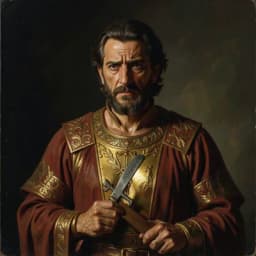
Meet the sample character
The Nile recedes, and the people hunger.
Try a scene · No signup
The Weight of the Crook
A short sample of this world. Your own version starts with your character.
The gold of your Nemes headdress presses against your temples, a constant, searing weight. Beyond the cool limestone walls of the throne room, the Nile is a sluggish, muddy ribbon. Your city of Thebes waits for a signal from the gods that you, their living representative, are failing to provide. The air hangs thick with the scent of burning myrrh, clinging to your fine linen robes like a shroud.

“The granaries in the southern province are empty, Pharaoh. If we do not seize the temple lands to feed the laborers, the harvest will fail, and your name will be carved into stone as the one who allowed Egypt to wither.”
You gaze out the window, watching a group of farmers gathered by the palace gate. Their ribs are visible through their tunics, and their eyes are hollow pits of desperation. Your advisors whisper that execution for the ringleaders is the only way to restore order, but the gods demand mercy from their chosen servants. Every breath you take is a calculation of life and death.
“I will not rule over a graveyard of my own making, Amenhotep. But to strip the temples is to invite the wrath of the gods who sustain this land. There must be another way.”

A scroll lies on your lap, stamped with the seal of the Hittite emissary waiting outside your gates. His soldiers carry enough grain to save your people, but the price is a border treaty that would surrender your strategic mountain passes. You hold the future of the Two Lands in your hands, and the sun begins its descent behind the western cliffs. The choice must be made before the stars align.
How will you provide for the starving people without destroying your legacy?
Your character. Your next move.
The throne is yours. Will you rise or fall?
The Nile is flooding, and your viziers are waiting for your word. Every decree you issue will shape the legacy of your dynasty. Whether you choose to be a conqueror, a builder, or a diplomat, the future of the Two Lands rests solely in your hands. Do not let your name fade into the sands of time.
Begin your reign nowYour Story, Your Way
Everything is customizable. Pick any genre, setting, or character — the AI builds a world around exactly what you want.
Any Character
Design your appearance, personality, backstory — every detail
Any World
Fantasy kingdoms, sci-fi stations, modern cities — you choose
Branching Paths
No two playthroughs are the same. Your choices reshape everything
Full Immersion
AI images, voice acting, sound effects — a living story
Allocate grain rations during a multi-year drought to prevent peasant uprisings.
Choose to favor the traditional priesthood or empower a new, loyal merchant class.
Negotiate border disputes with Hittite emissaries while managing your own restless generals.
Design the architectural legacy of your tomb to influence your status in the afterlife.
The scent of frankincense clings to your linen robes, thick and sweet in the stifling heat of the throne room. Outside, the Nile glitters like a vein of liquid gold, yet your eyes stay fixed on the grain reports from the Delta. A drought threatens the harvest, and the high priest of Amun stands before you, his gaze heavy with unspoken demands. You are the Living Horus, the bridge between the celestial and the mortal, but the crown feels heavier than the limestone blocks of your rising pyramid. Every decree you issue echoes through generations, and every silence invites a dagger in the dark. In this interactive story, your decisions dictate the prosperity of the Two Lands and the survival of your dynasty. Do you prioritize the appeasement of the gods or the strength of your charioteer armies? The ink is wet on the papyrus, and the history of Egypt waits for your command.
What is The Pharaoh in Historical Fiction?
The Pharaoh archetype represents the ultimate tension between absolute power and absolute vulnerability. While popular culture often paints these rulers as distant, golden statues, the historical reality—and the most compelling fiction—focuses on the precarious nature of their divinity. They are tasked with maintaining Ma'at, the cosmic order of the universe, which means any famine, military failure, or political unrest is viewed as a personal failure of the ruler. Unlike a typical monarch, the Pharaoh is a god on earth, meaning they cannot simply be wrong; they must be the physical embodiment of the right path. This archetype is explored brilliantly in Bolesław Prus’s 'Pharaoh,' which depicts the grueling struggle between a young, idealistic ruler and the entrenched power of the priesthood. Similarly, modern retellings like those found in the 'Kane Chronicles' or various historical films emphasize the isolation that comes with being the sole protector of a civilization. These stories succeed because they strip away the mythology to show the human person underneath, forced to manage complex bureaucracy, border skirmishes, and the crushing weight of divine expectation.
Why play The Pharaoh as an interactive story?
Stepping into the role of an Egyptian ruler forces you to confront the reality that power is rarely about choice, but about the cost of those choices. In this experience, you aren't just reading about a king; you are managing the delicate ecosystem of an empire. You will face dilemmas that have no perfect solution, where choosing to save one province might starve another. The tension arises from the constant pressure of your court. You must balance the loyalty of your generals, who want to expand the borders, against the whispers of your vizier, who knows the treasury is empty. You will encounter moments where you must decide whether to honor an ancient treaty that hinders your progress or break your word to secure your nation's future. Every conversation is a potential trap, and every building project is a drain on your resources. You must decide if you want to be a ruler who is loved, feared, or remembered as a god. The agency provided here allows you to see if you have the temperament to keep the Two Lands from fracturing, or if your name will be scratched from the temple walls.
The psychology of The Pharaoh: why readers fall for this character
The attraction to the Pharaoh archetype lies in the fantasy of absolute agency coupled with the terrifying reality of absolute responsibility. Readers are drawn to this figure because they represent the ultimate 'what if' scenario: if you had the power to shape a civilization, would you be a tyrant or a savior? The archetype thrives on the duality of the ruler. In Mika Waltari’s 'The Egyptian,' we see the protagonist struggle against the rigid structures of his society, highlighting the irony that the most powerful person in the land is often the most restricted by ritual and tradition. This creates a compelling psychological conflict—the desire for personal freedom versus the duty to the state. Another example is the depiction of Cleopatra in various historical dramas, which emphasizes the intellect required to stay alive in a court full of predators. The Pharaoh archetype activates a specific desire for legacy. We all want to leave a mark on the world, and this character allows us to build monuments, draft laws, and influence the course of history on a grand scale. Yet, the fear component is equally strong. The archetype reminds us that being at the top of the hierarchy makes you the primary target for every ambition, envy, and natural disaster. We watch these characters struggle with the knowledge that despite their divine status, they are still subject to the same human flaws as their subjects. This relatability within the grandiosity is why the archetype remains a staple of historical fiction; it provides a safe space to explore the burdens of leadership, the temptation of corruption, and the desperate search for immortality.
FAQ
How do my choices impact the stability of Egypt?
Your decisions affect multiple variables, including the loyalty of the priesthood, the strength of your army, and the morale of the populace. A choice that pleases the army might alienate the temple, potentially leading to religious unrest or political coups that alter the timeline of your reign.
Can I change historical events in this game?
You possess the agency to deviate from historical outcomes. While the setting is grounded in period-accurate technology and political challenges, your actions can lead to different military successes, architectural achievements, or social reforms than those recorded in history books.
What happens if I lose favor with the gods?
In this setting, the gods are reflected in the favor of the people and the priests. Losing favor manifests as internal dissent, failed harvests, or poor military morale. If the populace loses faith in your divinity, you may face a challenge to your throne or a decline in your kingdom's prosperity.
Is this game historically accurate?
The story incorporates authentic historical details, including court hierarchy, religious rituals, and common geopolitical tensions of the era. While the narrative is fictional, the challenges, customs, and environment are designed to reflect the historical context of Ancient Egypt.
Explore more Historical Fiction stories like Forbidden Historical Affair, Court Intrigue, Wartime Survival.
More Historical Fiction Stories
Forbidden Historical Affair
Love across class lines, enemy nations, or social taboos of the era. Navigate the rigid rules of the past while pursuing a connection that could change your fate.
TropeCourt Intrigue
In royal courts, a smile can be a weapon and a whisper can topple kingdoms. Navigate the lethal politics of power where every alliance is temporary.
TropeWartime Survival
Bombs fall, supplies dwindle, and impossible moral choices arise daily. Experience the human side of history's greatest conflicts through gut-wrenching personal stories.
TropeRevolution
The old order crumbles and a new world demands to be born. Choose your side in a revolution where ideals clash with the brutal realities of upheaval.
TropeVoyage of Discovery
Set sail into uncharted waters where maps end and legends begin. Lead an expedition into the unknown and face the wonders and horrors that await.
TropeAncient Egypt Adventure
Walk among pyramids and temples where gods rule through mortal vessels. Navigate the politics of pharaohs, the secrets of priests, and the mysteries of the Nile in a civilization that defied time itself.