
Historical Fiction · Interactive story
The Weight of Steel: A Medieval Knight’s Burden
The oath is simple, but the cost of blood and iron is heavy.
Start as a guest. Choose your character before the story begins.
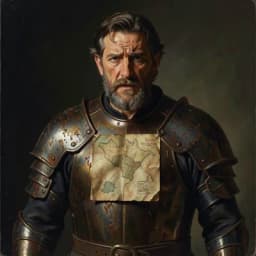
Meet the sample character
The Siege of Château Gaillard, 1204
Try a scene · No signup
Iron Against the Pale Wall
A short sample of this world. Your own version starts with your character.
You grip the hilt of your longsword, the leather wrapping worn thin by years of conflict. Below the crenellations, the French siege engines hammer against the limestone like a giant's heartbeat. Dust chokes the air, mingling with the scent of burning oil and pulverized rock. You are the last line of defense for a wall already crumbling under gravity and iron.

“Guiraut, the breach in the outer wall is widening! If we do not rally the men to the gatehouse now, they will be inside before the vesper bell.”

Your armor feels like a funeral shroud. Baudouin’s eyes are wide, reflecting the fires consuming the lower ward. You glance at your squire, who trembles while gripping a pike with white-knuckled hands. The weight of your oath sits heavy on your chest, but the parchment tucked in your tunic burns hotter—a secret path out that leaves the garrison to the slaughter.
“The gatehouse is a tomb, Baudouin. I have another path, one that secures our survival, but it means leaving the others to their fate.”
A boulder smashes into the gatehouse tower, showering the courtyard in jagged stone. Your squire cries out as debris tears through his surcoat. The wall is swaying, and the war cries of the French infantry grow louder through the gap in the masonry. You have seconds to decide whether to hold the line until the final breath or abandon the ruin.
The wall is buckling under the assault. How will you face the final hours of the siege?
Your character. Your next move.
Forging Your Legacy in Steel
The battlefield awaits your command. Will you be remembered as a saint of the realm or a ruthless tactician who did what was necessary to survive? Your choices in the heat of the fray determine the fate of your house. Pick up your sword and define your history.
Start Your Knight StoryYour Story, Your Way
Everything is customizable. Pick any genre, setting, or character — the AI builds a world around exactly what you want.
Any Character
Design your appearance, personality, backstory — every detail
Any World
Fantasy kingdoms, sci-fi stations, modern cities — you choose
Branching Paths
No two playthroughs are the same. Your choices reshape everything
Full Immersion
AI images, voice acting, sound effects — a living story
Decide whether to uphold your oath or prioritize the safety of your kin.
Manage your reputation among the nobility while maintaining the trust of your infantry.
Choose your tactics during a siege, weighing the lives lost against the strategic objective.
Rain slicks the cobblestones of the courtyard, reflecting the grey, suffocating sky. Sir Godwyn tightens his leather gauntlet, the smell of damp hay and horse sweat clinging to his surcoat. Before him, the king’s decree waits—a command to burn a village that has done nothing but survive. You stand at this precipice, your hand resting on the hilt of a blade forged for protection, now poised for destruction. Every decision you make ripples through the kingdom, altering the path of your honor and the lives of those who look to you for safety. This is an interactive experience where your choices dictate whether you remain a guardian of the realm or become a cautionary tale whispered by the peasantry.
What is The Medieval Knight in Historical Fiction?
The medieval knight archetype represents the intersection of religious devotion, military might, and rigid social structure. Often romanticized in literature like Sir Thomas Malory’s Le Morte d'Arthur, the knight is not just a soldier; they are a vessel for a moral code known as chivalry. However, history paints a grittier picture. Think of the conflicted protagonists in Ridley Scott’s The Last Duel or the mud-caked, tactical reality depicted in Kingdom Come: Deliverance. These stories highlight that being a knight meant balancing the brutal necessity of violence against the lofty ideals of protecting the weak. It is a persona defined by heavy plate armor, the politics of feudal land ownership, and the constant threat of a sudden, violent end on the battlefield. This archetype forces characters to navigate a world where a misplaced word or a failed charge can destroy a noble house.
Why play The Medieval Knight as an interactive story?
Agency turns the abstract concept of chivalry into a series of agonizing dilemmas. You are not just watching a story; you are living the consequences of a divided conscience. Will you defend a disgraced squire at the risk of losing your lord’s favor? Do you charge into the fray to uphold your vows, or do you prioritize the survival of your men when the strategy is clearly flawed? You manage the delicate balance between piety and pragmatism, often finding that the most noble choice in a courtroom is the most dangerous one on the field. The tension lies in the gap between the songs sung about you and the blood on your hands.
The psychology of The Medieval Knight: why readers fall for this character
The knight archetype thrives because it externalizes internal conflict. We see the knight as a symbol of order in a chaotic period, yet they are often the most constrained characters in the narrative. In Sir Walter Scott’s Ivanhoe, the knight is a vessel for national identity and romantic tension. Conversely, the protagonist of Umberto Eco’s The Name of the Rose—though a monk—deals with similar pressures of intellectual and physical survival against institutional power. The knight embodies the fantasy of absolute power tempered by absolute duty. We are drawn to them because they are trapped in a role that demands perfection in a world that is fundamentally broken. They represent the struggle to remain human while wearing a shell of cold, unfeeling steel. Whether it is the pursuit of a Holy Grail or the defense of a crumbling castle, the knight’s arc is one of endurance against inevitable decay.
FAQ
How does the chivalry system affect my choices?
Your adherence to chivalry acts as a reputation mechanic. Actions that align with your vows increase your standing with the church and nobility but may leave you vulnerable to political betrayal or tactical disadvantage.
Can I fail my quest as a knight?
Yes. The story adapts to your failures. If you lose your lands or your honor, the narrative shifts, forcing you to play as an exiled knight or a mercenary, changing your goals entirely.
Is this knight game historically accurate?
The narrative focuses on authentic period details, including feudal law, combat mechanics, and social hierarchy, while allowing for player agency to diverge from actual historical outcomes.
What makes this different from other fantasy RPGs?
Unlike high fantasy, this experience is grounded in historical fiction. You will not face dragons or magic; you will face the cold realities of starvation, political maneuvering, and the lethality of medieval weaponry.
Explore more Historical Fiction stories like Forbidden Historical Affair, Court Intrigue, Wartime Survival.
More Historical Fiction Stories
Forbidden Historical Affair
Love across class lines, enemy nations, or social taboos of the era. Navigate the rigid rules of the past while pursuing a connection that could change your fate.
TropeCourt Intrigue
In royal courts, a smile can be a weapon and a whisper can topple kingdoms. Navigate the lethal politics of power where every alliance is temporary.
TropeWartime Survival
Bombs fall, supplies dwindle, and impossible moral choices arise daily. Experience the human side of history's greatest conflicts through gut-wrenching personal stories.
TropeRevolution
The old order crumbles and a new world demands to be born. Choose your side in a revolution where ideals clash with the brutal realities of upheaval.
TropeVoyage of Discovery
Set sail into uncharted waters where maps end and legends begin. Lead an expedition into the unknown and face the wonders and horrors that await.
TropeAncient Egypt Adventure
Walk among pyramids and temples where gods rule through mortal vessels. Navigate the politics of pharaohs, the secrets of priests, and the mysteries of the Nile in a civilization that defied time itself.