
Historical Fiction · Interactive story
Whispers in Gion: The Geisha's Burden
Behind the painted mask, a single word can topple an empire.
Start as a guest. Choose your character before the story begins.
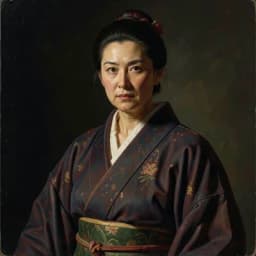
Meet the sample character
Silk conceals many things, including the edge of a blade.
Try a scene · No signup
The Weight of a Whispered Promise
A short sample of this world. Your own version starts with your character.
The room smells of stale cedar and expensive incense. You adjust your obi, feeling the weight of the silver hairpin tucked into your sash—a tool not for beauty, but for leverage. Lord Tanabe sits across the lacquer table, his face a mask of practiced indifference, though his fingers tremor slightly against his sake cup. Outside, the rain slickens the cobblestones of Gion, sealing the world away.

“The Ministry is tightening their grip, Hanae. I need to know which merchant families are funding the southern dissenters, and I need it by sunrise.”

You keep your expression serene, a mask perfected through years of training. Behind your eyes, you calculate the cost of this betrayal. If you provide the names, the merchant families will face the executioner’s blade. If you refuse, Tanabe’s guards will be at your door before dawn, tearing your tea house apart to find the documents you’ve hidden beneath the floorboards.
“Sunlight is a long way off, My Lord. Perhaps we should discuss the price of such sensitive information before the night grows any colder.”
He leans forward, the light catching the jagged scar on his cheek. He knows you hold the keys to his political survival, and he isn't the only one watching you tonight. A shadow flickers behind the shoji screen—a messenger from the very rebels you are considering exposing. You have seconds to decide whose life you value more.
The messenger waits in the shadows for a sign. Do you trade the names or turn the tables?
Your character. Your next move.
Will you remain a shadow, or rule from it?
The tea is served, the lords are waiting, and the fate of Kyoto hangs on your next word. Every fan you open and every secret you whisper changes the future of the shogunate. Step into the Gion district and see if you have the grace to survive.
Begin your life in GionYour Story, Your Way
Everything is customizable. Pick any genre, setting, or character — the AI builds a world around exactly what you want.
Any Character
Design your appearance, personality, backstory — every detail
Any World
Fantasy kingdoms, sci-fi stations, modern cities — you choose
Branching Paths
No two playthroughs are the same. Your choices reshape everything
Full Immersion
AI images, voice acting, sound effects — a living story
Manage your reputation across different social classes to gain access to forbidden areas.
Choose which secrets to trade for political favors and which to keep hidden forever.
Perform traditional arts to disarm rivals and extract information during high-stakes tea ceremonies.
Navigate the shifting alliances of the shogunate by choosing who to trust and deceive.
Snow falls silently over the Kamo River, dusting the wooden bridges of Kyoto in white. Inside the teahouse, the scent of charcoal and expensive incense hangs heavy, masking the tension between two powerful lords. You adjust your obi, the silk smooth against your fingertips, and pour sake with practiced, fluid grace. Every movement is a calculated performance, every smile a guarded secret. You are not merely an entertainer; you are the eyes and ears of a city that thinks you are invisible. A whispered conversation in the corner could reveal a betrayal, or it could lead to your ruin. In this story, your choices determine whether you remain a prisoner of tradition or become the architect of a new political era. Will you play the role expected of you, or will you use your influence to rewrite the fate of the shogunate?
What is The Geisha in Historical Fiction?
The geisha archetype represents the intersection of high art and high-stakes survival. Historically, these women were trained from childhood in traditional Japanese arts—dance, music, and the complex etiquette of the tea ceremony—but their true value lay in their ability to facilitate elite social connections. In literature and film, such as Arthur Golden’s 'Memoirs of a Geisha' or the nuanced portrayals in the classic film 'Gion Bayashi,' the geisha functions as a bridge between worlds. She exists in the 'flower-and-willow' world, a space physically and culturally separated from the rigid hierarchies of the samurai and the merchant classes. Unlike other historical archetypes that rely on physical strength, the geisha wields social capital. She is the ultimate listener, the keeper of secrets, and a master of psychological warfare. This character type thrives in environments where overt power is forbidden to women, forcing them to cultivate influence through wit, patience, and the strategic deployment of information. By positioning yourself as a confidante to the powerful, you gain access to the inner chambers of government, where the real decisions of the era are made.
Why play The Geisha as an interactive story?
Playing as a geisha shifts the focus from the battlefield to the parlor, where the stakes are often more dangerous. You are constantly balancing the need for public approval with the desire for private autonomy. Every patron you encounter brings a different set of risks and rewards. One lord might seek an ally to undermine his rival, while another might be a spy looking for a leak in his own household. You must choose how to respond to subtle threats, when to reveal a piece of information, and when to feign ignorance. The agency in this experience lies in the tension of the 'performance.' If you act too bold, you lose your reputation; if you act too timid, you lose your leverage. You will face moments where you must decide whether to protect a friend at the cost of your status or sacrifice a patron to secure your own safety. The narrative adapts to your temperament, rewarding those who can maintain their composure while manipulating the political landscape from the shadows.
The psychology of The Geisha: why readers fall for this character
The appeal of the geisha archetype lies in the fantasy of hidden competence. Readers are drawn to characters who possess profound knowledge they cannot openly express. This archetype activates a desire for control in a world that denies it, showing how the quietest person in the room often holds the most influence. It is the antithesis of the 'hero' who swings a sword; instead, it is the hero who holds the pen, the secret letter, or the whispered confession. In James Clavell’s 'Shogun,' the interactions between characters often hinge on these subtle power dynamics, where a simple gesture carries the weight of a death sentence. Similarly, the protagonist in 'The Makioka Sisters' navigates the rigid expectations of family and status, showing the internal strain of maintaining a perfect exterior. The geisha archetype pushes this to its limit by forcing the character to be a mirror for others—reflecting back exactly what they want to see, while hiding her own internal world. This creates a compelling psychological conflict: the longer you pretend to be someone else for the sake of survival, the harder it becomes to remember who you were before the makeup and the silk. This struggle for identity, played out against the backdrop of historical instability, makes the geisha a uniquely rewarding character for anyone interested in the nuance of human interaction and the quiet, often overlooked history of those who actually held the strings of power.
FAQ
How do my choices affect my reputation as a geisha?
Your reputation is your currency. Each interaction with a patron or rival changes how the tea houses and the local authorities perceive you. High reputation grants you entry to exclusive events, while a tarnished reputation can leave you isolated and vulnerable to political enemies.
Can I influence historical events in this game?
Yes. While you start as an entertainer, your reach extends into the inner circles of the ruling class. By feeding information to the right people or withholding it from the wrong ones, you can shift the balance of power during major historical turning points.
Is this story historically accurate?
The setting, social hierarchies, and cultural practices are grounded in historical records of the Edo and Meiji periods. While the specific narrative path is yours to create, the environmental details and the constraints of your character's life reflect the authentic conditions of the era.
What happens if I make a social mistake?
Social mistakes have immediate consequences. Depending on the setting, a slip in etiquette might cause you to lose a patron’s favor, alert a guard to your presence, or force you into a difficult negotiation to save your position.
Explore more Historical Fiction stories like Forbidden Historical Affair, Court Intrigue, Wartime Survival.
More Historical Fiction Stories
Forbidden Historical Affair
Love across class lines, enemy nations, or social taboos of the era. Navigate the rigid rules of the past while pursuing a connection that could change your fate.
TropeCourt Intrigue
In royal courts, a smile can be a weapon and a whisper can topple kingdoms. Navigate the lethal politics of power where every alliance is temporary.
TropeWartime Survival
Bombs fall, supplies dwindle, and impossible moral choices arise daily. Experience the human side of history's greatest conflicts through gut-wrenching personal stories.
TropeRevolution
The old order crumbles and a new world demands to be born. Choose your side in a revolution where ideals clash with the brutal realities of upheaval.
TropeVoyage of Discovery
Set sail into uncharted waters where maps end and legends begin. Lead an expedition into the unknown and face the wonders and horrors that await.
TropeAncient Egypt Adventure
Walk among pyramids and temples where gods rule through mortal vessels. Navigate the politics of pharaohs, the secrets of priests, and the mysteries of the Nile in a civilization that defied time itself.