
Historical Fiction · Interactive story
The Conquistador: Ambition and Gold in the New World
The map is empty, the jungle is hostile, and your legacy is unwritten.
Start as a guest. Choose your character before the story begins.
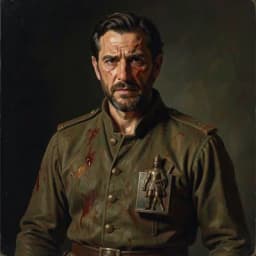
Meet the sample character
Try a scene · No signup
Blood and Bittersweet Gold
A short sample of this world. Your own version starts with your character.
Humidity clings to your steel breastplate like a fever. You hack through a wall of vines, the machete biting into wood, while behind you, the expedition's morale rots faster than the damp floor. The map in your bag, etched in goat skin, promises a temple of gold, but the silence of these trees feels like a held breath before a scream.

“God is not in this place, Gonzalo. Only the Devil’s own mirrors, waiting to show us our sins.”

You wipe sweat from your eyes, watching the friar stumble over a protruding root. His hands clutch a wooden crucifix so tightly his knuckles are white, a stark contrast to the verdant green that surrounds you. Your men are starving, their eyes darting toward your belt, toward the rations, and toward the shimmering heat haze that might be a mirage or a trap.
“Keep your prayers for the camp, Friar. If we find this gold, it won't be God who pays for our passage home.”
A branch snaps—not the soft sound of a falling twig, but the sharp crack of a weapon being readied. From the dense canopy, a single feather-clad warrior emerges, spear leveled at your throat, while the rest of your men freeze, their arquebuses still cold and unprimed. You have seconds to act before the jungle claims your entire company.
The spear tip trembles inches from your throat. How do you respond to the unseen army surrounding you?
Your character. Your next move.
Claim your fortune in the New World
The horizon is calling, and your crew is waiting for your command. Will you be remembered as a pioneer who built bridges, or a warlord who burned everything to ash? Your first choice awaits.
Start Your ExpeditionYour Story, Your Way
Everything is customizable. Pick any genre, setting, or character — the AI builds a world around exactly what you want.
Any Character
Design your appearance, personality, backstory — every detail
Any World
Fantasy kingdoms, sci-fi stations, modern cities — you choose
Branching Paths
No two playthroughs are the same. Your choices reshape everything
Full Immersion
AI images, voice acting, sound effects — a living story
Decide whether to trade for supplies or seize them, altering local diplomatic relations forever.
Manage the morale of a splintering crew through speeches, punishments, or shared hardship.
Negotiate complex treaties with local chieftains while hiding your true intent from your men.
Choose between chasing rumors of gold and establishing a permanent, defensible settlement.
The salt air stings your eyes as the shoreline of the Yucatan finally breaks the horizon. Your breastplate is scorching under the tropical sun, a heavy reminder of the crown’s expectations and the weight of your own ambition. Behind you, the men are restless; ahead, a jungle that hides gold, ruin, or perhaps both. You are here to claim land, souls, and fortune, but the silence of the dense forest suggests the land has its own plans for you. Every decision you make carries the gravity of history, from the first parley with local chieftains to the final, desperate charge for survival. In this narrative, your choices dictate whether your expedition ends in triumph or is swallowed by the earth itself.
What is The Conquistador in Historical Fiction?
The Conquistador archetype represents a volatile mixture of religious zeal, insatiable greed, and physical courage. Historically, these figures were not merely soldiers of fortune; they were agents of empires operating far from the reach of their monarchs. They arrived in the Americas with limited resources and immense audacity, attempting to topple vast, sophisticated civilizations like the Aztec or Inca empires. In fiction, this archetype is often portrayed with deep moral ambiguity. Look at Werner Herzog’s film 'Aguirre, the Wrath of God,' which tracks a descent into madness fueled by the search for El Dorado. Or consider the film 'The Mission,' where the conflict between spiritual duty and colonial expansionism forces characters into impossible corners. These stories rarely paint the protagonist as a hero in the modern sense. Instead, they present a figure pushed by the fervor of their time—a man driven by the promise of gold and the perceived necessity of spreading his faith, regardless of the cost to himself or the civilizations he encounters. The archetype is defined by the friction between the European worldview and the realities of a continent that refuses to submit to his expectations.
Why play The Conquistador as an interactive story?
Playing as a conquistador forces you to confront the brutal math of conquest. You are not just managing your own survival; you are responsible for the morale of men who are starving, sick, and terrified. The tension arises from the competing pressures of your mission. Do you respect the local traditions to secure a peaceful passage, risking the ire of your superiors back in Spain? Or do you seize what you need by force, knowing that every violent act sows the seeds of future rebellion? You will face moments where the map you carry is useless, and the only guide you have is your own intuition. Perhaps you encounter a city of gold, only to realize the cost of taking it involves an alliance that will eventually betray you. You must weigh the political implications of your actions against the immediate need for survival. Does your loyalty lie with the King, your crew, or the legacy you intend to build? Every dialogue choice with indigenous leaders or your own officers changes the landscape of your expedition. You are the architect of a colonial disaster or a new beginning, and the consequences of your failures are etched permanently into the history you are writing.
The psychology of The Conquistador: why readers fall for this character
The fascination with the Conquistador archetype lies in the tension between human limitations and the pursuit of the impossible. We are drawn to these characters because they represent the extreme edge of human agency. They possess the audacity to believe they can rewrite the geography of the world, a fantasy that is both terrifying and seductive. This character type acts as a lightning rod for themes of hubris, cultural clash, and the ultimate futility of empire. Consider the portrayal of Cortes in various historical accounts versus fiction; he is rarely a static figure. He is a master of adaptation, utilizing local politics to dismantle an empire from within. This specific type of intelligence—the ability to manipulate a foreign environment to serve one's own ends—is what makes the archetype compelling to follow. Readers fall for the Conquistador because they want to understand the mindset that allowed a few hundred men to challenge millions. It is a study in extreme pressure. In novels like those by Buddy Levy, or even the darker, more visceral depictions in Cormac McCarthy’s 'Blood Meridian'—though set later, it captures the same spirit of the frontier—the protagonist is defined by the environment they try to conquer. The environment acts as a mirror, reflecting the protagonist's inner rot or their surprising capacity for empathy. The Conquistador archetype forces us to ask: what is the price of legacy? When we inhabit this character, we are not looking for a moral victory. We are looking to test the limits of our own resolve. We want to see if we would break under the same pressure, or if we would be the one to hold the line when everything falls apart. The fear they activate is the fear of being forgotten, while the desire they embody is the singular, burning need to be the person who changes the map.
FAQ
What is the primary challenge in a Conquistador story?
The primary challenge is balancing your limited resources against the vast, unknown territory. You must manage your crew's loyalty, your supplies, and your diplomatic standing with local civilizations, all while the pressure from the Spanish Crown grows.
Can I choose to be a peaceful explorer instead of a conqueror?
Yes. Your choices dictate your path. You can prioritize trade, diplomacy, and cultural exchange, though doing so may put you at odds with your own men and your ultimate mission objectives.
How does the game handle the historical accuracy of the era?
The narrative draws from period-accurate accounts, detailing the weaponry, social structures, and motivations of 16th-century expeditions. While you have the freedom to change the outcome, the world reacts to you based on the historical realities of the time.
Is this story suitable for fans of strategy games?
Absolutely. If you enjoy managing logistics, political maneuvering, and high-stakes decision-making, the Conquistador archetype offers a deep experience where every tactical choice impacts your long-term success.
Explore more Historical Fiction stories like Forbidden Historical Affair, Court Intrigue, Wartime Survival.
More Historical Fiction Stories
Forbidden Historical Affair
Love across class lines, enemy nations, or social taboos of the era. Navigate the rigid rules of the past while pursuing a connection that could change your fate.
TropeCourt Intrigue
In royal courts, a smile can be a weapon and a whisper can topple kingdoms. Navigate the lethal politics of power where every alliance is temporary.
TropeWartime Survival
Bombs fall, supplies dwindle, and impossible moral choices arise daily. Experience the human side of history's greatest conflicts through gut-wrenching personal stories.
TropeRevolution
The old order crumbles and a new world demands to be born. Choose your side in a revolution where ideals clash with the brutal realities of upheaval.
TropeVoyage of Discovery
Set sail into uncharted waters where maps end and legends begin. Lead an expedition into the unknown and face the wonders and horrors that await.
TropeAncient Egypt Adventure
Walk among pyramids and temples where gods rule through mortal vessels. Navigate the politics of pharaohs, the secrets of priests, and the mysteries of the Nile in a civilization that defied time itself.