
Historical Fiction · Interactive story
The Edge of Honor: Feudal Japan Awaits
Your lord is dead. Your sword is thirsty. What price will you pay for loyalty?
Start as a guest. Choose your character before the story begins.
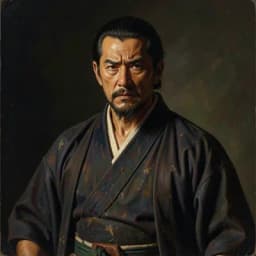
Meet the sample character
Honor is a heavy burden when the path forward is stained with blood.
Try a scene · No signup
The Blade’s Cold Debt
A short sample of this world. Your own version starts with your character.
You kneel on the tatami, the coarse grain pressing into your knees. Steam curls from a bowl of bitter matcha, but you haven't touched it. Across from you, Lord Takamori’s hand rests on the hilt of his tachi. The silence in the chamber is suffocating, broken only by the rhythmic dripping of rain from the eaves into the stone basin outside.

“The order stands, Kenjiro. Your brother-in-arms has shamed this clan. If you do not strike, you are as guilty as he.”

You feel the familiar, cold weight of your katana tucked into your obi. Your knuckles ache. Memories of training alongside Daisuke—sharing rice, bandaging wounds, laughing in the mud—flare in your mind like dying embers. To follow the Lord is to follow the code, but to strike is to sever your own spirit.
“My loyalty is to the clan, My Lord, but justice requires evidence beyond rumors whispered in the dark.”
Takamori’s eyes narrow, his grip tightening. He draws his blade a fraction, the steel singing a lethal note. You have one heartbeat to decide: obey a flawed master, defy him and invite immediate execution, or propose a gamble that could ignite a civil war within these walls. The guards wait behind the shoji screen, their hands already on their hilts.
How do you respond to the Lord's ultimatum?
Your character. Your next move.
Will you keep your honor or your life?
The daimyo’s order is clear, but your heart screams for mercy. In the mud of the battlefield, your blade rests in your hand, trembling with the weight of your next move. Do you strike down the innocent to satisfy your duty, or do you defy the shogunate and face the consequences? Your legacy is waiting to be written.
Start your samurai storyYour Story, Your Way
Everything is customizable. Pick any genre, setting, or character — the AI builds a world around exactly what you want.
Any Character
Design your appearance, personality, backstory — every detail
Any World
Fantasy kingdoms, sci-fi stations, modern cities — you choose
Branching Paths
No two playthroughs are the same. Your choices reshape everything
Full Immersion
AI images, voice acting, sound effects — a living story
Choose to uphold rigid traditions or prioritize mercy when the two conflict directly.
Manage your reputation among the daimyo, influencing your access to resources and allies.
Decide the fate of your clan through tactical maneuvers and high-stakes social interactions.
Face the physical and mental consequences of your actions in the aftermath of combat.
The scent of rain clings to the cedar rafters of the tea house, masking the metallic tang of blood on your sleeve. Outside, the village burns, a grim witness to the failed negotiation between rival clans. You stand at a crossroads: return to your master with failure hanging over your head, or commit seppuku to preserve a shred of dignity. Every decision you make carries the weight of history and the sharp sting of steel. In this interactive story, your choices dictate whether you die a legend or live as a ronin, haunted by the path you chose. The code of the warrior is not merely a set of rules; it is a razor-thin line between salvation and total disgrace.
What is Samurai Honor in Historical Fiction?
Samurai Honor centers on the conflict between personal morality and the rigid demands of Bushido. In historical fiction, this trope explores the psychological toll of living in a society where one’s reputation is more valuable than life itself. It is rarely about the glory of battle; instead, it focuses on the silent, agonizing decisions made behind closed doors. Consider Akira Kurosawa’s masterpiece, 'Harakiri,' which examines the hypocrisy of the warrior code when confronted with true poverty and desperation. The trope forces characters to navigate a landscape where a single misspoken word or a failed duty can force a man to choose between his family and his status. It is a narrative of restraint, where the most powerful moments occur not during the clash of katanas, but in the quiet silence following a command that defies a character's conscience. When you engage with these stories, you are not just a spectator; you are the one deciding if the code is a shield or a cage.
Why play Samurai Honor as an interactive story?
Playing through these scenarios shifts the perspective from observation to accountability. When you embody a warrior in feudal Japan, the pressure of every interaction feels real because the game remembers your reputation. You might face a situation where your lord orders you to execute a childhood friend for a minor infraction. Do you follow the order and maintain your standing, or do you commit treason to save a life, knowing you will be hunted by your own brothers-in-arms? Agency adds a layer of anxiety that static media cannot replicate. You are forced to weigh the long-term cost of your actions against the immediate survival of your character. The tension arises from the fact that there is no 'correct' path; every choice leaves a scar on your character's soul and shifts the political landscape of the shogunate.
Famous examples of Samurai Honor in books, film, and games
The trope of the conflicted warrior appears across diverse media, each using it to highlight different facets of human nature. In 'Ghost of Tsushima,' the protagonist Jin Sakai faces the ultimate test of honor: he must abandon the honorable, face-to-face combat style of his ancestors to adopt the 'Ghost' persona—a dishonorable, stealth-based approach—to save his people from invasion. This highlights the brutal pragmatism required when traditional methods fail. Conversely, the manga 'Lone Wolf and Cub' showcases a ronin who carries his young son while seeking vengeance, navigating a world where he is an outcast because he has lost his master, yet he maintains his own strict, personal code of honor that is far more rigid than the society he wanders through. In the film '47 Ronin,' the focus is on the collective sacrifice of honor for the sake of long-term justice, illustrating how the code can be weaponized against those who hold it most dear. These stories endure because they mirror the modern dilemma of balancing professional or societal expectations with personal integrity. By placing this choice in your hands, the narrative becomes a reflection of your own values when tested under the most extreme circumstances imaginable.
FAQ
What is the Bushido code in the context of these stories?
Bushido is the ethical framework governing the samurai, emphasizing loyalty, courage, and honor. In these stories, it acts as a mechanical restraint. You are often rewarded for following the code, but the most compelling narratives occur when the code demands something you find morally abhorrent, forcing you to choose between your status and your conscience.
Can I play as a ronin instead of a loyal samurai?
Yes. Depending on your choices, you can lose your status, be exiled, or choose to abandon your master. Becoming a ronin changes the narrative, as you lose the protection and resources of a clan, but you gain the freedom to define your own path outside of the social hierarchy.
How do my choices impact the ending?
Your choices accumulate throughout the story. Decisions regarding honor, political alliances, and tactical mercy determine whether your character dies in a blaze of glory, survives as a disgraced wanderer, or rises to become a powerful leader who reshapes the laws of the land.
Are these stories historically accurate?
While the settings, social structures, and weaponry are grounded in the realities of feudal Japan, the stories prioritize dramatic tension and character agency. They aim to capture the spirit and sensory details of the era while allowing you to deviate from actual historical events.
Explore more Historical Fiction stories like Forbidden Historical Affair, Court Intrigue, Wartime Survival.
More Historical Fiction Stories
Forbidden Historical Affair
Love across class lines, enemy nations, or social taboos of the era. Navigate the rigid rules of the past while pursuing a connection that could change your fate.
TropeCourt Intrigue
In royal courts, a smile can be a weapon and a whisper can topple kingdoms. Navigate the lethal politics of power where every alliance is temporary.
TropeWartime Survival
Bombs fall, supplies dwindle, and impossible moral choices arise daily. Experience the human side of history's greatest conflicts through gut-wrenching personal stories.
TropeRevolution
The old order crumbles and a new world demands to be born. Choose your side in a revolution where ideals clash with the brutal realities of upheaval.
TropeVoyage of Discovery
Set sail into uncharted waters where maps end and legends begin. Lead an expedition into the unknown and face the wonders and horrors that await.
TropeAncient Egypt Adventure
Walk among pyramids and temples where gods rule through mortal vessels. Navigate the politics of pharaohs, the secrets of priests, and the mysteries of the Nile in a civilization that defied time itself.