
Historical Fiction · Interactive story
The Gallows Call: Surviving the Salem Witch Trials
1692. The village is turning. Your neighbor is watching. Who will you betray to survive?
Start as a guest. Choose your character before the story begins.
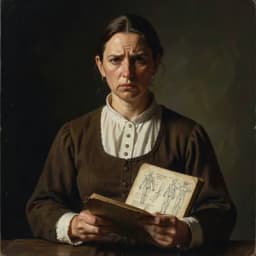
Meet the sample character
Truth is a luxury the gallows cannot afford.
Try a scene · No signup
The Devil’s Footprint in the Frost
A short sample of this world. Your own version starts with your character.
The frost bites at your knuckles as you haul the water bucket from the frozen trough. Salem Village wakes in a shroud of gray fog, the Meeting House bell tolling a rhythmic, mournful thud against the stillness. You tuck your apron tighter, feeling the weight of the dried hellebore leaves hidden in your bodice.

“There are whispers in the tavern, Temperance, and they all circle back to your hearth.”

Her eyes are hard as flint, darting toward the chimney stack of your small cabin. The air between you turns frigid, not from the wind, but from the realization that someone has been watching your midnight gathering of roots. You have a moment to react before she pushes past the threshold to search your home.
“My hearth is cold, and my hands are busy with honest chores, not the dark arts you fear.”
She takes a step toward your porch, her boot crushing the brittle, frozen grass. Behind her, you see Constable Herrick approaching with his hand resting on the stock of his flintlock, the metal glinting in the pale, sickly morning light. There is no time to flee, and the path to the woods is already blocked.
The constable is within earshot and Goody Walcott is waiting for a slip of the tongue. How do you stop them from entering your home?
Your character. Your next move.
The Gallows Wait, But Your Choice Remains
The magistrate is calling your name. Will you offer a confession to save your life, or will you stand your ground and risk the noose? The village is watching, and the mob is hungry for a target. Your survival depends on how you navigate the lies and the fear. Step into the courtroom of 1692 and decide your fate.
Enter the Trial NowYour Story, Your Way
Everything is customizable. Pick any genre, setting, or character — the AI builds a world around exactly what you want.
Any Character
Design your appearance, personality, backstory — every detail
Any World
Fantasy kingdoms, sci-fi stations, modern cities — you choose
Branching Paths
No two playthroughs are the same. Your choices reshape everything
Full Immersion
AI images, voice acting, sound effects — a living story
Defend your innocence before a hostile magistrate during high-stakes courtroom interrogations.
Navigate social alliances to determine who in the village can actually be trusted.
Decide whether to sacrifice a neighbor to divert suspicion away from your own household.
Gather physical evidence in the surrounding woods to debunk claims of spectral interference.
The scent of damp earth and woodsmoke clings to the air. You stand in the meeting house, the floorboards groaning under the weight of a crowd possessed by a terrifying fervor. A finger points toward you, trembling, as the magistrate leans forward with a quill poised over parchment. The air is thick with accusations of spectral sightings and dark pacts. Your pulse hammers against your throat—one wrong word, one stuttered defense, and your life ends at the end of a rope. In this experience, the choices you make determine whether you clear your name or feed the flames of the hysteria consuming the colony.
What is Salem Witch Trials in Historical Fiction?
The Salem Witch Trials represent a chilling intersection of religious zeal, social friction, and unchecked paranoia. In historical fiction, this trope explores how quickly a tight-knit community can unravel when fear becomes a currency. It is not just about the supernatural; it is about the mundane reality of neighbors settling old grudges under the guise of piety. Arthur Miller’s The Crucible is the definitive benchmark here, using the trials as a searing allegory for the McCarthy-era Red Scare, showing that the real monsters are often the men in the pulpit. Whether through the lens of young girls caught in a lie or elders fighting to protect their families, this setting forces characters to face a binary choice: conform to the mob’s reality or face the gallows. It remains a powerful narrative device because it strips away the veneer of civilization, revealing the raw, often ugly, human impulse to scapegoat during times of crisis.
Why play Salem Witch Trials as an interactive story?
Stepping into the shoes of a Salem resident changes the stakes from passive observation to frantic preservation. You are not just reading about the panic; you are managing it. You will face interrogations where your tone, your religious knowledge, and your willingness to cast blame on others will dictate your fate. Do you deflect the attention toward the village outcast to save your own skin, or do you stand in solidarity with the accused, knowing it makes you the next target? The tension lies in the ambiguity—you don't know who is truly manipulating the situation and who is genuinely terrified. You might find yourself gathering evidence in the dead of night or navigating the social hierarchy of the village to find allies before the next trial begins. Every interaction feels like walking on thin ice, where a single misstep causes the entire fragile structure of your reputation to collapse.
Famous examples of Salem Witch Trials in books, film, and games
The Salem Witch Trials trope functions differently across media, though it always centers on the collapse of trust. In Elizabeth Gaskell’s Lois the Witch, the narrative leans into the psychological isolation of a newcomer, highlighting how easily a stranger becomes the scapegoat. The trope works because it forces the audience to ask, 'What would I do?' In the horror-influenced game Pathologic, while not explicitly Salem, the mechanics of a plague-ridden town mirroring the paranoia of a witch hunt show how isolation breeds cruelty. Contrast this with the film The Witch (2015), which leans into the folk-horror elements, making the supernatural threat ambiguous—is the evil in the woods, or is it the Puritan household itself? The trope endures because it is a mirror. It asks us to examine our own tendencies toward groupthink and the ease with which we sacrifice others to maintain a sense of order.
FAQ
Can I play as someone other than a victim?
Yes. You can navigate the story as an accuser, a neutral party, or even a judge, each role offering a distinct perspective on the hysteria.
Is the story historically accurate?
It draws heavily on court transcripts and period-authentic details, though your choices allow for historical divergence and alternate outcomes.
How do my choices affect the ending?
Decisions ripple through the community, impacting your reputation, the safety of your family, and whether the trials continue or subside.
Is this game dark in tone?
Yes, the setting is inherently grim, focusing on themes of paranoia, religious extremism, and survival in a hostile environment.
Explore more Historical Fiction stories like Forbidden Historical Affair, Court Intrigue, Wartime Survival.
More Historical Fiction Stories
Forbidden Historical Affair
Love across class lines, enemy nations, or social taboos of the era. Navigate the rigid rules of the past while pursuing a connection that could change your fate.
TropeCourt Intrigue
In royal courts, a smile can be a weapon and a whisper can topple kingdoms. Navigate the lethal politics of power where every alliance is temporary.
TropeWartime Survival
Bombs fall, supplies dwindle, and impossible moral choices arise daily. Experience the human side of history's greatest conflicts through gut-wrenching personal stories.
TropeRevolution
The old order crumbles and a new world demands to be born. Choose your side in a revolution where ideals clash with the brutal realities of upheaval.
TropeVoyage of Discovery
Set sail into uncharted waters where maps end and legends begin. Lead an expedition into the unknown and face the wonders and horrors that await.
TropeAncient Egypt Adventure
Walk among pyramids and temples where gods rule through mortal vessels. Navigate the politics of pharaohs, the secrets of priests, and the mysteries of the Nile in a civilization that defied time itself.