
Historical Fiction · Interactive story
Echoes of the Great Mortality
The bells toll for the dead, but the living still have a choice to make.
Start as a guest. Choose your character before the story begins.
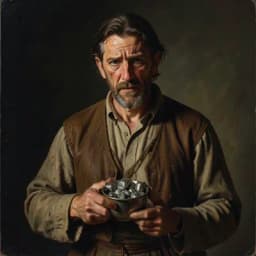
Meet the sample character
The church bells in Saint-Céneri have not stopped ringing for three days.
Try a scene · No signup
The Bell Tolls at Midnight
A short sample of this world. Your own version starts with your character.
You stand in the doorway of your shack, the smell of rotting thatch clinging to your tunic. The village square is eerily silent, save for the rhythmic clatter of a wooden cart carrying bodies toward the communal fire. You feel the cold weight of the leather pouch against your ribs, a small fortune that could buy your sister’s passage to the northern ports, if you can only leave before the quarantine gates are barred for good.

“Mathieu, do not lie to me. I know you have the coin, and God demands his tithe before the fever claims us all.”

The priest’s eyes are bloodshot, his habit stained with the dark, jagged marks of the sickness. He steps closer, his breath ragged and heavy with the scent of damp earth. You grip the pouch tighter, your knuckles white, as the cart driver shouts from the gate, his own face a map of blackened sores, waiting for the priest’s command to begin the final transport.
“My sister is shivering with the sweat, Father. If I surrender this silver now, she dies before the sun sets.”
The priest reaches for the heavy iron cross at his belt, his expression shifting from supplication to a cold, hungry resolve. Behind him, the cart driver stands, his eyes fixed on you with the vacant stare of a man already dead. You have mere seconds to act before the priest decides to take the silver—and your life—by force.
How will you protect your sister and your only means of escape?
Your character. Your next move.
The plague is at the gates. Will you survive?
Your village is falling, and the physicians have given up. Every choice from this moment on defines your legacy in a dying world. Will you hoard your rations or lead the survivors to safety? The story is yours to write.
Start Your Historical SurvivalYour Story, Your Way
Everything is customizable. Pick any genre, setting, or character — the AI builds a world around exactly what you want.
Any Character
Design your appearance, personality, backstory — every detail
Any World
Fantasy kingdoms, sci-fi stations, modern cities — you choose
Branching Paths
No two playthroughs are the same. Your choices reshape everything
Full Immersion
AI images, voice acting, sound effects — a living story
Decide whether to quarantine your household or risk infection to trade for supplies.
Navigate the volatile superstitions of villagers who blame the plague on divine wrath.
Choose between fleeing the city gates or staying to protect your ancestral home.
The soot-stained cart rumbles over cobblestones, its driver calling for the departed to bring out their dead. Outside your window, the village of Oakhaven has gone deathly quiet, save for the rhythmic thud of the gravedigger’s spade. You press a wet cloth to your face, hoping to filter out the stench of rot that clings to the humid air. In these interactive tales, your path is not written in stone; it is carved by your own desperate instincts. Will you barricade the door and hoard your meager supplies, or venture into the shadows to find a cure for your dying kin? Every decision carries the weight of history, and your choices determine whether you survive the collapse of your world.
What is Medieval Plague in Historical Fiction?
The Black Death, or the Great Mortality, is a recurring fixture in historical fiction because it represents the ultimate crucible. It is a period where the familiar structures of society—the church, the law, and family bonds—fracture under the pressure of an invisible, unstoppable killer. In works like Ken Follett’s 'World Without End,' the plague acts as a catalyst, forcing characters to abandon their previous lives and adapt to a world where rank and wealth offer no protection against the swell of lymph nodes. It is not just about the misery; it is about the sudden, jarring shift in human behavior when tomorrow is no longer a guarantee. This trope pushes characters to their absolute limits, exposing the best and worst of humanity in the face of inevitable expiration. It challenges the protagonist to find purpose when the very ground beneath them feels cursed.
Why play Medieval Plague as an interactive story?
Playing through the plague requires more than luck; it demands a cold, analytical mind. You are constantly balancing the need for self-preservation against the moral imperative to help others. Will you steal food from a wealthy merchant’s pantry to feed a starving child, knowing the risk of exposure? The tension lies in the scarcity of information and resources. You might need to decide whether to flee a bustling city for the isolation of the countryside, or stay behind to care for an infected lover, knowing full well the risks. Your agency transforms the experience from a passive observation of horror into a high-stakes survival simulation. The choices you make—from how you treat the dying to whom you trust in the village square—directly influence your survival rate and the state of your community.
Famous examples of Medieval Plague in books, film, and games
The plague trope finds life in various media, each highlighting a different facet of the disaster. In the novel 'Doomsday Book' by Connie Willis, the plague is a terrifying reality discovered by a time-traveling historian who finds the 14th century far more lethal than the history books implied. Contrast this with the film 'The Seventh Seal,' where the plague serves as a backdrop for a philosophical confrontation between a knight and Death itself. In games like 'A Plague Tale: Innocence,' the focus shifts to the claustrophobic experience of evading both the sickness and the soldiers who have lost their minds to fear. These stories endure because they force us to confront our own fragility. They show that when the structures of civilization collapse, only the individual’s resolve remains. By stepping into these stories, you are not just reading about history—you are testing your own ability to endure the impossible.
FAQ
How do decisions affect my survival in this setting?
Every action you take—such as choosing to boil your water, avoiding crowded markets, or interacting with the sick—is tracked. These choices accumulate, affecting your health status and the attitudes of those around you. Poor decisions might leave you vulnerable to illness, while strategic ones can prolong your life.
Is the historical detail accurate?
The settings are built on historical research regarding 14th-century life, from the social hierarchies to the primitive medical practices of the time. While the stories are fictional, the environment is grounded in the reality of the era.
Can I choose to be a physician during the outbreak?
Yes, you can define your role at the start of your story. Choosing to be a physician grants unique access to medical knowledge, though it also increases your exposure to the afflicted, forcing you to constantly weigh your duty against your own safety.
Do these stories focus solely on the tragedy?
While the backdrop is grim, the narratives focus on the human response to that tragedy. You will encounter moments of hope, rebellion, and community building as characters attempt to carve out a life amidst the decay.
Explore more Historical Fiction stories like Forbidden Historical Affair, Court Intrigue, Wartime Survival.
More Historical Fiction Stories
Forbidden Historical Affair
Love across class lines, enemy nations, or social taboos of the era. Navigate the rigid rules of the past while pursuing a connection that could change your fate.
TropeCourt Intrigue
In royal courts, a smile can be a weapon and a whisper can topple kingdoms. Navigate the lethal politics of power where every alliance is temporary.
TropeWartime Survival
Bombs fall, supplies dwindle, and impossible moral choices arise daily. Experience the human side of history's greatest conflicts through gut-wrenching personal stories.
TropeRevolution
The old order crumbles and a new world demands to be born. Choose your side in a revolution where ideals clash with the brutal realities of upheaval.
TropeVoyage of Discovery
Set sail into uncharted waters where maps end and legends begin. Lead an expedition into the unknown and face the wonders and horrors that await.
TropeAncient Egypt Adventure
Walk among pyramids and temples where gods rule through mortal vessels. Navigate the politics of pharaohs, the secrets of priests, and the mysteries of the Nile in a civilization that defied time itself.