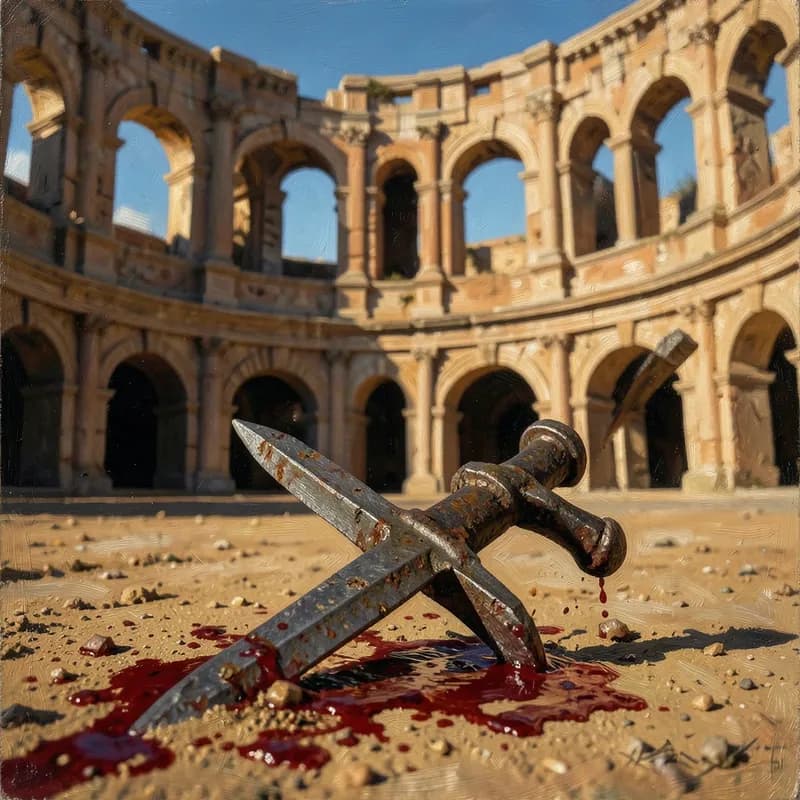
Historical Fiction · Interactive story
Blood, Sand, and Liberty: A Roman Gladiator Tale
The crowd demands violence; you demand your life. Will you earn your freedom?
Start as a guest. Choose your character before the story begins.
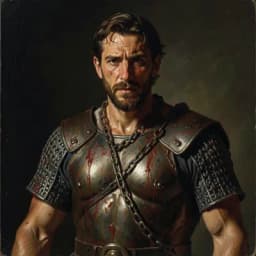
Meet the sample character
In the Colosseum, silence is the only mercy.
Try a scene · No signup
The Price of Iron
A short sample of this world. Your own version starts with your character.
You stand in the damp darkness of the tunnel, your breath coming in a jagged, shallow rhythm. The sound of the crowd above is not a roar; it is a physical weight pressing against your chest. You grip the hilt of a gladius that feels too light, the leather grip slick with the sweat of the man who died holding it only moments before you arrived.

“Stop shaking, Roman. If you die, I lose my best shield-mate. Keep your eyes on the gate, not the gods.”

The torches flicker, casting dancing, sickly shadows against the limestone walls. You hear the screech of the heavy iron portcullis being winched upward, a sound that signals your inevitable march toward the blinding Mediterranean sun. Your heart hammers against your ribs like a trapped bird, counting down the seconds until you must kill or be gutted.
“My eyes are on the gold, Drusus. If I leave this sand alive, I am finished with this life.”
The gate rises fully, revealing a blinding, razor-edged sliver of the arena floor. Dust motes dance in the harsh light, and the silence from the spectators is sudden, sharp, and terrifying. A towering Gaul stands waiting in the center, his trident leveled directly at your throat, his eyes promising a slow, agonizing end.
The Gaul lunges forward, the trident tip gleaming as it slices the air toward your stomach. How do you respond?
Your character. Your next move.
Step into the arena and fight for your life.
The gates are opening, and the roar of Rome is deafening. Will you be remembered as a champion of the sands, or will your name be forgotten in the dust? Your choices in the barracks and your skill in the pit will decide your fate. Start your journey today and claim your freedom.
Begin Your Gladiator TaleYour Story, Your Way
Everything is customizable. Pick any genre, setting, or character — the AI builds a world around exactly what you want.
Any Character
Design your appearance, personality, backstory — every detail
Any World
Fantasy kingdoms, sci-fi stations, modern cities — you choose
Branching Paths
No two playthroughs are the same. Your choices reshape everything
Full Immersion
AI images, voice acting, sound effects — a living story
Choose to fight as a nimble Retiarius or a heavily armored Murmillo.
Manage your reputation with the crowd to influence the outcome of your trials.
Forge alliances with fellow captives to plan an escape from the ludus.
Decide between mercy and execution to shape your character’s moral compass.
The iron gate shrieks as it rises, admitting a blinding sliver of Mediterranean sunlight into your damp, lightless cell. Dust motes dance in the air, thick with the scent of sawdust, stale sweat, and the iron tang of dried blood. Outside, the roar of fifty thousand spectators vibrates through the stone floor, a living, hungry beast waiting to be fed. You tighten your grip on a chipped gladius, your knuckles white against the hilt. Every choice you make—from the armor you scavenge to the alliances you forge in the barracks—determines if you leave this place a legend or a corpse. Your survival is not guaranteed, and your path through the empire’s most brutal gauntlet is yours to forge. In this historical landscape, your tactical decisions and moral compromises dictate whether you die in the dirt or win your freedom.
What is Gladiator Arena in Historical Fiction?
The gladiator arena represents the intersection of state-sanctioned cruelty and individual agency. It is a space where the rigid social hierarchy of Rome is temporarily suspended, replaced by the brutal meritocracy of the sword. In these narratives, the protagonist is often stripped of their title, family, and past, forced to endure the grueling training of the ludus, or gladiator school. The trope thrives on the tension between the dehumanization of the arena and the desperate, flickering hope for manumission—total freedom from the yoke of slavery. Unlike typical war stories, the gladiator narrative is intensely personal. It focuses on the camaraderie of the barracks, the politics of the lanista who owns your life, and the fickle favor of the crowd. Ridley Scott’s film Gladiator serves as the definitive modern touchstone for this trope, focusing on the pursuit of vengeance through the lens of arena combat. Similarly, Ben Kane’s novel The Forgotten Legion offers a grittier, more grounded look at the life of a slave-soldier forced into the sands. These stories succeed because they force the protagonist to confront the reality that their life is a commodity, and their only way to reclaim their humanity is to master the very violence that threatens to consume them.
Why play Gladiator Arena as an interactive story?
Playing a gladiator narrative places the weight of survival directly on your shoulders. Unlike a passive viewer, you must manage your physical fatigue, choose your combat style, and navigate the treacherous social dynamics of the training school. Do you save your strength for the final bout, or do you fight with flair to win the crowd’s favor, knowing the risk of injury increases with every flourish? You will face moments where you must decide whether to spare an opponent you have grown to respect or obey the thumb-down gesture of a sadistic magistrate. These decisions change how your peers view you and how the audience responds, which in turn affects your prospects for future matches. The tension comes from the limited resources at your disposal; you have only so much time to train, heal, and scheme before the next game. Every error is a potential death sentence, making each victory feel earned through strategy and sheer grit.
Famous examples of Gladiator Arena in books, film, and games
The gladiator trope has fascinated audiences for centuries, evolving from ancient Roman accounts to modern digital media. One of the most prominent examples is the 1960 film Spartacus, which shifts the focus from individual glory to the collective uprising of slaves. It uses the arena as a catalyst for revolution, showing how a gladiator’s training can be repurposed to challenge the state. In contrast, the video game Ryse: Son of Rome provides a more cinematic, visceral experience, emphasizing the rhythm and brutality of combat. It highlights the perspective of a soldier who is forced into the arena, showing how the experience changes a man’s identity. Another notable example is the book Those About to Die by Daniel P. Mannix, which provides a non-fiction foundation for many fictional depictions, detailing the horrific reality of the games and the lives of those who worked the floor. These stories endure because they distill the human experience into a binary state: survival or defeat. Whether it is a film, a book, or an interactive game, the gladiator trope forces the protagonist to find their strength in a place designed to break them. It is a testament to the human instinct to persist against impossible odds, making it a compelling framework for any interactive narrative.
FAQ
Can I choose my own gladiator class?
Yes. You can select your training path based on your preferred combat style, whether you favor the speed of a net-fighter or the defensive stability of a shield-bearer.
Does my reputation with the crowd matter?
Absolutely. A popular gladiator is more likely to be granted mercy by the emperor or a wealthy patron, which can save your life in a losing battle.
Is this game historically accurate?
The narrative focuses on authentic details regarding Roman training, social class, and arena culture, though it allows for personal agency that may alter historical outcomes.
What happens if I lose a match?
Losing a match can lead to injury, loss of favor, or even a premature end to your story. Every fight carries significant stakes.
Explore more Historical Fiction stories like Forbidden Historical Affair, Court Intrigue, Wartime Survival.
More Historical Fiction Stories
Forbidden Historical Affair
Love across class lines, enemy nations, or social taboos of the era. Navigate the rigid rules of the past while pursuing a connection that could change your fate.
TropeCourt Intrigue
In royal courts, a smile can be a weapon and a whisper can topple kingdoms. Navigate the lethal politics of power where every alliance is temporary.
TropeWartime Survival
Bombs fall, supplies dwindle, and impossible moral choices arise daily. Experience the human side of history's greatest conflicts through gut-wrenching personal stories.
TropeRevolution
The old order crumbles and a new world demands to be born. Choose your side in a revolution where ideals clash with the brutal realities of upheaval.
TropeVoyage of Discovery
Set sail into uncharted waters where maps end and legends begin. Lead an expedition into the unknown and face the wonders and horrors that await.
TropeAncient Egypt Adventure
Walk among pyramids and temples where gods rule through mortal vessels. Navigate the politics of pharaohs, the secrets of priests, and the mysteries of the Nile in a civilization that defied time itself.