
Historical Fiction · Interactive story
Shadows of the Shogunate: A Life in Edo Japan
The scent of incense, the weight of a katana, and a destiny left to you.
Start as a guest. Choose your character before the story begins.
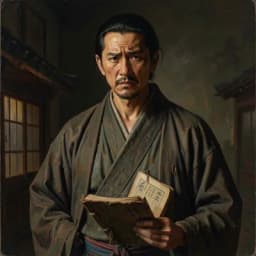
Meet the sample character
In the shadows of the floating world, honor is the first thing sold.
Try a scene · No signup
Ink and Cold Steel
A short sample of this world. Your own version starts with your character.
You sit on the worn tatami, the scent of bitter green tea masking the metallic tang of the scroll hidden against your ribs. Outside, the Yoshiwara district bustles with the rhythmic clatter of geta sandals on wooden planks. The sliding shoji screen ripples, and a man in a navy blue haori stops, his hand resting casually on the hilt of his katana.

“That scroll has a habit of finding the wrong hands, ronin. Would you prefer to return it to its master, or have me carve it out of you?”

Your palm sweats against the rough paper hidden beneath your robe. The retainer’s eyes are like polished obsidian, tracking the slight hitch in your breath. The room feels smaller, the air thick with the humidity of the evening rain. You have a chance to draw your blade, but his stance is flawless, a predator waiting for a single tremor in your resolve.
“I found this in the mud, forgotten by a ghost. Why should I hand a ghost's fortune to a man who smells of blood and arrogance?”
The retainer’s grip tightens on his tsuba, the wood of the floor creaking under his shifting weight. Behind him, the paper lantern flickers, casting a long, jagged shadow that stretches across the table. He is seconds away from a lethal strike, and your own blade is still sheathed. You have to move, but in which direction does your salvation lie?
The retainer's hand trembles with the urge to kill. How do you respond to the threat?
Your character. Your next move.
Will you uphold the Shogun or change history?
The capital is teeming with spies and secrets. A single decision in the Yoshiwara district will ripple through the halls of power, determining whether your name is remembered as a legend or erased from the records. The era is waiting for a leader to define its course. Do not stand on the sidelines while history is written.
Enter the ShogunateYour Story, Your Way
Everything is customizable. Pick any genre, setting, or character — the AI builds a world around exactly what you want.
Any Character
Design your appearance, personality, backstory — every detail
Any World
Fantasy kingdoms, sci-fi stations, modern cities — you choose
Branching Paths
No two playthroughs are the same. Your choices reshape everything
Full Immersion
AI images, voice acting, sound effects — a living story
Navigate the intricate etiquette of a formal tea ceremony to uncover a political secret.
Choose whether to uphold your family’s honor or defect to a group of dissidents.
Manage resources while maintaining your status as a merchant in a strictly regulated economy.
The winter wind bites through the paper walls of your teahouse in the Yoshiwara district. Outside, the rhythmic clack of wooden sandals on cobblestones marks the passing of a merchant fleet. You hold a sealed scroll—a message that could either secure your family’s status or lead to an ignominious end at the hands of the Shogun’s censors. In this era of strictly enforced peace, the most dangerous weapons are not blades, but whispered rumors and misplaced loyalties. Every action you take reverberates through the rigid social hierarchy of the Tokugawa era. Whether you choose to serve the daimyō or disappear into the bustling, lawless underbelly of the floating world, the path forward remains entirely in your hands.
What is Edo Period Japan in Historical Fiction?
The Edo period, spanning from 1603 to 1867, represents a unique era of isolationist peace under the Tokugawa shogunate. It was a time of intense social stratification, where the samurai class sat at the top, followed by farmers, artisans, and merchants. Despite the strict laws, the arts flourished. Works like James Clavell’s 'Shogun' or the visual splendor of Akira Kurosawa’s 'Seven Samurai' often highlight the tension between bushido honor and the encroaching reality of a changing society. It was a world of masks. Actors in Kabuki theater performed stylized versions of reality, while geisha navigated the complex political currents of the pleasure districts. To understand this time is to recognize that stability was bought at the price of extreme control. Every interaction in Edo was a negotiation of status and survival, making it a fertile ground for stories where one wrong step can lead to exile or ritual atonement.
Why play Edo Period Japan as an interactive story?
Playing through this era forces you to weigh your personal ambition against the heavy expectations of your social standing. You might find yourself balancing the demands of a local magistrate against the interests of a guild leader, or deciding whether to protect a disgraced ronin at the risk of your own reputation. The tension comes from the lack of room for error; the Shogun’s laws are absolute, yet the human spirit constantly pushes against them. You will face moments where you must choose between the rigid honor of the warrior class and the pragmatic survival of the merchant. Will you prioritize the stability of your clan, or gamble on a secret rebellion brewing in the shadows of the capital?
What makes Edo Period Japan work: the worldbuilding
The storytelling potential of the Edo period lies in the contrast between its outward stillness and the internal volatility of its residents. It is a setting defined by 'The Floating World'—ukiyo—where the fleeting nature of life is celebrated in art, print, and theater, even as the government attempts to freeze society in a permanent state of order. Eiji Yoshikawa’s 'Musashi' captures this perfectly, showing the evolution of a man from a wild brute to a disciplined master within that restrictive framework. Similarly, the game 'Ghost of Tsushima' and the film 'Silence' by Martin Scorsese explore the visceral consequences of ideological conflict in a closed society. To write here, you must master the art of the subtext. Characters rarely say what they mean; a polite bow can be a threat, and a gift of silk can be a bribe. The sensory environment is essential—the smell of charcoal, the sound of the shamisen, and the visual clutter of the crowded city streets provide a backdrop that grounds the drama. The conflict is rarely about physical survival alone, but about the preservation of identity when the state demands total conformity. By leaning into these tensions, you create a narrative where every conversation is a duel and every choice carries the weight of history.
FAQ
Can I play as a samurai in this story?
Yes, the narrative allows you to assume various roles, including that of a samurai bound by the code of bushido or a merchant navigating the economic shifts of the Shogunate.
How does the social hierarchy affect my choices?
The rigid class system acts as a constraint. Your status determines who you can speak to, what locations you can access, and how the world reacts to your actions.
Is this setting historically accurate?
The stories are grounded in the authentic cultural, political, and social dynamics of the Edo period, though they remain flexible enough to accommodate your personal decisions.
What happens if I break the Shogun's laws?
Actions have consequences. Breaking the law can lead to immediate social ostracization, exile, or direct confrontation with the authorities, drastically altering your story path.
Explore more Historical Fiction stories like Forbidden Historical Affair, Court Intrigue, Wartime Survival.
More Historical Fiction Stories
Forbidden Historical Affair
Love across class lines, enemy nations, or social taboos of the era. Navigate the rigid rules of the past while pursuing a connection that could change your fate.
TropeCourt Intrigue
In royal courts, a smile can be a weapon and a whisper can topple kingdoms. Navigate the lethal politics of power where every alliance is temporary.
TropeWartime Survival
Bombs fall, supplies dwindle, and impossible moral choices arise daily. Experience the human side of history's greatest conflicts through gut-wrenching personal stories.
TropeRevolution
The old order crumbles and a new world demands to be born. Choose your side in a revolution where ideals clash with the brutal realities of upheaval.
TropeVoyage of Discovery
Set sail into uncharted waters where maps end and legends begin. Lead an expedition into the unknown and face the wonders and horrors that await.
TropeAncient Egypt Adventure
Walk among pyramids and temples where gods rule through mortal vessels. Navigate the politics of pharaohs, the secrets of priests, and the mysteries of the Nile in a civilization that defied time itself.