
Historical Fiction · Interactive story
Forge Your Legend in the Age of Gods
Will you earn a place among the immortals, or be forgotten by the Muses?
Start as a guest. Choose your character before the story begins.
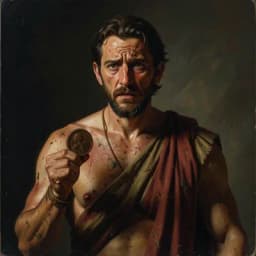
Meet the sample character
The Aegean demands a toll for your homecoming.
Try a scene · No signup
Salt and Broken Oars
A short sample of this world. Your own version starts with your character.
You drag your brine-soaked body onto the jagged shingle, clutching a splintered oar. The ship is gone, consumed by the churning Aegean. Above, the sky bruises a deep purple, and you hear the low, rhythmic chanting of someone hidden by the thick sea-spray.

“Poseidon does not let his playthings wash up on these sands for mercy, soldier.”

You push yourself up on trembling arms, your lungs burning with cold seawater. She stands there, wrapped in a threadbare tunic stained with sacrificial charcoal. You feel the weight of an unseen gaze—not hers, but something vast, watching from the clouds, weighing your worth against the wreckage.
“I am no plaything. I am a man of Ithaca, and I will see my hearth again, gods willing or not.”
The woman points her staff toward the sea, where a massive, bioluminescent shape crests the waves, its eyes glowing with a terrifying, ancient intelligence. She offers you a sacrificial blade, its hilt warm as if freshly held by a furnace. If you strike, you might appease the beast, but the weight of the steel feels like a curse. The tide is rising, and the creature is closing the distance.
The creature surges forward, water cascading off its armored scales. How will you meet your fate?
Your character. Your next move.
Will your name be remembered by the gods?
The Oracle has spoken, but the final path is yours to carve. Whether you seek the favor of Zeus or the wisdom of Athena, your legacy begins the moment you step onto the shores of the Aegean. Do not let your story vanish into the mists of time; take up your mantle and decide the fate of your house now.
Begin your odyssey todayYour Story, Your Way
Everything is customizable. Pick any genre, setting, or character — the AI builds a world around exactly what you want.
Any Character
Design your appearance, personality, backstory — every detail
Any World
Fantasy kingdoms, sci-fi stations, modern cities — you choose
Branching Paths
No two playthroughs are the same. Your choices reshape everything
Full Immersion
AI images, voice acting, sound effects — a living story
Decide whether to appease Poseidon with an offering or risk a shipwreck in the Aegean.
Choose to interpret the cryptic warnings of the Oracle to change your character's fate.
Navigate complex political alliances between warring city-states to protect your ancestral home.
Face moral dilemmas where honoring a promise to a god conflicts with human compassion.
The dust of the Aegean coast clings to your sandals, and the sharp scent of crushed olives hangs in the Mediterranean air. Ahead, the marble columns of the Parthenon gleam with a blinding, divine white against a sky so blue it feels heavy. You are not merely a spectator in this world of blood, wine, and prophecy; you are the architect of a legacy written in the stars. Whether you stand before the Oracle at Delphi or draw your bronze sword against a beast born of Olympian spite, your decisions carry the weight of fate. The gods watch from their golden heights, indifferent to your survival but hungry for your story. Every word spoken to a king, every sacrifice offered at a crumbling altar, and every path taken through the labyrinthine ruins shifts the tides of history. Here, the line between mortal effort and divine intervention is thin, and your next action determines if your name will be carved into history or whispered only as a cautionary tale.
What is Ancient Greek Odyssey in Historical Fiction?
The Ancient Greek Odyssey trope centers on the intersection of human fragility and the relentless whims of the divine. It draws deeply from the foundational works of Western literature, most notably Homer’s The Odyssey, where the journey home is fraught with obstacles that are as much psychological as they are physical. In this narrative structure, the protagonist is usually a hero—or an aspiring one—cast into a world where reality is fluid. Myth is not just a collection of stories; it is a tangible force. A sudden storm at sea is not just weather; it is Poseidon’s anger manifest. A plague in the city is not just sickness; it is a sign of Apollo’s displeasure. Unlike standard historical fiction, which focuses on the grit of everyday life, the Odyssey trope demands that the character reconcile their mortal limitations with the overwhelming power of the supernatural. It is a story of endurance, where the goal is often to return to a lost home, secure a lost throne, or simply survive a journey that the gods themselves have conspired to complicate.
Why play Ancient Greek Odyssey as an interactive story?
Playing through an Ancient Greek odyssey grants you agency over the very fate that defined the heroes of antiquity. Instead of reading about a character who defies the gods, you must decide how to navigate the consequences of your own piety—or your hubris. You might find yourself standing at a crossroads, forced to choose between the safety of your kin and the promise of glory that leads to a certain death. Do you offer the golden fleece to the temple, knowing it will leave your fleet vulnerable to the sirens? Do you challenge the local magistrate, knowing he holds the favor of Athena? The tension arises from the fact that in this era, every choice is a gamble against an unseen, cosmic judge. You are not just managing resources; you are managing your reputation among the gods and your standing among the city-states. The weight of your decisions is felt in the immediate, sensory reality of the world: the clatter of bronze armor, the heat of the forge, and the cold dread of an ill-omened sacrifice.
Famous examples of Ancient Greek Odyssey in books, film, and games
The allure of the Greek Odyssey is timeless, appearing in various forms across modern media. In Madeline Miller’s novel 'Circe', the trope is subverted by focusing on the perspective of the sorceress, showing how a hero's journey looks when viewed from the sidelines of myth. It highlights how the 'hero' is often just a pawn in the games of the gods, a theme that resonates throughout the genre. In the video game 'Assassin's Creed Odyssey', the trope is utilized to place the player directly into the Peloponnesian War. Here, the odyssey is a mix of historical conflict and mythological wonder, allowing the player to interact with figures like Socrates while simultaneously battling legendary beasts. The game excels by showing that the 'odyssey' is not just a linear trip, but a sprawling exploration of a world where history and legend are inseparable. Another example is the 2010 film 'Clash of the Titans', which leans into the high-stakes, action-oriented side of the trope. It portrays the hero’s journey as a literal battle against the machinations of Hades, focusing on the sheer scale of the conflict. These works endure because they tap into the universal fear of being small in a world governed by forces far larger than ourselves. Whether through the lens of a tragedy or an epic adventure, the Greek Odyssey forces us to ask what it means to be human when the world itself is alive with magic and malice.
FAQ
What makes an Ancient Greek odyssey different from other historical fiction?
While standard historical fiction relies on known events and realistic limitations, the Greek odyssey incorporates mythological elements as active, objective truths. In this genre, gods, monsters, and prophecies are not metaphors; they are real threats that force characters to balance human logic with divine unpredictability.
Can I influence the outcome of the myths in this story?
Yes. The interactive nature of the narrative allows you to challenge established legends. Your choices can lead to outcomes where heroes fail, gods are defied, or the trajectory of historical events shifts entirely based on your strategy and moral compass.
Do I need to know Greek mythology to play?
Not at all. While familiarity adds layers of recognition, the stories are written to be accessible. You will learn the context of the gods and the culture through your interactions, ensuring you can make informed decisions even if you are new to the subject.
Is this experience focused on combat or strategy?
It is a blend of both. You will face moments that require quick, tactical decisions in the heat of battle, as well as long-term strategic choices regarding diplomacy, religion, and the management of your resources as you traverse the ancient world.
Explore more Historical Fiction stories like Forbidden Historical Affair, Court Intrigue, Wartime Survival.
More Historical Fiction Stories
Forbidden Historical Affair
Love across class lines, enemy nations, or social taboos of the era. Navigate the rigid rules of the past while pursuing a connection that could change your fate.
TropeCourt Intrigue
In royal courts, a smile can be a weapon and a whisper can topple kingdoms. Navigate the lethal politics of power where every alliance is temporary.
TropeWartime Survival
Bombs fall, supplies dwindle, and impossible moral choices arise daily. Experience the human side of history's greatest conflicts through gut-wrenching personal stories.
TropeRevolution
The old order crumbles and a new world demands to be born. Choose your side in a revolution where ideals clash with the brutal realities of upheaval.
TropeVoyage of Discovery
Set sail into uncharted waters where maps end and legends begin. Lead an expedition into the unknown and face the wonders and horrors that await.
TropeAncient Egypt Adventure
Walk among pyramids and temples where gods rule through mortal vessels. Navigate the politics of pharaohs, the secrets of priests, and the mysteries of the Nile in a civilization that defied time itself.