
Folk Horror · Interactive story
The Foliate Face: A Green Man Folklore Story
The leaves are turning, but the sap running through the bark is warm and red.
Start as a guest. Choose your character before the story begins.
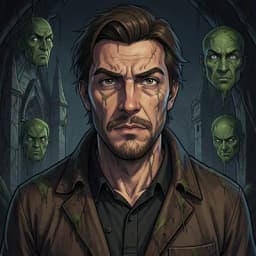
Meet the sample character
The soil demands a debt that stone cannot pay.
Try a scene · No signup
The Foliate Crown
A short sample of this world. Your own version starts with your character.
You stand before the ancient stone church in Blackwood Dale. Moss drips from the eaves like liquefying flesh. On the lintel, a face carved from lichen-crusted sandstone stares back, its mouth overflowing with thick, dark ivy. The air smells of damp earth and something sickly sweet, like rotting orchard fruit.

“He has not been fed properly in a century, Mr. Mallow. The soil is turning to dust and the harvest is failing.”

The vicar’s skin is papery, thin enough to see the blue veins pulsing beneath. He points a gnarled finger at the Green Man’s open mouth, which seems to widen as the evening light fades. The ivy is not just stone; a vine shifts, coiling like a serpent against the masonry.
“The structural integrity of this lintel is failing, Vicar. What exactly are you asking me to put inside that mouth?”
The vicar steps closer, the smell of fresh mulch clinging to his cassock. He pulls a rusted iron blade from his belt and presses it into your palm. The metal is freezing, vibrating with a rhythmic pulse that matches your own heartbeat. Behind you, the forest trees lean closer, their branches scratching against the church wall in a chorus of clicking wooden fingers.
The iron blade grows warm in your hand, pulling you toward the stone mouth. What is your response to the vicar's silent command?
Your character. Your next move.
The Harvest Demands a Decision
The village bells are ringing, and the elders are gathering at the edge of the woods. You hold a torch in one hand and a hidden talisman in the other. Do you light the pyre or run for the hills? Your choice changes the landscape forever.
Face the Green ManYour Story, Your Way
Everything is customizable. Pick any genre, setting, or character — the AI builds a world around exactly what you want.
Any Character
Design your appearance, personality, backstory — every detail
Any World
Fantasy kingdoms, sci-fi stations, modern cities — you choose
Branching Paths
No two playthroughs are the same. Your choices reshape everything
Full Immersion
AI images, voice acting, sound effects — a living story
Choose whether to obey local rituals or defy the village elders to escape the valley.
Analyze carvings and cryptic symbols found deep within the overgrown, forgotten stone ruins.
Manage your dwindling supplies while the forest actively alters the path behind you.
Silas pushed aside the heavy, wet ivy clinging to the stone archway. He did not expect to find a face staring back—eyes carved from moss-slicked granite, lips curled into a silent, eternal yawn. Locals in the valley whispered that the Green Man did not just decorate the church; he kept the harvest honest. That night, the bells began to toll without a ringer, and the hedgerows pulled closer to the cottage windows, tightening their grip on the wood frames. In this story, every step you take through the overgrown orchard could be your last. Your choices determine whether you appease the spirit of the thicket or become fertilizer for the coming season. You must decide if the whispers in the branches are a warning or an invitation to join the eternal growth.
What is The Green Man (Folklore) in Folk Horror?
The Green Man is an ancient motif, a face peering out from foliage, representing the cycle of growth, decay, and rebirth. While often seen as a benign symbol of spring, folk horror reimagines him as something far more demanding. In films like The Wicker Man (1973), the ritualistic devotion to nature takes a dark turn, showing how deeply rooted traditions can demand a bloody price. Similarly, in the novel The Green Man by Kingsley Amis, the character is tied to haunting, psychological dread rather than simple pastoral joy. He is not a mascot; he is the embodiment of a nature that does not care for human morality. When you see him in architecture or folklore, you are looking at a reminder that humanity is merely a temporary tenant on land that belongs to the wild. He is the keeper of the woods, and when he stirs, the boundaries between the civilized world and the untamed forest begin to dissolve.
Why play The Green Man (Folklore) as an interactive story?
Playing a story featuring the Green Man forces you to weigh your modern sensibilities against the brutal demands of an ancient, unyielding ecosystem. Will you offer a sacrifice to ensure the village survives the drought, or will you fight to preserve your own ethics while the forest encroaches on your sanity? You might find yourself deciding whether to burn the effigy of the harvest lord, knowing that the town elders are watching from the shadows with flint in hand. Every decision shifts the balance between civilization and the encroaching bramble. You are negotiating with a force that existed long before the first fence was built. The tension lies in the realization that the forest is not merely a setting, but an active participant in your demise.
The literary legacy of The Green Man (Folklore)
The Green Man has roots that stretch back to pre-Christian Europe, appearing in stone carvings on medieval cathedrals from England to Germany. Scholars often link him to earlier deities like Cernunnos, the antlered god of the wild, or the Roman Silvanus. His appearance is almost always a mask of leaves, vines, and branches, suggesting a being that is half-human and half-flora. In modern fiction, his influence is vast. The 2019 film Midsommar captures the terrifying potential of this folklore, where the celebration of the seasons becomes a nightmare of ritualistic sacrifice. Similarly, the Green Man series by Juliet E. McKenna explores his presence in more fantastical settings, though the underlying dread of a nature that bites back remains. He represents the uncanny because he is familiar—a face—yet alien because he is made of wood and leaf. He reminds us that the wild is not a playground but a hungry entity. Today, he remains a potent symbol because we still fear what we cannot control. As climate anxieties grow, the image of a forest that refuses to be tamed feels more relevant than ever. He is the shadow in the hedgerow, the face in the ivy, and the reason you should never walk into the woods after the sun sets.
FAQ
What is the Green Man in folklore?
He is a decorative motif of a face surrounded by leaves, historically representing nature's cycle. In horror, he acts as a vengeful or demanding spirit of the wild.
How does the Green Man appear in horror stories?
He often represents the price of survival, demanding blood or obedience from villagers in exchange for a bountiful harvest, turning pastoral settings into traps.
Is this story game historical or supernatural?
It blends both, using authentic pagan folklore and ritualistic elements set against a backdrop of modern, mounting psychological dread.
Can I change the ending of the story?
Yes, your choices directly impact the village's fate and whether you survive the harvest season or become part of the forest yourself.
Explore more Folk Horror stories like Harvest Ritual, Outsider in the Village, Wicker Man Sacrifice.
More Folk Horror Stories
Harvest Ritual
The village celebrates the harvest with rituals that predate Christianity, and this year the crops demand more than grain. You must participate in traditions that grow darker with each passing hour and discover what the land truly hungers for.
TropeOutsider in the Village
You arrived seeking peace and found smiles that do not reach the eyes. The villagers welcome you warmly but their customs make no sense, and you are beginning to suspect that leaving was never part of their plan for you.
TropeWicker Man Sacrifice
A towering effigy looms at the edge of the field and someone must burn inside it. You must unravel the sacrificial logic of a community that believes blood is the only currency the old gods accept.
TropeGreen Man Awakening
The forest is growing where it should not and the faces in the bark are opening their eyes. You must confront the Green Man as nature reclaims the land with a sentience and fury that civilization cannot withstand.
TropeAncient Pact
Generations ago, your ancestors made a deal with something in the earth and the debt is coming due. You must honor or break a pact written in blood and bone, knowing that either choice carries a terrible price.
TropeFairy Ring Trap
You stepped inside the ring of mushrooms and now the world has shifted. Time moves differently here, the fae folk are watching, and finding your way back to the mortal world requires a deal you may regret for centuries.