
Folk Horror · Interactive story
The Old Gods Demand a Voice
The soil is hungry, the village is waiting, and the mask is heavy.
Start as a guest. Choose your character before the story begins.
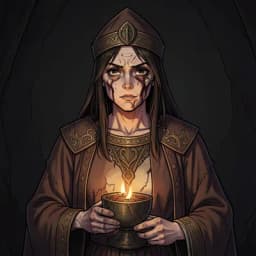
Meet the sample character
The harvest demands a payment in blood.
Try a scene · No signup
The Marrow of the Marsh
A short sample of this world. Your own version starts with your character.
You kneel upon the slick peat, your palms pressed against the cold, damp stone of the monolith. Behind you, the villagers of Oakhaven stand in a shivering line, their lanterns flickering against the encroaching fog. The scent of stagnant water and crushed hemlock fills your lungs. You feel their eyes boring into your back, waiting for you to signal the start of the final harvest rites.

“The grain is black with rot, Maren. If the gods do not answer tonight, we burn the shrine and we burn you with it.”

The threat hangs heavy in the air, mingling with the sound of insects humming in the reeds. Your skin prickles as you realize the sacrificial knife in your belt feels unusually heavy. You have always been their voice, the conduit for the old ones, but the silence from the marsh tonight is absolute. You sense a presence—something older and hungrier than any deity you have ever served.
“The harvest is not merely grain, Bram. It is the blood that feeds the roots. Wait for the ripple in the water, or we all perish.”
A sudden, violent ripple shatters the black surface of the pond. A pale, webbed hand breaches the sludge, clutching a rusted iron token—the sign that the sacrifice must be one of noble blood. The villagers surge forward, their faces illuminated by the frantic, dying light of their torches. You realize the mark etched into the token matches the birthmark hidden on your own wrist.
The villagers are closing in, their eyes frantic and bloodthirsty. How do you respond to the claim of the marsh?
Your character. Your next move.
The Old Gods are waiting for your command.
The villagers are gathered in the square, the fire is lit, and the signs are clear. Step into the mask of the Priestess and decide the fate of your people. Will you be the savior they pray for, or the shadow that consumes them? Your ritual begins now.
Begin Your RitualYour Story, Your Way
Everything is customizable. Pick any genre, setting, or character — the AI builds a world around exactly what you want.
Any Character
Design your appearance, personality, backstory — every detail
Any World
Fantasy kingdoms, sci-fi stations, modern cities — you choose
Branching Paths
No two playthroughs are the same. Your choices reshape everything
Full Immersion
AI images, voice acting, sound effects — a living story
Select the specific ritualistic components to appease the local spirits during the solstice.
Choose how to handle outsiders who stumble upon your secluded, sacred forest grounds.
Interpret ambiguous signs from the natural world to dictate the village's seasonal labor.
Navigate the internal politics of your coven to maintain your grip on the faithful.
The mud clings to your hemlock, stained dark by the morning’s offerings. Outside the chapel of rotting timber, the village elders gather, their eyes fixed on your lips, waiting for the word that decides who will feed the earth this autumn. A cold wind rattles the shutters, carrying the scent of pine and drying blood. You are the vessel for something ancient, a shadow that moved through these hills long before the first stone church was laid. Every decision you make ripples through the settlement, from the quiet murmurs of the harvest to the sudden, violent silence of a ritual gone wrong. In this tale, your words hold the weight of divine law, and the consequences of your interpretation are etched into the very landscape you claim to protect. What you choose here will determine if the crops rise or if the village fades into the bracken.
What is The Cult Priestess in Folk Horror?
The Cult Priestess is a central figure in folk horror, representing the bridge between a community and the primal, often indifferent, forces of nature. Unlike a standard antagonist, she is a shepherd of tradition, tasked with maintaining the precarious balance between her people and the local deities or spirits. In films like 'The Wicker Man' (1973), the authority held by the islanders is absolute, rooted in a terrifyingly coherent worldview that outsiders simply cannot grasp. Similarly, the May Queen in Ari Aster’s 'Midsommar' (2019) reflects the transformative power of being chosen as a central vessel for a cult's collective psyche. This archetype thrives on the tension of isolation. Whether she is a relic of a dying religion or a visionary of a new one, the Cult Priestess must constantly perform her role to justify her position. She is not merely a leader; she is a function of the environment, often sacrificing her own humanity to ensure the survival of the group. Her power is fragile, dependent on the constant validation of the faithful and the successful outcome of her rituals. If the rain fails or the harvest withers, the priestess is the first to be questioned, making her role a psychological pressure cooker of divine expectation and human fear.
Why play The Cult Priestess as an interactive story?
Stepping into the role of a Cult Priestess forces you to grapple with the ethics of survival in an environment where modern morality has no purchase. You are not just reacting to events; you are the architect of the community's spiritual life. Every interaction is a test of your authority. Do you use fear to keep the congregants in line, or do you cultivate genuine devotion? When a drought strikes, do you interpret the signs to demand a sacrifice, or do you gamble on a more peaceful, yet potentially disastrous, alternative? The agency lies in how you define your connection to the divine. You might find yourself debating with a dissenting village elder, choosing whether to exile them or integrate them into the ritual, or deciding how to handle the arrival of a suspicious outsider who threatens to expose the secrets kept in your groves. The tension comes from the thin line between being a savior and a monster. Every choice you make alters the village's morale and the intensity of the rituals you perform, leading to endings that range from a prosperous, secluded utopia to a crumbling, blood-soaked ruin.
The psychology of The Cult Priestess: why readers fall for this character
The appeal of the Cult Priestess lies in the fantasy of absolute, unquestioned purpose. In a modern world defined by ambiguity and fragmented identity, this archetype offers a singular, terrifying clarity. She embodies the desire to be part of something larger than oneself, even if that 'something' is inherently destructive. This character taps into the primal fear of the unknown—the 'other' that lives in the dark woods—and turns it into a source of personal empowerment. Consider the influence of characters like Sister Beatrice in various gothic narratives; they command respect not through kindness, but through the weight of their convictions. Readers are drawn to the priestess because she operates outside the social contract. She is a woman who has claimed the power to define reality for her people. This gives the reader a rare opportunity to explore the seductive nature of total control. You aren't just playing a character; you are exploring the psychological cost of holding the lives of others in your hands. It is a study in the burden of the divine. Whether she is a true believer or a cynical manipulator, the priestess represents the human need to project meaning onto a chaotic universe. By playing this role, you confront the reality that for a community to survive, someone must be willing to make the impossible choices that keep the darkness at bay. It is a journey into the heart of belief, where the line between faith and madness is as thin as a ritual blade.
FAQ
What makes a Cult Priestess different from a standard villain?
A standard villain often acts out of selfishness or malice, whereas a Cult Priestess acts out of a sense of duty to her community and their gods. Her actions, however violent, are framed as necessary for the greater good of the collective.
Can I choose to be a benevolent leader?
Yes, your choices define your path. You can attempt to lead through compassion and harmony, though the environment of folk horror often presents challenges that punish mercy and demand sacrifice, forcing you to constantly adapt your moral compass.
How do my choices impact the village?
Your choices influence the village's prosperity, the fervor of your followers, and the likelihood of external interference. A bad decision might lead to a failed harvest or a rebellion, while a strong, decisive hand can ensure your cult thrives in the shadows.
Is this story suitable for fans of historical horror?
Absolutely. The narrative draws heavily on the aesthetics of rural, pre-industrial life, focusing on the atmospheric dread and superstition that define the folk horror genre.
Explore more Folk Horror stories like Harvest Ritual, Outsider in the Village, Wicker Man Sacrifice.
More Folk Horror Stories
Harvest Ritual
The village celebrates the harvest with rituals that predate Christianity, and this year the crops demand more than grain. You must participate in traditions that grow darker with each passing hour and discover what the land truly hungers for.
TropeOutsider in the Village
You arrived seeking peace and found smiles that do not reach the eyes. The villagers welcome you warmly but their customs make no sense, and you are beginning to suspect that leaving was never part of their plan for you.
TropeWicker Man Sacrifice
A towering effigy looms at the edge of the field and someone must burn inside it. You must unravel the sacrificial logic of a community that believes blood is the only currency the old gods accept.
TropeGreen Man Awakening
The forest is growing where it should not and the faces in the bark are opening their eyes. You must confront the Green Man as nature reclaims the land with a sentience and fury that civilization cannot withstand.
TropeAncient Pact
Generations ago, your ancestors made a deal with something in the earth and the debt is coming due. You must honor or break a pact written in blood and bone, knowing that either choice carries a terrible price.
TropeFairy Ring Trap
You stepped inside the ring of mushrooms and now the world has shifted. Time moves differently here, the fae folk are watching, and finding your way back to the mortal world requires a deal you may regret for centuries.