
Folk Horror · Interactive story
The Old God of the Wild: A Folk Horror Encounter
The forest floor breathes, and the reed pipes are calling your name.
Start as a guest. Choose your character before the story begins.
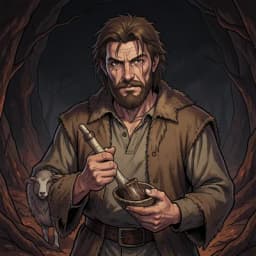
Meet the sample character
The Arcadian wild demands a tithe.
Try a scene · No signup
The Hoof-Print in the Soil
A short sample of this world. Your own version starts with your character.
You stand on the edge of the Maenalus timberline, the scent of parched earth and musk thick in the humid air. The sheep are silent, huddled against the crags, their eyes rolling in white-rimmed terror. A sudden, discordant melody ripples through the canopy—a flute sound that vibrates in your marrow rather than your ears.

“Drop the reed, boy. The hills do not like to be listened to after the sun bleeds out.”

The old man grips your wrist, his fingers cold as river stone despite the summer heat. You look down at the bone pipe you scavenged from the cave; it pulses with a rhythmic, unnatural heat against your palm. Behind the trees, a shape shifts—too large for a goat, too lithe for a man, silhouetted by the dying twilight.
“It whispered to me, Vasso. It promised that the pasture would never turn to ash again if I only answered the call.”
The shadow steps forward, and the smell of rot and wildflower overwhelms your senses. The ground beneath its heavy, cloven hoof turns to black dust instantly. The creature raises a hand, awaiting your performance, while the village behind you remains blissfully unaware of the ancient hunger you have invited to their door.
The creature waits for its song, but its eyes hold a predatory gleam. How will you appease the lord of the wild?
Your character. Your next move.
Will you answer the piper's call?
The village is silent, but the woods are alive with a melody that makes your blood run cold. You stand at the boundary line with an offering in your hands—will you leave it for the god, or will you turn your back on the old ways? Your path begins in the heart of the wild. Step forward and decide the fate of your village.
Face the GodYour Story, Your Way
Everything is customizable. Pick any genre, setting, or character — the AI builds a world around exactly what you want.
Any Character
Design your appearance, personality, backstory — every detail
Any World
Fantasy kingdoms, sci-fi stations, modern cities — you choose
Branching Paths
No two playthroughs are the same. Your choices reshape everything
Full Immersion
AI images, voice acting, sound effects — a living story
Choose whether to offer a sacrifice or defy the ancient rites in the woods.
Decide if you will answer the call of the pipes or flee in terror.
Determine the fate of the village elders who hide the god's dark requirements.
Navigate the psychological toll of hearing the god's music in your dreams.
Aris stands at the edge of the Blackwood. The air smells of wet pine and something sweet, like rotting fruit. Somewhere, a flute trills—a discordant, shivering melody that sets his teeth on edge. This is not a hike, but a tethered walk into an ancient trap. The villagers in the valley below refuse to speak of the goat-footed shadow that stalks the perimeter of their crops, yet they leave offerings of honey and raw meat at the boundary line. You must decide whether to respect these rituals or defy the silence. Every step forward brings you closer to a presence that predates humanity. Your decisions here determine whether the shadow between the trees is a blessing or a hunger. In this space, the old ways possess teeth, and the god of the wild is watching your every move.
What is Pan (Greek) in Folk Horror?
Pan is the goat-footed deity of Arcadia, a figure who represents the raw, untamed spirit of nature. Unlike the structured gods of Olympus, Pan is chaotic, erotic, and fundamentally indifferent to human morality. In the 1894 novella 'The Great God Pan' by Arthur Machen, the deity represents a terrifying exposure to the absolute truth of reality—a realization that mortals are not meant to withstand. This archetype serves as a cornerstone for folk horror, emphasizing the idea that the wilderness is not a park, but a place where ancient, primal forces demand submission. Modern media, such as the film 'The Ritual' or the unsettling atmosphere found in E.M. Forster’s 'The Story of a Panic,' draws heavily on this legacy. Pan is the architect of the 'panic' that strikes when you realize you are not alone in the dark, reminding us that nature possesses a brutal, unyielding autonomy.
Why play Pan (Greek) as an interactive story?
Playing as a witness to Pan’s influence forces you to weigh the costs of survival against the demands of a god who does not speak in words. You are not a hero on a quest, but a wanderer caught in a power struggle between a dying village and a primordial force. The agency provided allows you to dictate the outcome of specific, harrowing moments. Will you attempt to bargain with the god for the safety of your kin, or will you try to silence the pipes forever? The tension arises from the ambiguity of the deity; he is neither strictly good nor evil, but a force of nature that can provide bounty or bring ruin. Every interaction requires you to weigh the sanity of your character against the potential for divine favor.
The literary legacy of Pan (Greek)
The origins of Pan trace back to the rugged landscapes of Arcadia, where he was a protector of shepherds and their flocks. However, as cultural values shifted, the image of Pan underwent a radical transformation. During the rise of Christianity, the goat-like features of Pan were co-opted and demonized, cementing his association with the devil and the forbidden dark arts. This shift from a pastoral deity to a figure of temptation and fear is exactly what fuels the folk horror genre today. In literature, Pan has appeared in various forms, from the gentle, flute-playing protector in Kenneth Grahame’s 'The Wind in the Willows'—specifically 'The Piper at the Gates of Dawn' chapter—to the more menacing, soul-shattering presence in the works of early 20th-century horror writers. These reinterpretations highlight the duality of his nature: he is the god who brings music and life, but also the god who brings madness and ruin. By placing Pan into a modern narrative, you are engaging with a character that has haunted the western imagination for millennia. He remains a relevant figure because he represents the part of the world that we can never fully tame or categorize. He is the reminder that beneath the veneer of modern life, the woods are still wild, and the old gods are still waiting.
FAQ
What is the role of Pan in this story?
In this narrative, Pan acts as an unpredictable force of nature. He is not a traditional antagonist, but an entity whose presence forces characters to confront their own fears and the limitations of human control.
Can I choose to defy the god?
Yes. You have the agency to attempt to defy the ancient rites or bargain with the god. Be warned, however, that the god of the wild does not react kindly to those who seek to impose human will upon him.
Is this story suitable for fans of folk horror?
If you enjoy rural, ritualistic settings and the feeling of something 'wrong' beneath the surface of pastoral life, this experience is designed for you.
How does the AI influence the narrative?
The AI adapts the story based on your specific choices, tracking your relationship with the deity and the village, ensuring that the consequences of your actions feel reactive and grounded in the lore.
Explore more Folk Horror stories like Harvest Ritual, Outsider in the Village, Wicker Man Sacrifice.
More Folk Horror Stories
Harvest Ritual
The village celebrates the harvest with rituals that predate Christianity, and this year the crops demand more than grain. You must participate in traditions that grow darker with each passing hour and discover what the land truly hungers for.
TropeOutsider in the Village
You arrived seeking peace and found smiles that do not reach the eyes. The villagers welcome you warmly but their customs make no sense, and you are beginning to suspect that leaving was never part of their plan for you.
TropeWicker Man Sacrifice
A towering effigy looms at the edge of the field and someone must burn inside it. You must unravel the sacrificial logic of a community that believes blood is the only currency the old gods accept.
TropeGreen Man Awakening
The forest is growing where it should not and the faces in the bark are opening their eyes. You must confront the Green Man as nature reclaims the land with a sentience and fury that civilization cannot withstand.
TropeAncient Pact
Generations ago, your ancestors made a deal with something in the earth and the debt is coming due. You must honor or break a pact written in blood and bone, knowing that either choice carries a terrible price.
TropeFairy Ring Trap
You stepped inside the ring of mushrooms and now the world has shifted. Time moves differently here, the fae folk are watching, and finding your way back to the mortal world requires a deal you may regret for centuries.