
Folk Horror · Interactive story
Whispers from the Bog: A Moorland Horror Tale
The mist knows your name, and it has no intention of letting you leave.
Start as a guest. Choose your character before the story begins.
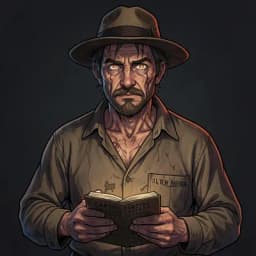
Meet the sample character
The bog only remembers what it is fed.
Try a scene · No signup
The Peat-Blood Tithe
A short sample of this world. Your own version starts with your character.
You are knee-deep in the sucking mud of Blackwood Moor. The fog is heavy and cold, clinging to your wool coat with a damp, suffocating grip. Every step requires a violent tug to free your boots from the dark, grasping peat that smells of rotted heather and old copper.

“You are late, Silas. The humors have already shifted, and the bog demands its due before the moon reaches its zenith.”

Halloway stands motionless in the gloom, his long coat stained with black, oily moisture. He gestures toward a depression in the earth where the wind whistles a low, mournful note. It sounds hauntingly like a human throat straining to catch a final breath.
“There is no debt left to settle, Halloway. You have already taken enough from this valley.”
The ground ripples beneath you as if something massive shifts in the deep water table. Halloway smiles, revealing teeth stained black by the soil, and he steps aside to uncover a jagged, ancient stone altar rising from the muck. The bog is not just hungry—it is waiting for your hand to finish the ritual.
The ground heaves beneath your feet, demanding a choice before the moon hides behind the clouds. How will you respond to Halloway's ultimatum?
Your character. Your next move.
The Mist is Closing In
The villagers are waiting for the final guest to arrive for the solstice. Your path is blocked, the light is dying, and something is moving in the heather. Do you run toward the stone circle or stay in the dark?
Enter the MoorYour Story, Your Way
Everything is customizable. Pick any genre, setting, or character — the AI builds a world around exactly what you want.
Any Character
Design your appearance, personality, backstory — every detail
Any World
Fantasy kingdoms, sci-fi stations, modern cities — you choose
Branching Paths
No two playthroughs are the same. Your choices reshape everything
Full Immersion
AI images, voice acting, sound effects — a living story
Choose whether to investigate the rhythmic drumming echoing from the valley floor.
Decide if you will accept the hospitality of a village that hates outsiders.
Scavenge for supplies in a crumbling stone ruin while the fog tightens around you.
Silas trudges through the thick, wet heather, his boots sinking into peat that feels too much like soft, rotting flesh. Every few steps, the fog shifts, revealing stone circles that shouldn't be there. He hears his mother’s voice calling from the hollow, though she has been buried in the churchyard for a decade. The path behind him has vanished, replaced by an endless expanse of grey, shivering grass. Your decisions determine if he finds shelter in the village of Blackwood or succumbs to the pull of the marsh. The wind carries a rhythmic chanting, and the flickering lights in the distance are not lanterns. They are eyes. In this interactive story, the environment is as dangerous as any creature lurking in the dark, and every step you take might be your last.
What is Moorland in Folk Horror?
Moorland horror leans into the isolation of vast, desolate landscapes. It is a setting where the geography feels sentient, hostile, and ancient. Think of the suffocating, isolated atmosphere in films like The Ritual or the unsettling rural dread found in The Wicker Man—places where modern technology fails and the old, forgotten gods still demand payment. In these stories, the land itself acts as the antagonist. The moor is a place of transition, a border between the civilized world and something primal. It is where travelers get lost not just in geography, but in time. When you step onto the moor, you are entering a space where the laws of cause and effect are replaced by ritual necessity. The silence is heavy, broken only by the sound of your own heartbeat and the unseen things moving through the gorse. Unlike a haunted house, where you can potentially escape through a window, the moor offers no boundaries. It is a trap made of grass, water, and shadow.
Why play Moorland as an interactive story?
Survival on the moor requires more than just luck. You face moments where you must decide whether to follow the strange, glowing path or backtrack through the freezing rain. Do you trust the villagers who offer you a seat at their feast, or do you flee into the dark? The tension comes from the weight of your choices. Each decision alters the environment, potentially shifting the fog to reveal new threats or ancient shrines. You might find yourself hiding in a derelict cottage while something scratches at the door, or perhaps you are forced to participate in a harvest ceremony that makes your skin crawl. You are not a spectator; you are the one holding the lantern as the light starts to fade. The agency creates a unique strain: when you choose to investigate a sound, you accept the consequences of what might be waiting for you.
What makes Moorland work: the worldbuilding
The effectiveness of moorland horror comes from the sensory overload of nothingness. Authors like Algernon Blackwood and films like A Field in England masterfully use the open space to create a suffocating sense of dread. There is nowhere to hide, yet there is nowhere to run. The landscape is characterized by its damp, heavy weight—the smell of wet peat, the constant drizzle, and the feeling of being watched by the very hills. Characters in this setting are often outsiders—hikers, surveyors, or lost travelers—who represent modernity clashing with the eternal, unchanging nature of the moor. The primary conflict is the erosion of self. As the protagonist spends more time in the wilderness, their memories become unreliable and their physical grip on reality slips. To write this well, you must focus on the wrongness of the landscape: the tree that looks like a person, the stream that flows backward, or the bird that mimics human laughter. It creates a psychological trap where the environment forces the character to confront their own buried secrets. The setting functions as a mirror, reflecting the character's internal decay back onto the rotting landscape.
FAQ
What makes moorland horror different from standard ghost stories?
It focuses on the environment as a living, breathing entity rather than a specific haunting. The danger is not just a spirit, but the landscape itself.
How do I survive the moor in this story?
Trust your instincts, avoid the strange lights in the distance, and pay close attention to the local rituals you encounter.
Is this setting suitable for supernatural elements?
Absolutely. The moor is traditionally viewed as a thin place where the barrier between our world and the supernatural is dangerously weak.
What kind of characters work best on the moor?
Outsiders, skeptics, or those running from their pasts work best, as the moor forces them to confront the reality of the impossible.
Explore more Folk Horror stories like Harvest Ritual, Outsider in the Village, Wicker Man Sacrifice.
More Folk Horror Stories
Harvest Ritual
The village celebrates the harvest with rituals that predate Christianity, and this year the crops demand more than grain. You must participate in traditions that grow darker with each passing hour and discover what the land truly hungers for.
TropeOutsider in the Village
You arrived seeking peace and found smiles that do not reach the eyes. The villagers welcome you warmly but their customs make no sense, and you are beginning to suspect that leaving was never part of their plan for you.
TropeWicker Man Sacrifice
A towering effigy looms at the edge of the field and someone must burn inside it. You must unravel the sacrificial logic of a community that believes blood is the only currency the old gods accept.
TropeGreen Man Awakening
The forest is growing where it should not and the faces in the bark are opening their eyes. You must confront the Green Man as nature reclaims the land with a sentience and fury that civilization cannot withstand.
TropeAncient Pact
Generations ago, your ancestors made a deal with something in the earth and the debt is coming due. You must honor or break a pact written in blood and bone, knowing that either choice carries a terrible price.
TropeFairy Ring Trap
You stepped inside the ring of mushrooms and now the world has shifted. Time moves differently here, the fae folk are watching, and finding your way back to the mortal world requires a deal you may regret for centuries.