
Fairy Tale · Interactive story
The Wishing Well: A Debt to the Deep
The coin hits the water, but the silence that follows is far too long.
Start as a guest. Choose your character before the story begins.
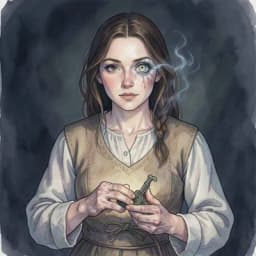
Meet the sample character
A drop of blood for every wish granted.
Try a scene · No signup
The Price of Salt and Stone
A short sample of this world. Your own version starts with your character.
You stand before the well, the cold stone biting into your fingertips. Moss drips like wet hair over the basin, and the water inside is a circle of ink reflecting nothing. The woods around you have stopped breathing; even the wind refuses to stir the leaves. You didn't come here for gold, but the silence in your brother’s throat has grown loud enough to drive you to this rotting mercy.

“The well does not drink silver, weaver. It drinks the things you think you cannot lose.”

The voice rasps from the darkness below, vibrating through the stones beneath your boots. It sounds like grinding teeth. You grip the edge of the rim, your knuckles turning white, staring down into the abyss where shadows coil like eels. You feel the well pulling at your pulse, drawing the heat from your skin as it prepares to bargain.
“If you want my warmth, take it—but give him back his voice before the winter frost bites his lungs for good.”
The surface of the water ripples without a breeze, forming a singular, jagged tear that looks back at you with a hunger that defies nature. A skeletal shadow reaches up from the black, pressing against the inner rim. It waits for your final confirmation, a price etched in the language of the forgotten. Do you hold your ground, or do you flee with your voice intact?
The well reaches for your throat, waiting for your final offering. What will you sacrifice to break the silence?
Your character. Your next move.
The well is waiting. What will you trade?
The surface of the water is perfectly still, waiting for your coin. Will you ask for wealth, or will you try to undo the mistake that haunts your past? The cost is steep, but the power is real. Step up to the edge and make your choice before the guardian loses interest.
Make Your WishYour Story, Your Way
Everything is customizable. Pick any genre, setting, or character — the AI builds a world around exactly what you want.
Any Character
Design your appearance, personality, backstory — every detail
Any World
Fantasy kingdoms, sci-fi stations, modern cities — you choose
Branching Paths
No two playthroughs are the same. Your choices reshape everything
Full Immersion
AI images, voice acting, sound effects — a living story
Decide which personal memory or possession to offer as tribute to the well.
Choose whether to confront the guardian or attempt to outsmart the ancient magic.
Face the consequences of your wish as the world physically changes around you.
Navigate the moral weight of obtaining a miracle at someone else's expense.
The moss clings to the circular stone rim like velvet, damp and smelling of ancient, stagnant rain. You stand at the edge of the clearing, a rusted copper coin burning a hole in your pocket. Folklore says the well grants your deepest desire, but it never mentions the guardian waiting just beneath the surface. It does not ask for gold or silver; it asks for a piece of your history. As you lean over the abyss, the water ripples without a breeze, reflecting a face that looks like yours, but older and significantly more tired. Your choices determine whether you walk away with a miracle or leave a part of your spirit behind in the darkness. This is a story of exchange, where every gain requires a sacrifice, and the well is always hungry for more.
What is The Wishing Well in Fairy Tale?
The Wishing Well is a classic literary motif that transforms a simple request into a high-stakes negotiation. In traditional folklore, these wells are rarely passive; they are sentient, predatory, or bound by strict, archaic laws. Unlike the whimsical fountains in modern romantic comedies, a true fairy tale well is a site of transition and trial. In The Witcher 3, the 'Devil by the Well' quest highlights the horror of a spirit tethered to such a location, while the dark, subterranean atmosphere of Pan’s Labyrinth mirrors the way these settings force characters into uncomfortable bargains. The well acts as a mirror—not of your appearance, but of your desperation. Whether it is a Grimm-inspired cautionary tale or a darker, modern fable, the well represents the point of no return. You do not simply walk up to a well and get what you want. You engage in a transaction with a force that has existed long before your arrival, and it expects you to understand the weight of what you are asking for. It is the boundary between the mundane world and the chaotic, magical unknown.
Why play The Wishing Well as an interactive story?
Playing this setting means you are no longer a spectator to the protagonist’s folly; you are the one deciding if the cost is worth the reward. When you face the well, the tension comes from the ambiguity of the guardian’s demands. Will you trade your memories of home for a crown? Will you sacrifice your ability to speak to regain a lost love? Every choice forces you to weigh your morality against your desires. You might encounter a moment where the well demands a secret you have never told anyone, or perhaps it asks you to complete a task that contradicts your values. Agency here is defined by what you are willing to lose. You are not just clicking through a script; you are negotiating your character's future with a power that knows exactly how to manipulate your weaknesses. The narrative branches based on your resolve, meaning your ending depends entirely on the sacrifices you choose to make—or refuse to make.
What makes The Wishing Well work: the worldbuilding
Effective fairy tale worldbuilding relies on the tension between the familiar and the uncanny. The Wishing Well works because it utilizes a setting that everyone recognizes but few treat with the necessary caution. To build this setting successfully, you need to focus on sensory decay: the smell of ozone, the unnatural stillness of the water, and the way shadows seem to stretch toward the well rather than away from it. In works like The Buried Giant by Kazuo Ishiguro, the environment itself carries a heavy, forgotten history that forces characters to reckon with their pasts; a well functions similarly, acting as a focal point for repressed desires. Character types that thrive here are those with something to lose—the grieving widow, the disgraced knight, or the ambitious apprentice. These characters are desperate, which makes them perfect candidates for the well’s manipulation. The well should feel like a character in its own right, one that observes the player’s hesitation. Sensory details are paramount: the sound of a coin hitting the water shouldn't be a splash, but a muffled thud that echoes, as if the well is not as deep as it appears. When writing for this setting, avoid the trap of making the well a simple vending machine for magic. Instead, treat it as a cosmic accountant. It tracks every transaction, and it ensures that the balance is always tipped in its favor. By referencing the darker roots of folklore, you create a space where players feel the genuine threat of their own greed or grief, grounding the magic in a reality that feels both ancient and immediate.
FAQ
What makes this different from a standard fairy tale?
Standard fairy tales often feature a passive well that grants wishes without consequence. Here, the well is a sentient entity that negotiates, demands payment, and reacts to your specific moral choices, turning the story into a high-stakes psychological drama.
Can I choose not to make a wish?
Yes. Walking away from the well is a valid choice. However, doing so may influence the story in unexpected ways, as the well does not take kindly to being toyed with or ignored after you have attracted its attention.
How does the guardian influence the story?
The guardian acts as the narrative antagonist or catalyst. It speaks through the water, tests your resolve, and determines the price of your wishes based on your character’s background and current emotional state.
Is this story setting suitable for darker themes?
Absolutely. The setting is designed for those who enjoy the grittier, original roots of fairy tales. Expect themes of sacrifice, moral ambiguity, and the personal cost of ambition.
Explore more Fairy Tale stories like Cursed Princess, Beast Transformation, Wicked Stepmother.
More Fairy Tale Stories
Cursed Princess
A terrible curse transforms the princess into something monstrous, and the kingdom has given up hope. Only your choices can unravel the enchantment and reveal whether breaking the curse requires sacrifice, love, or something no one expects.
TropeBeast Transformation
A handsome prince trapped in a monstrous form, a curse that only deepens with time — your compassion and choices determine whether the beast within is tamed or unleashed forever.
TropeWicked Stepmother
She smiles sweetly while plotting your ruin, and no one believes she is anything but kind. Outsmart the wicked stepmother whose cruelty hides behind a mask of maternal concern in a tale where survival depends on your wits.
TropeFairy Godmother Twist
Your fairy godmother arrives with a wave of her wand, but her gifts come with conditions you did not read in the fine print. Discover that magical help always has a price in a story where wishes are never quite what they seem.
TropeEnchanted Sleep
A magical slumber descends, and the whole kingdom falls silent. Race against time to find the cure before the spell becomes permanent, choosing between dangerous shortcuts and the longer path that might save everyone.
TropeImpossible Tasks
Sort a mountain of grain by dawn, spin straw into gold, or fetch water from the edge of the world. You are given tasks that seem impossible, but cleverness, unexpected allies, and bold choices can achieve the unachievable.